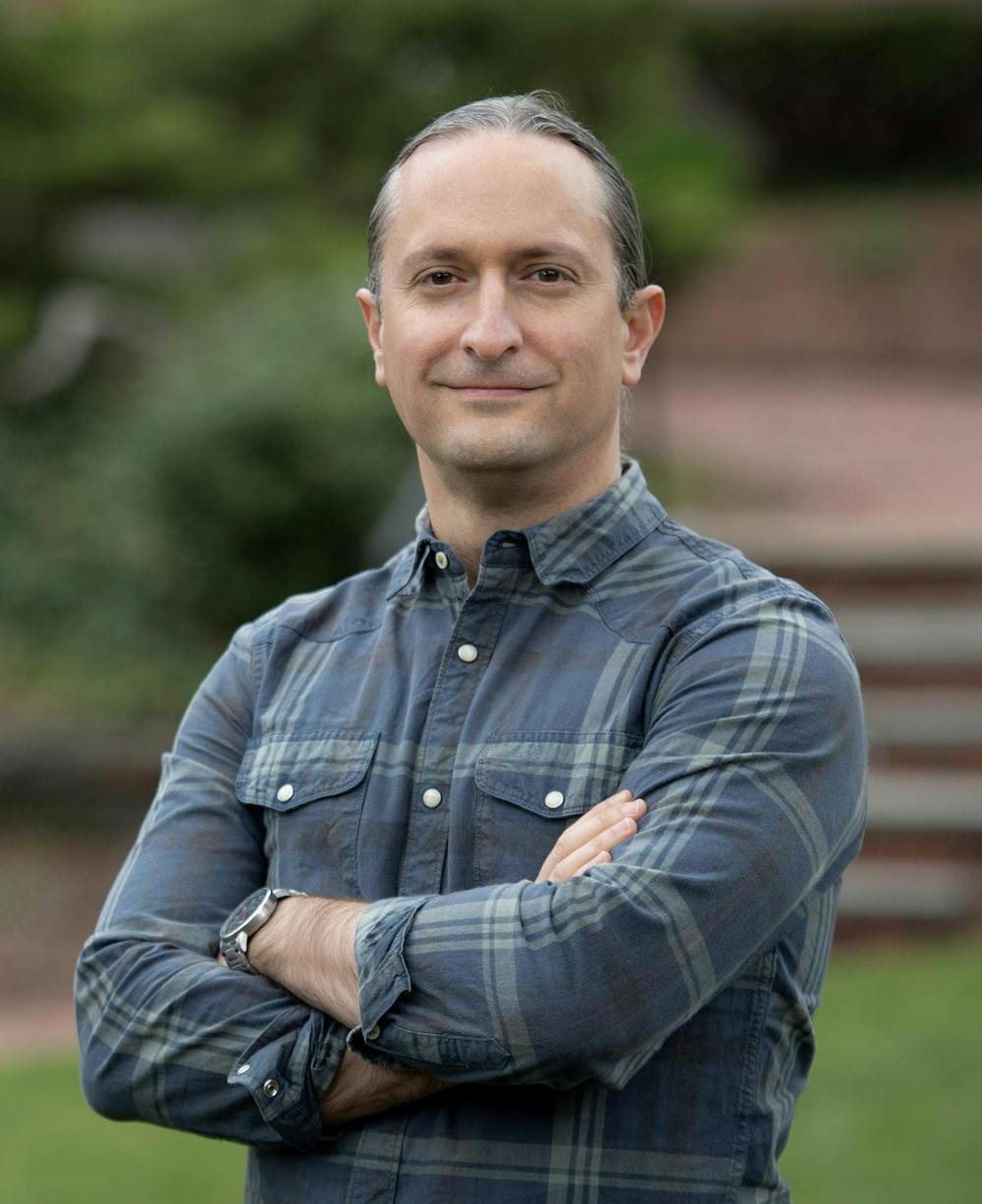
Drawing upon 25 years of research, Andrew Scherer, professor of anthropology and archaeology and the ancient world and director of the Joukowsky Institute for Archaeology and the Ancient World, explores how violence in pre-colonial Mayan civilization was morally understood and enacted in social and ritual contexts in his new book “As the Gods Kill: Morality and Social Violence among the Precolonial Maya.”
“Whether we’re talking about the ritual violence that was done to uphold their relationships to their gods and to their ancestors, or whether we’re talking about warfare,” violence was a “really important part of (Mayan) society,” Scherer said in an interview with The Herald.
By analyzing the written record of the Maya, Scherer found evidence of ritual violence, which is “oftentimes glossed as sacrifice” in popular perceptions.
But people should not think of the Maya as “prone to violence or bloodthirsty,” Scherer noted. In his book, he said, one goal was to “take a different sort of approach to how we think about the violence as the Maya themselves would have understood it.”
“Violence was necessary, but it wasn’t necessarily something that was good,” Scherer added.
Scherer said that the Maya seemed to “compartmentalize” the violence as separate from everyday life by portraying themselves as animals or supernatural beings, rather than humans, in their depictions of the acts of violence.
The book draws upon written records, art and architecture of the Maya, Scherer said. His work also involved “diving into research across the social sciences,” especially into the fields of psychology and sociology, “to look at contemporary experiences of violence across human society,” he added.
Another assumption that Scherer’s research pokes holes in is that the Maya’s collapse “was because of warfare getting sort of out of scale,” he said. Looking at the placement of fortifications provides “really good evidence” that intensive warfare was prevalent centuries before the civilization’s collapse around A.D. 750 to A.D. 900, he explained.
Takeshi Inomata, a professor of anthropology at the University of Arizona, described Scherer’s book as “remarkable” for how it “provides new insights into Maya practices of war, sacrifice and violence,” he wrote in an email to The Herald.
“Through his long-term fieldwork in the Usumacinta region along the border between Mexico and Guatemala, Professor Scherer has made profound contributions to the study of Maya culture and society,” Inomata added.
Brown students also helped shape the book, which was supported by a fellowship from the Cogut Institute of the Humanities, according to Scherer. In Spring 2023, Scherer taught a class on reconstructing violence in history, during which students read drafts of chapters in the book and offered feedback.
David Freidel, professor emeritus of archaeology at Washington University in St. Louis, told The Herald that he has “followed Andrew Scherer’s research now for many decades” and served on committees evaluating Scherer for tenure. He added that Scherer’s book will prove to be a “deeply referenced and enduring contribution and advance in our field.”
“This is an exceptional and brilliant benchmark monograph,” Freidel said. “It’s been important in the last generation of scholars, led by people like Andrew Scherer, to show us that the Maya are no more or less brutish than the rest of us.”