
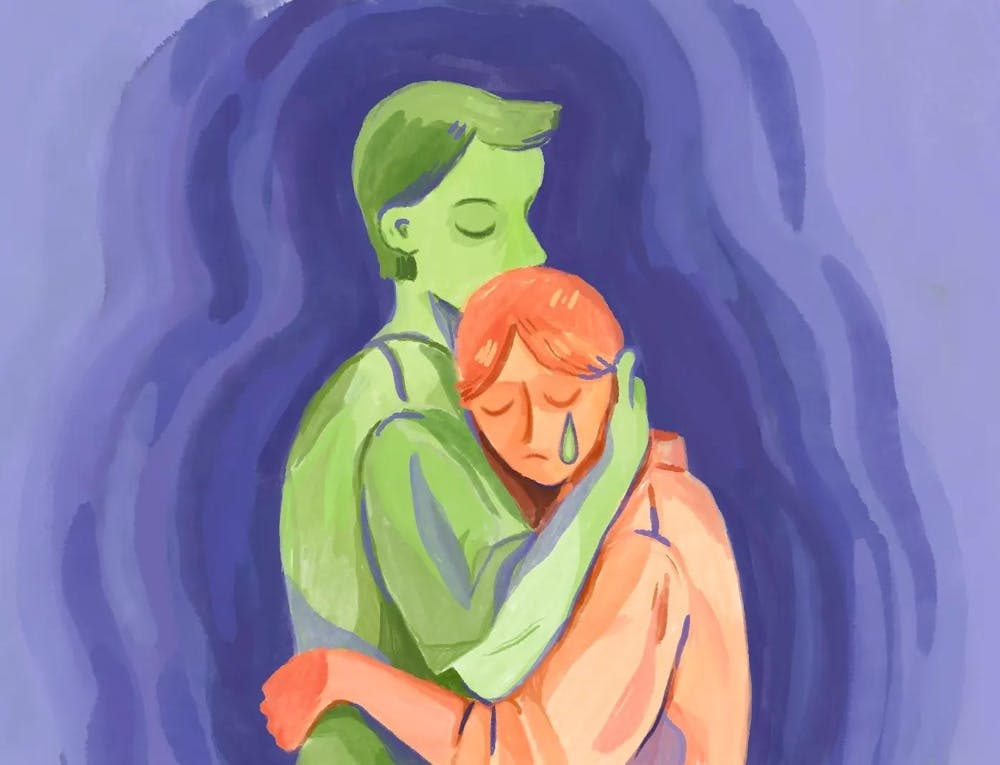
Many people in relationships quietly ask themselves the same question: How responsible am I for my partner’s mental health? We’re taught that good partners are endlessly patient, emotionally available and willing to make sacrifices. The dominant narrative says if someone you love is struggling, you should show up harder. You should text back faster. You should stay even when it hurts. You should absorb the weight because that’s what care looks like.
But there’s a difference between supporting someone and being responsible for their feelings. Confusing the two can slowly hollow out a relationship, and knowing the difference is essential for a partnership’s long-term success.
You can often see the tension between support and responsibility in the way some couples talk about emotional capacity in numbers. We’re taught that the ideal relationship involves equal investment from both parties at all times, but when someone is struggling, that 50/50 balance becomes impossible. Sometimes, language like “today I’m at 40% capacity, so are you able to give me 60?” is useful. It can name limits, signal vulnerability and make the invisible labor of care visible. But when that framework becomes the default, it can inadvertently shift responsibility. It implies that when one partner isn’t doing well, the other must always be prepared to take on additional labor. Care goes from being mutual to calculated and contractual. One person’s bad day becomes the other’s ongoing obligation.
It’s absolutely human to want to protect someone you love from pain. When a partner is anxious, depressed or spiraling, your instinct might be to manage their feelings. Maybe you choose your words carefully, avoid certain topics or rearrange your own needs so you don’t “make things worse.” At first, this feels like love. Over time, it can start to feel like walking on glass. Truthfully, you cannot regulate someone else’s mental health for them. You can influence, support and encourage, but ultimately, you cannot control your partner’s mental state, no matter how good your intentions are.
This doesn’t mean you shouldn’t care, but it does mean that caring has limits. A healthy relationship allows room for both empathy and autonomy. You can sit with someone in their sadness without becoming the sole thing holding them together. You can encourage therapy without becoming their therapist. You can listen without fixing. You can love someone deeply and still acknowledge that you cannot complete their healing for them.
There’s a temptation to believe that love should be enough, that if you just show up consistently enough, things will stabilize. And when they don’t, guilt can start to creep in. You might think, “If I were a better partner, they’d be okay.” That’s an unfair and unattainable amount of power to give yourself.
When one partner becomes the emotional caretaker, the relationship can quietly shift from mutual to imbalanced. Resentment builds, even if you don’t want it to or don’t realize it's happening. You start measuring your own emotions against theirs, minimizing your stress because it feels smaller and less urgent.
Over time, both people lose something. The caretaker grows exhausted and unseen. Meanwhile, the dependent partner can start to feel fragile and ashamed — aware, on some level, that they’re taking more than they can give, but unsure how to stop. They may hesitate to voice their needs out of fear of being “too much,” or cling tighter because the relationship feels like the only place they’re being comforted.
Sometimes, despite genuine care, a relationship cannot survive someone else’s unaddressed mental health needs. That doesn’t mean you failed your partner. Love alone isn’t treatment, and staying at the cost of yourself isn’t proof of devotion.
Being a good partner doesn’t require you to abandon your own boundaries. It requires honesty about what you can offer and what you can’t. It’s okay to say, “I care about you deeply, but I can’t be the only support system in your life.” Choosing yourself doesn’t mean either one of you becomes the villain.
There’s also something powerful about releasing the illusion of control. When you stop believing you’re responsible for another person’s emotional state, you can start to show up in a realistic, sustainable way. That means being honest about your own limits and admitting when you’re tired, overwhelmed or unsure what to say, instead of performing stability or presenting a version of yourself that feels easier to be with. When this shift happens, care becomes something you give freely rather than something you owe, and support becomes mutual rather than one-sided. A relationship built this way is grounded in the trust that two people can care for each other while still being responsible for themselves.
If you’re in a relationship where mental health feels like the central axis, ask yourself a few gentle questions: Am I supporting, or am I managing? Do I feel allowed to have bad days too? Am I staying in my relationship out of love, or out of fear of what might happen if I leave?
None of these questions have easy answers. But asking them is an act of care for both you and your partner.
At the end of the day, the most loving thing you can do is recognize the limits of your role. You can walk with someone through their struggle, but you cannot walk it for them.
If you have questions about sex or relationships that could be discussed in a future column, please submit questions to an anonymous form at https://tinyurl.com/BDHsexcolumn. Anusha Gupta ’25 MD’29 can be reached at anusha_gupta@brown.edu. Please send responses to this opinion to letters@browndailyherald.com and other op-eds to opinions@browndailyherald.com.


