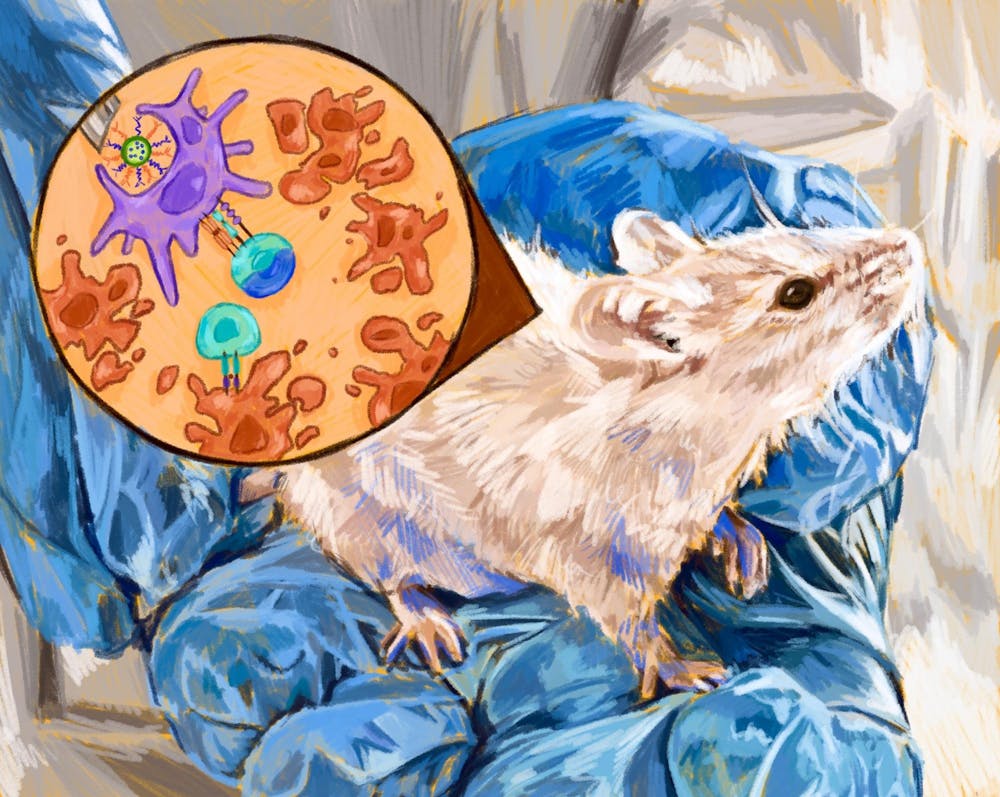
In a recent study about enhancing the precision of a therapeutic drug to target tumors, the Desai Lab — led by principal investigator and Dean of Engineering Tejal Desai ’94 — succeeded in using nanoparticles to deliver antibodies that stimulate local immune cells.
Utilizing the new technology, researchers were able to target tumors in mice, with promises for applications beyond cancer treatment.
During the project, mice were injected with cancer cells and monitored for tumor growth, said Emilia Herdes ’25, who worked on the project during her undergraduate years. Mice who received the nanoparticle treatment had “significantly suppressed” tumor growth compared to their untreated counterparts, who saw continued growth, Herdes added.
“Scientists have … developed a powerful drug” that can activate an immune response against tumors, Desai wrote in an email to The Herald. “But if the drug is just injected into the body, it can go everywhere, causing toxic side effects.”
The nanoparticle is partially composed of DNA, whose unique structure allows highly specified placement of antibodies like “linking logs,” said Kayla Mash, who graduated from the University of Colorado Boulder and worked on the project through the Leadership Alliance’s Summer Research Early Identification Program.
The DNA scaffolding of the particle allows for the precise control of “the ratio of different targeting antibodies,” Desai wrote. This “allows the particle to hone in on specific” cells that alert the immune system to attack the tumor “with precision,” she explained.
“The ability for us to add two antibodies on the surface is really novel, because in the past, most people have only been able to add one antibody on the surface,” Herdes said. “That limits the response in a wide variety of people, because different people have different amounts of receptors for one specific antibody.”
Due to the “programmable” nature of the nanoparticle, researchers are able to “swap out the antibodies or the drugs to target different diseases — like autoimmune disorders or different types of cancer — without having to reinvent the entire nanoparticle,” Desai wrote.
“It’s essentially a ‘plug-and-play’ system for the future of therapeutic targeting,” she added.
Deblin Jana, a senior research associate in the Institute of Biology, Engineering and Medicine and the lead author of the paper, described the nanoparticle as a “velcro-type situation.”
“The advantage of this platform compared to any other platform that is in the market right now is that you can actually load almost 100% of whatever your biomolecule is given,” Jana explained, noting that other platforms can only reach a third or fourth of the theoretical value.
Unlike chemotherapy treatments, during which drugs are released to the entire body, Mash added that the engineering of the particle allows the antibodies to target specific cells. The particles are also less likely to be rejected by the body because nanoparticle systems are so small, she explained.
Yizhou Dong, a professor of nanomedicine at the Icahn School of Medicine at Mount Sinai, found the study to be “comprehensive” and was impressed by the design of the nanoparticle.
The project builds upon technology that was first developed at Desai’s lab at the University of California, San Francisco, Desai wrote.
“There’s just many different things that should be researched using a platform like this,” said Justin Moustouka ’25 GS, who worked on the project as an undergraduate. “There’s opportunities to go into different diseases and different cancers.”
Angel Lopez is a senior staff writer covering Science and Research. He’s a first-year student from Tyler, Texas and planning to study neuroscience and literary arts. In his free time, you can find him playing ping pong, listening to music, or reading.