In each of the past five years, at least one Brown alum has been named to the Forbes 30 Under 30 list. In December 2025, nine Brown alums featured on the 2026 list joined those ranks.
This year, the list featured 600 young professionals who were honored for their accomplishments and potential in 20 categories. Brown alums were featured across eight of those categories.
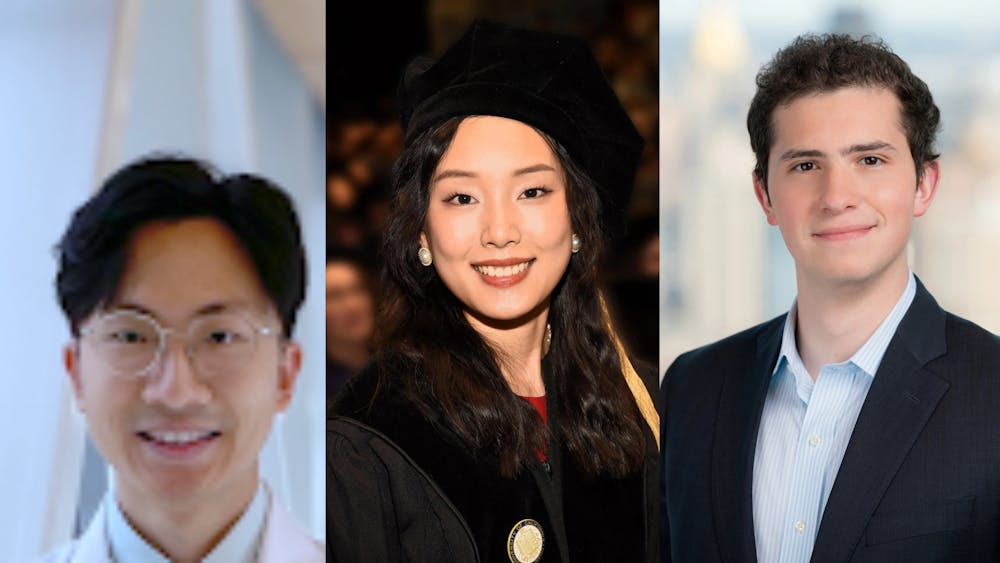
The Herald spoke to Mengzhou (Clara) Hu MS’21, John Huddleston ’21 and Jonathan Huang ’20 about the accomplishments that brought them their Forbes recognition.
Huddleston, who was recognized under Transportation & Aerospace, is a co-founder of Albacore Inc., a defense and space manufacturing company. The company develops “long-range, autonomous underwater vehicles to deter maritime invasions," according to his Forbes profile.
The idea that brought Huddleston recognition from Forbes didn’t even exist a year ago. “Ten months ago, Albacore was an idea scribbled on the back of a napkin at a dinner party,” Huddleston wrote in an email to The Herald. “Since then, we have built a world-leading team and have moved at a breakneck pace through prototyping.”
Huddleston wrote that the company has “launched (their) first production unmanned underwater vehicle.” The team’s work is “just getting started, and I cannot wait for what is ahead,” he added.
Huang, currently a student under the Medical Scientist Training Program at Northwestern, explained that he was “genuinely shocked” when he first found out about Forbes’ recognition of his work in the healthcare field.
“I re-read the email four or five times before it sank in,” he wrote in an email to The Herald. “I’m still a student and still figuring out the professional path ahead, so it felt surreal to pause and reflect on how far the work has come. It was an unexpected but meaningful moment of validation.”
Huang has worked on developing a tool that helps radiologists “interpret X-rays and CT scans,” which are the “most common forms of medical imaging,” he wrote. The research “is the first to study generative AI in real radiology practice,” Huang added, noting that the technology has “shown concrete benefits for clinicians and patients without compromising quality of care.”
The “real clinical benefit” and recognition of his work “means a great deal” to Huang. “It reinforces my belief that AI can support physicians in ways that are safe, responsible and genuinely useful,” he wrote.
Huang and his team are working to commercialize this technology and “bring it to more radiologists and ultimately to the patients who stand to benefit,” he wrote.
Hu, a postdoctoral scientist at Johnson & Johnson Innovation, was recognized in the science category. Her work uses AI to develop the “largest and most comprehensive” map of cancer cells to date, according to her Forbes profile.
“I hope this recognition helps generate more interest and support for developing AI tools to better understand biology, especially how the machinery inside cells works,” Hu wrote.
Hu aims to bridge the fields of machine learning and biology in ways that “lead to deeper, more interpretable insights and ultimately help facilitate drug discovery and development,” she added.
For Hu, being named under Forbes 30 Under 30 is an avenue for her work to be viewed by a “broader audience.” She also noted that the recognition gave her “a lot of motivation to keep going.”
The six other alums who were named to the list include Paul Lee ’18, Clementine Quittner ’19, Anand Lalwani ’18, Xander Carlson ’20, Dana Biechele-Speziale PhD’24 and Katie Vasquez ’20. They did not reply to The Herald's requests for comment.

Alice Xie is a section editor for Science and Research from Los Angeles, California. She studies Applied Mathematics and Biology, and enjoys reading gut wrenching literature in her free time.