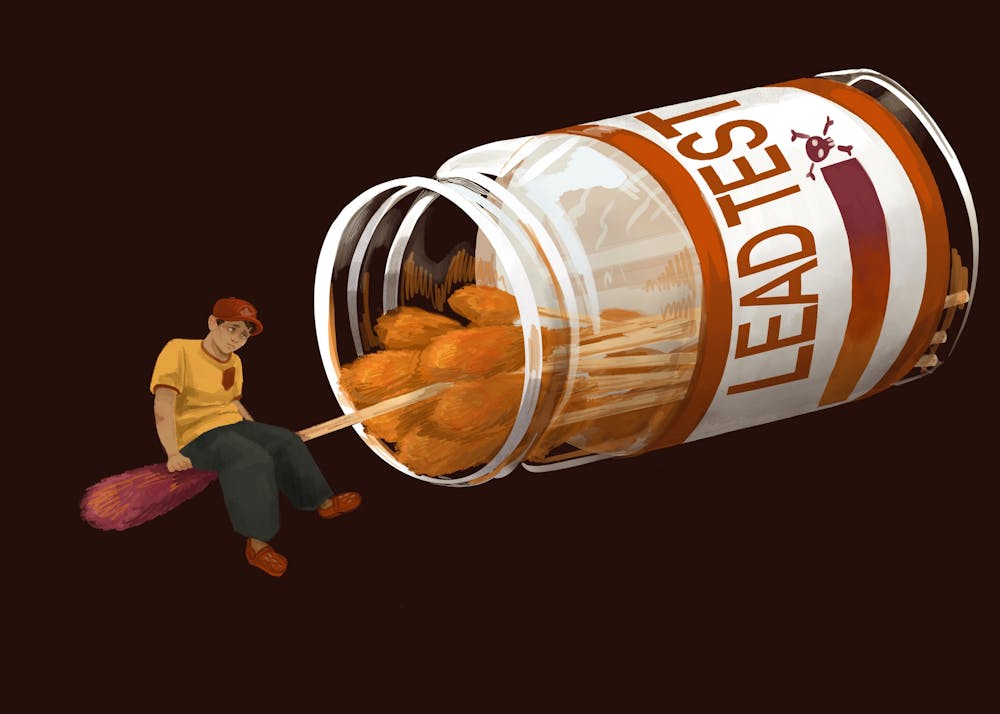
Even lead exposure levels deemed safe may lead to serious mental health consequences in child development, a Brown study contends.
In a longitudinal study that began recruitment over 20 years ago, researchers from Brown and other universities revealed an association between childhood lead exposure and symptoms of depression in later adolescence.
While much research has been conducted on various health impacts of lead exposure, not enough has been dedicated to its impacts on mental health, according to the study’s first author Christian Hoover GS, a Ph.D. student in epidemiology at Brown.
Lead is a neurotoxin that is particularly dangerous because it displaces calcium — one of the most important metals in the nervous system and skeleton — when it enters the body, Hoover said. Lead can also negatively affect communication between neurons and chemical messaging, according to Professor of Epidemiology Joseph Braun, one of the principal investigators for the study.
The study was conducted using data from the Cincinnati-based Health Outcomes and Measures of Environment Study, which seeks to understand how exposure to environmental chemicals affects various health outcomes — including lead’s effects on mental health. The project has followed 218 caregiver-child pairs starting in the second trimester of pregnancy and spanning until the children were 12 years old.
To create the dataset, the children’s blood lead levels were measured serially. At 12 years old, the children then went through mental health screenings, including self-reporting symptoms of depression.
One of these tests showed a strong association between lead exposure around age eight and symptoms of depression. Anxiety symptoms, on the other hand, had no association.
Children are more likely to intake higher amounts of lead because they touch their mouths more frequently, which can lead to ingestion of dust that can contain toxins, Braun wrote in an email to The Herald.
In addition, since children are still growing, small amounts of lead can have a much greater impact proportionally, Hoover added.
“If I had a grape that had (a toxin) in it, depending on what it was, I’d probably be okay, but if my son, who’s 16 months, ate that grape, that grape is huge” compared to his size, Hoover said. “That grape is like an apple.”
Those undue environmental exposures to lead can “disrupt the carefully synchronized processes that take place during childhood brain development,” Braun wrote.
The researchers had hypothesized that blood lead levels would be related to depression and anxiety, wrote Braun, but they were surprised that exposure later in adolescence had a stronger association with depression than early childhood exposure.
The researchers did not come to a consensus on the rationale behind the association, Hoover said. Currently, he believes a potential reason for the increased depression indicators for children exposed later in adolescence is that older children are more likely to have had prolonged exposure to lead.
“My interpretation of it is that it’s more of a reflection of the cumulative exposure,” he said.
According to Hoover, lead is often viewed as “a problem from antiquity that we’ve overcome.” But, as the study shows, lead, which is present in many pipes across the United States, is still a pressing issue that requires further mitigation efforts.
Hoover hopes that further studies “demonstrate that the effects of lead exposure, even at the levels that everyone is saying is totally safe and normal, can lead to really serious consequences for adolescents.”