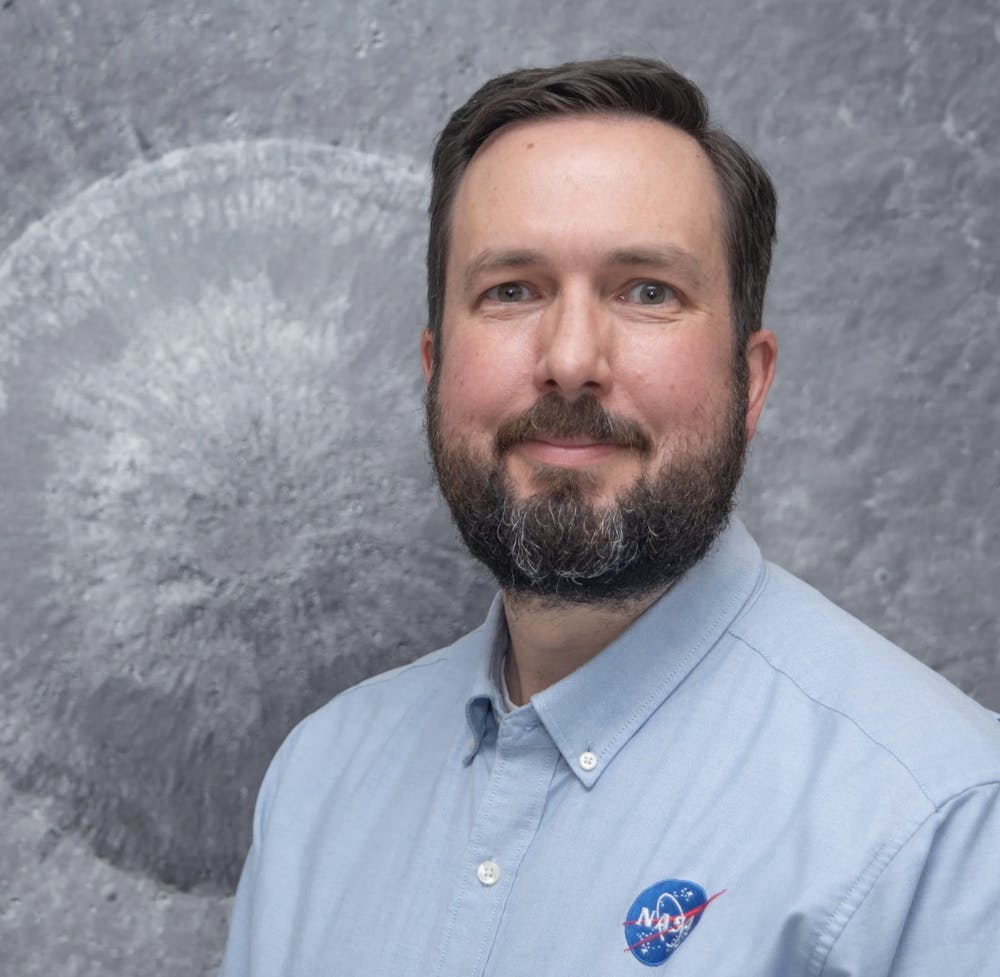
Over half a century ago, a crew of three astronauts set out from Florida on a bold mission — humankind’s first trip to the moon. By 2028, a Brown alum will help humankind return.
As the launch of Artemis II — the first crewed moon flyby in over 50 years — approaches, Artemis III Project Scientist Noah Petro PhD’07 outlined the next mission’s goals and motivations.
“For the first time since 1972, we’ll have astronauts going to the lunar surface,” Petro said in an interview with The Herald.
As the project scientist, Petro’s job is to oversee Artemis III’s geological plan, which details the types of samples crew members will collect and the instruments they’ll leave behind on the moon.
According to Petro, the motivation behind this mission is to “recreate the history of the moon.” When they reach the surface, astronauts will try to describe and document the texture and properties of the planetary body.
The project provides an opportunity to build on the samples collected during Apollo and Soviet robotic missions, he added. “We’re entering this new era of understanding the moon, its environment and how we’ll be able to use these samples to unravel four and a half billion years of history,” Petro said.
Artemis II, on the other hand, will serve as a test mission and “kind of an entrée for the rest of the Artemis program” to demonstrate that the Orion spacecraft can accommodate crew for an “extended period of time,” Petro explained.
Armed with data on lunar gravity and the moon’s surface, “there’s nothing standing in our way of being able to accomplish a landing,” he said. “At the same time, (we also) have the national will to do it.”
The Artemis missions are “intended to be sustainable,” with the goal of creating an infrastructure for trips to the moon, Petro said. “Part of (preparation) is talking to people who are interested in trying to get the rest of the world excited about this,” Petro said. “We want this to grow and grow.”
One reason for the mission’s “broad support” comes from other nations’ interest in sending humans to the moon, Petro noted.
“It helps to have some other entities pacing us,” Petro said. “In terms of providing evidence for your progress as a spacefaring nation, sending things to the lunar surface, to lunar orbit is a great demonstration of what you’re able to achieve.”
In 2023, the Indian Space Research Organization announced its goal of sending individuals to the moon by 2040. In October, China announced the nation’s intentions for a manned lunar landing by 2030.
While the precise landing location for Artemis III has not yet been determined, the manned mission will send crew members to the south pole of the moon, which has a “unique environment,” compared to the rest of the planetary body, Petro said. The site has never been sampled before and may contain frozen water within its surface, he added.
Currently, Artemis III is in a “preparatory phase,” Petro said. While a geology team and instruments for the mission have been selected, the team is still planning for the difficulties that may arise during the mission.
He emphasized the importance of “empowering” the astronauts with the skills and training to make exploratory decisions on their own while on the moon.
“There’s this misconception that, well, you’ve just got to pick up rocks,” Petro said. “You need to pick up representative rocks,” he explained, noting that collecting abnormal samples won’t allow scientists to understand the moon’s normal environment.
“It may sound simple, but we want to train that and practice it,” he added.
Petro, who arrived at Brown already set on studying lunar science, said his time at the University as an experience that “fleshed out his enthusiasm.”
“The breadth of my Brown education definitely prepared me for the breadth of things that I have to tackle today,” he said.
Professor Emeritus of the Geological Sciences James Head PhD ’69, who worked on the Apollo Lunar Exploration program and provides guidance to scientists working on Artemis, described Petro as “the perfect choice” for his position.
Petro can both speak and listen to “scientists, astronauts, managers and the public,” Head wrote in an email to The Herald. This is “a combination of talents that is unusual,” he added.
To Head, seeing scientists who studied lunar and planetary geosciences at Brown take on leadership positions like Petro’s is “incredibly rewarding.”
Daniel Moriarty PhD’16, an assistant research scientist at the University of Maryland working on the Artemis program, described Petro as an “extremely supportive and positive” mentor.
“As a group, we’ve faced numerous challenges over the years, and he guides us through everything with a much needed calming presence,” Moriarty wrote in an email to The Herald. “His is a much-needed perspective: staying grounded in the past while soaring into the future.”
“Every time the moon is out, and I see it, it takes my breath away a little bit,” Petro said. “I would just encourage everyone to turn your eye to the moon — more than once — and start falling in love with it.”

Samah Hamid is a university news editor covering faculty and career & alumni. She is from Sharon, Massachusetts and plans to concentrate in Biology. In her free time, you can find her taking a nap, reading, or baking a sweet treat.