By scrounging through letters sent across the Atlantic from Germans to their friends and family who immigrated to the United States, Assistant Professor of History Benjamin Hein unlocked new insights into 19th-century German economic transformation.
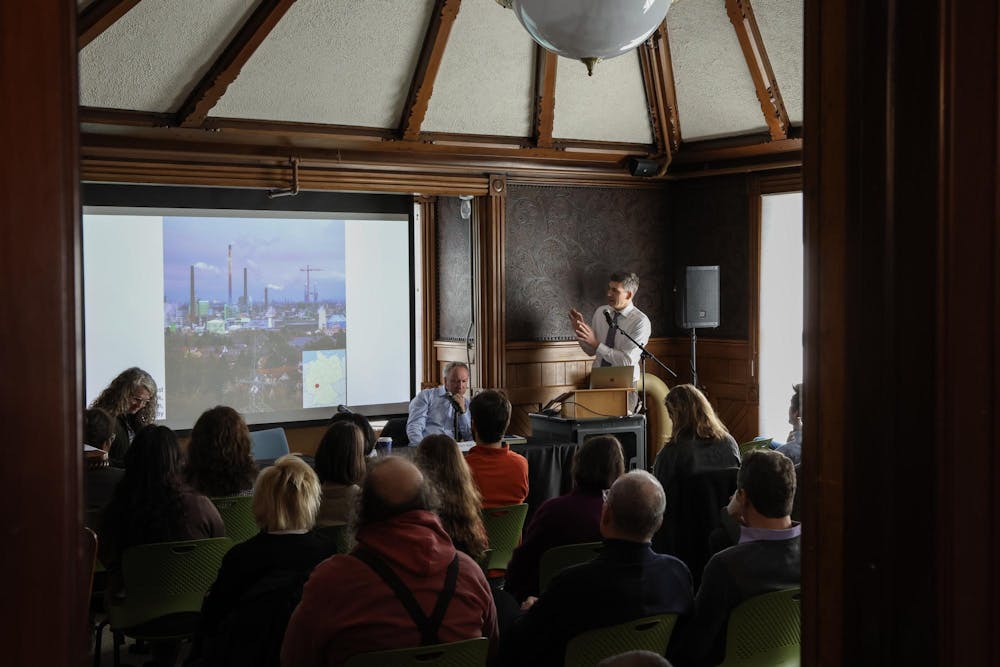
Hein presented these findings at a Monday Department of History event that also celebrated the release of his latest book, “The Migrant’s Spirit: How Industrial Modernity Came to the German Lands,” which explores how the German-American diaspora impacted German industrialization.
The book is about the brief moment in the 19th century “when contemporaries in Germany were unusually infatuated by information, advice (and) ideas that were coming out of America,” Hein said in an interview with The Herald. “The Migrant’s Spirit” investigates why Germany turned to the United States as a source of inspiration for reshaping the country’s economy instead of drawing from European neighbors such as England or France.
Hein explained that while Germans were inspired by economic institutions in other European countries, the rise of nationalism at the time made them less receptive to these ideas.
“France and England were seen by many segments of Germany’s populations as rival peoples, such that if you imported those particular ethics, you were kind of losing yourself — you stop being German, you became English or French,” Hein said.
U.S. economic ideas were better received because 19th-century Germans “didn’t understand America as a foreign country” but rather “as a quasi-extension of the German nation,” Hein explained.
When Germans began immigrating to the United States, they would describe it as “going to North America” instead of moving to the United States in particular, he added. Ideas coming out of the United States were “less likely to be dismissed as part of a rival culture.” Instead, they were seen as ideas that came from what some immigrants saw as “another Germany,” he said.
Letters exchanged between Germans and their loved ones abroad recorded conversations that may have typically taken place over the dinner table, which would not have created a historical record, Hein said.
The letters uncovered questions and “moral wranglings” Germans had regarding industrialization, Hein said. They shed light on how people in the 19th century made sense of a “rapidly transforming” world.
The book is “a very cool use of microdata to tell a macro story,” Professor of International Economics and International and Public Affairs Mark Blyth said in an interview with The Herald. Using letters “as a source material is really unusual, and I was just interested in how that scaled up to basically being a story about German economic development,” he added.
Toward the end of the book, Hein ascribes the “fallout” of this diasporic relationship between Germany and the United States to the latter’s rise as a global superpower in its own right.
Ultimately, the relationship “broke down once there was the realization that perhaps the people in America were not actually part of a larger German national geography,” Hein said.
Hein’s book is the culmination of almost a decade of research on German economies and industrialization. The work builds on his PhD dissertation, which explored how individuals were convinced to embrace the new social organizations brought about by industrialization.
“How (The Migrant’s Spirit) differs from the dissertation is that it takes quite seriously the idea that contemporaries place the particular kind of value and significance on ideas that were coming from America at that moment in time,” Hein said.
“It’s an extraordinary work,” said Professor of History Holly Case, who had given Hein feedback on the manuscript of the book. “I think it’s what historians at their best do: it’s when they are able to allow the sources to change the story.”