
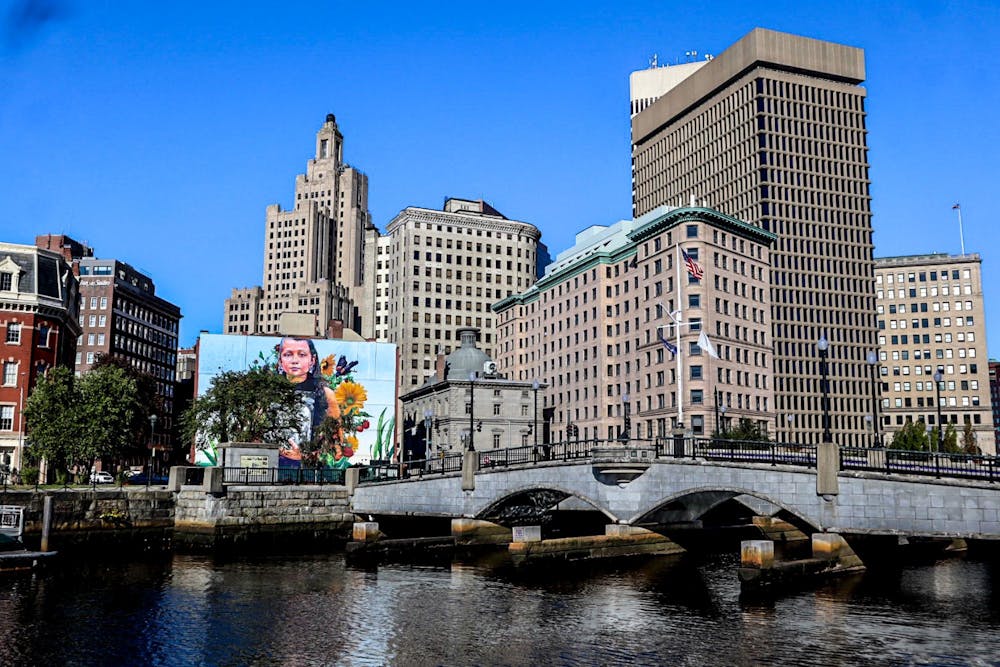
Rising above the Providence skyline sits a familiar beacon, visible from College Hill night after night: the Superman building. Once one of the nation’s most prominent office towers, the skyscraper has sat mostly vacant since Bank of America relocated its headquarters in 2013, 85 years after the building’s opening. Windows remain boarded, scaffolding rises and falls with the seasons and redevelopment proposals come and go without coming to fruition. This is not due to a lack of demand but to a persistent financing failure. The Superman Building, in addition to being a relic of the past, has now also become a “symbol of suffering downtown economies” nationwide, as the Wall Street Journal put it. Rather than let this iconic building be lost in the bureaucracy of real estate financing, Brown should use its financial capacity to revitalize the Superman building.
The landmark — named for its resemblance to the Daily Planet building in the 1950s Superman television series— has faced major difficulties throughout its most recent cycle of redevelopment, including the death of David Sweetser, the owner of High Rock Development, the real estate firm that bought the building in 2008. Sweetser had initiated plans to convert the building into a 300-unit apartment complex with commercial space in 2022. The new manager of High Rock Development has indicated his intention to pursue Sweetser’s vision for the building’s redevelopment, but as of August, no timeline has been announced.
Friction in obtaining tax credits and a low-interest loan from the U.S. Department of Transportation has dragged out the planning process. These hurdles have led to delayed construction, and building costs have risen precipitously because of the rapid price inflation of construction materials nationwide. Converting office space into housing is already notoriously strenuous, so these added difficulties have put the building’s stakeholders through the ringer even more. Even after securing a 30-year tax stabilization agreement from the city and a host of government subsidies, the Superman redevelopment has remained stalled. In an April 2025 Boston Globe article, state Rep. Joseph Shekarchi (D-Warwick), the house speaker, said that Rhode Island would not be able to contribute additional funding to make the project happen. “They’ve got to find another way to fill the gap,” he said.
This is where Brown’s institutional position differs from private developers. Unlike High Rock, Brown does not need to rely on volatile private debt markets to finance long-term real estate investments, nor does it face the same return expectations from outside investors. With an endowment surpassing $8 billion and a nonprofit tax structure, the University could absorb the very risks that have likely stalled private redevelopment.
Beyond merely restoring a gem of Providence’s history, redeveloping Superman would give Brown the chance to inject further support into the Providence economy. As the building lays vacant, it casts a dark shadow over the center of Providence. The loss of foot traffic from its previous inhabitants led to closures of nearby restaurants and shops, a drop in vibrancy at Kennedy Plaza and a drag on the Providence economy. Any such office-to-residential redevelopment would not only help bring Downtown back to its former vibrance, but also augment the city’s liveliness by bringing hundreds of new permanent residents into the heart of downtown. With housing prices skyrocketing across Providence and new development stagnating in recent years, Brown taking a hands-on role in the project would not only deliver wins for the University, it would be huge for Providence.
Brown’s recent developments in the Jewelry District have proved our competence in deploying large amounts of capital and executing local developments. This model could serve as a template for Brown’s redevelopment of the Superman. The Rhode Island School of Design undertook a similar project when it redeveloped the former R.I. Hospital Trust Building, converting a once-vacant historic tower into dorms and a library. This project preserved an architecturally significant landmark while anchoring it to stable institutional use.
Brown could follow suit and use space in the Superman to advance its academic mission. The tower’s scale and central location make it well-suited for graduate and faculty housing, where long-term occupancy and institutional stability matter more than maximizing rental yields. Beyond the benefits of such an injection into the housing market, the building could accommodate academic conference space or administrative offices, contributing to the stimulation of downtown foot traffic.
By investing in such a project, Brown could not only help revitalize a New England treasure, but also provide the city with a stimulus from which the University community will benefit, year in and year out.


