
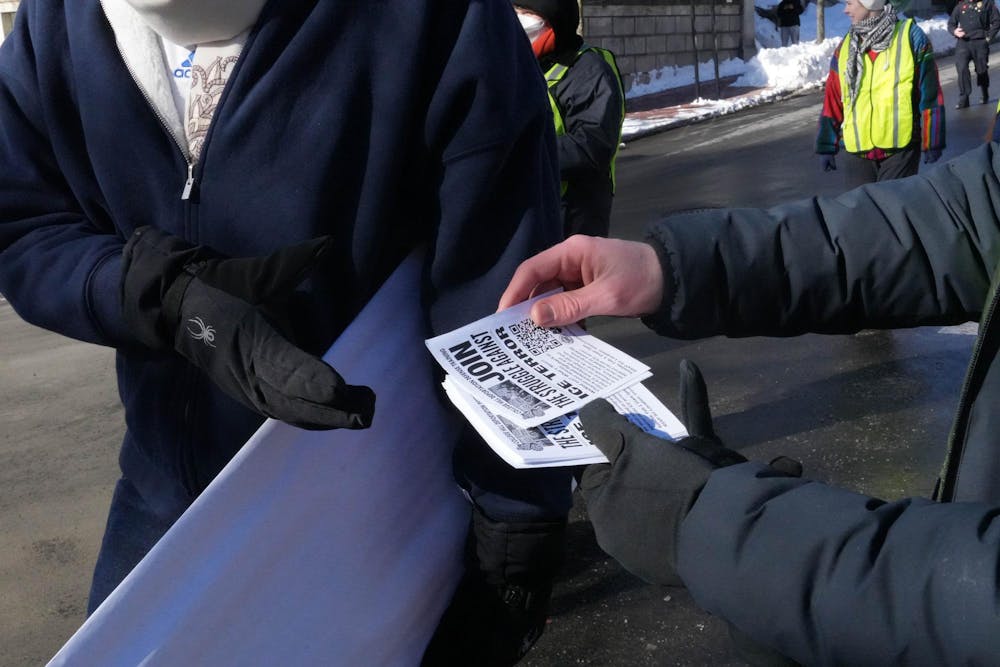
A few weeks ago, I attended a rally in protest of the violence in Minneapolis enacted by the U.S. Immigration and Customs Enforcement agency. The protest began in front of The John D. Rockefeller, Jr. Library and was organized by Brown Rise Up, Sunrise Brown, the Deportation Defense Network and the Rhode Island Student Climate Coalition. According to BRU’s Instagram account, the protest was for Brown students to “stand in solidarity with activists in Minneapolis and across the nation to resist ICE’s violence and terror.” That post motivated me to show up. The senseless acts of violence in Minnesota were completely unnecessary, beyond cruel and heartbreaking. I arrived in front of the library a few minutes early, and in mere minutes, I was surrounded by hundreds of students as eager to protest as I was.
The rally began with a clear purpose: to condemn and demand accountability from ICE. But soon a different chant began: “No justice, no peace! No ICE or police!” I paused and thought to myself: Isn’t getting rid of the police a whole different thing? ICE and the police serve very different purposes. They are different institutions that have different responsibilities, and their defunding has vastly different implications for society. This chant may seem like a minor deviation from the rally’s main message, but it exemplifies something larger about progressive activism on campus: Sometimes, causes that should be distinct are bundled together and made inseparable. Collapsing progressive causes into a single package can weaken the movements that are trying to win realistic change — both by alienating potential supporters and by diminishing the force behind individual calls for action.
Chants that call for abolishing both ICE and the police in the same sentence fail to recognize the dangers of their oversimplification — a failure that may alienate those who have different lived experiences. Over the past couple months, seeing police cars near campus has been an unexpected source of comfort for me. I couldn’t help but remember how on Dec. 13, my friends and I were terrified as we hid in the bathroom of Friedman Hall. Eventually, we were joined by a police officer whose presence was deeply comforting during that traumatic time. We were lucky to have so many officers serving to protect our school in such dire times. I cannot picture what we would have done without them. Such an experience makes it hard for me to blindly sign on to chants calling for “no police.”
Many of the students who came out to protest, like me, came for the specific cause that they felt passionate about. That support is immensely influential, and shifting ideas loses the heat of the specific argument and cuts down on the support base. The ICE protest is just one example of this: If there was someone in the crowd that felt strongly about demanding justice for the victims of ICE’s violence but disagreed with one of the chants that addressed another issue, the protestor could become disillusioned with the movement. Protest, when done right, is a powerful way to demand change and make our voices heard. While I am a progressive, I am not defined by one ideology.
When we group multiple causes together under one umbrella, we trade critical thinking for conformity. Individuals lose the privilege and responsibility to think for themselves: instead of investigating what they actually believe about each issue, they’re expected to adopt and regurgitate a suite of positions without question. This kind of political operation is both intellectually lazy and strategically costly. Grouping several issues together takes attention away from each individual cause. If we overwhelm legislators with a laundry list of causes all at once, it detracts attention from one concrete action to focus on first. As constituents, we have the influence to communicate what is most pressing. Each issue deserves to be analyzed separately.
Homogenizing distinct causes into one blanket viewpoint does not only weaken protests — it reduces critical thinking in an environment that already struggles to protect free speech. According to The Herald’s fall 2025 poll, 40% of Brown students have felt uncomfortable sharing their political beliefs in social settings, and the Foundation for Individual Rights and Expression gave Brown a grade of F for its speech climate. At a school with diversity of thought, even if people are not outwardly expressing their differing opinions, it is important to find solidarity where we can — especially at protests for such urgent causes.
Beatriz Lindemann ’29 can be reached at beatriz_lindemann@brown.edu. Please send responses to this column to letters@browndailyherald.com and other opinions to opinions@browndailyherald.com.

Bea Lindemann is a staff columnist and a member of the Editorial Page Board. She is from Miami Beach, FL and plans on concentrating in Political Science.


