For the past month, several inches of snow have consistently coated the ground in Providence and areas across the state. With grass buried and ponds frozen solid, birds that rely on the food sources these ecosystems provide have not been able to find sustenance.
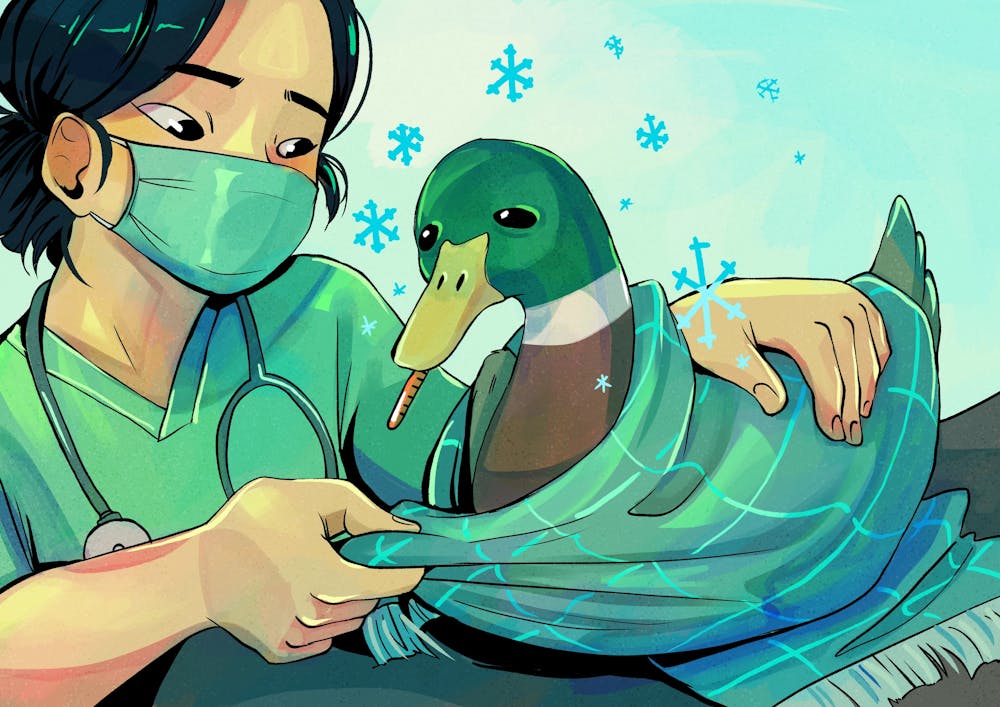
And because of these treacherous conditions, Rhode Island’s wildlife rehabilitation clinics are reporting record numbers of sick and injured birds.
“They’re coming in completely depleted and emaciated,” said Sheida Soleimani, the executive director and founder of Congress of the Birds — a wildlife rehabilitation facility that focuses on avian patients.
Soleimani, who has worked in the Ocean State for a decade, said she has never seen this many patients in the winter. Usually, winter is a quieter time for wildlife rehabilitators, as many birds have migrated south and baby birds have not yet been born.
“These birds aren’t able to even get the basic food they need to survive,” she said.
A lack of periodic melting has caused snow and ice to remain in place for weeks, preventing access to food for local birds, Blaine Hymel, the medical director of the Wildlife Clinic of Rhode Island, said. As a result, more birds have arrived to the clinic weak and severely underweight.
The Wildlife Clinic, the only fully functioning wildlife hospital in the state, has treated almost 250 avian patients so far this year. Hymel said this was a 66% increase from the same time last year.
She added that many birds require “intensive supportive care” due to starvation. The clinic expected the number of patients to rise after the blizzard on Monday.
The long-term impact of the snow on bird populations remains uncertain.
Soleimani noted that many juvenile birds may not survive the winter. “This year is even more treacherous than it would be normally,” she said. “I think we're going to have a lot more decline in some species.”
Treating these animals often begins with stabilization. Clinics provide fluids, food and medication in hopes of eventually releasing the birds into the wild.
But some cases are more complex. According to Soleimani, the snowy conditions create the “perfect storm” for spreading the highly contagious H5N1 avian influenza. Birds experiencing hunger are much more vulnerable to infection, she explained.
Several birds have already tested positive for the virus this season, Hymel said. Both clinics treat patients for influenza as well as for injuries such as fractures.
Rhode Island recorded its first case of avian flu in 2022, The Herald previously reported.
This year, more infected animals are recovering from the virus. “We’ve seen a handful of asymptomatic or very mild cases and have released even a few that have fully recovered and tested negative,” Hymel said.
The risk of bird-to-human transmission is generally low, but people with direct animal exposure are at the greatest risk, Jennifer Nuzzo, a professor of epidemiology and the director of the Pandemic Center at the School of Public Health, said.
As of right now, Nuzzo believes the risk to the general public remains low. There have not been recent human cases detected and wastewater data has not shown concerning signals, she said.
Because of avian flu concerns, Soleimani advises against touching or feeding birds.
“We don't know off the bat if that bird's going to be avian flu positive or not,” Soleimani said. If residents encounter potentially sick wild birds, they should “just give (the Congress of Birds) a call or a text and we'll be happy to walk people through with assessing.”