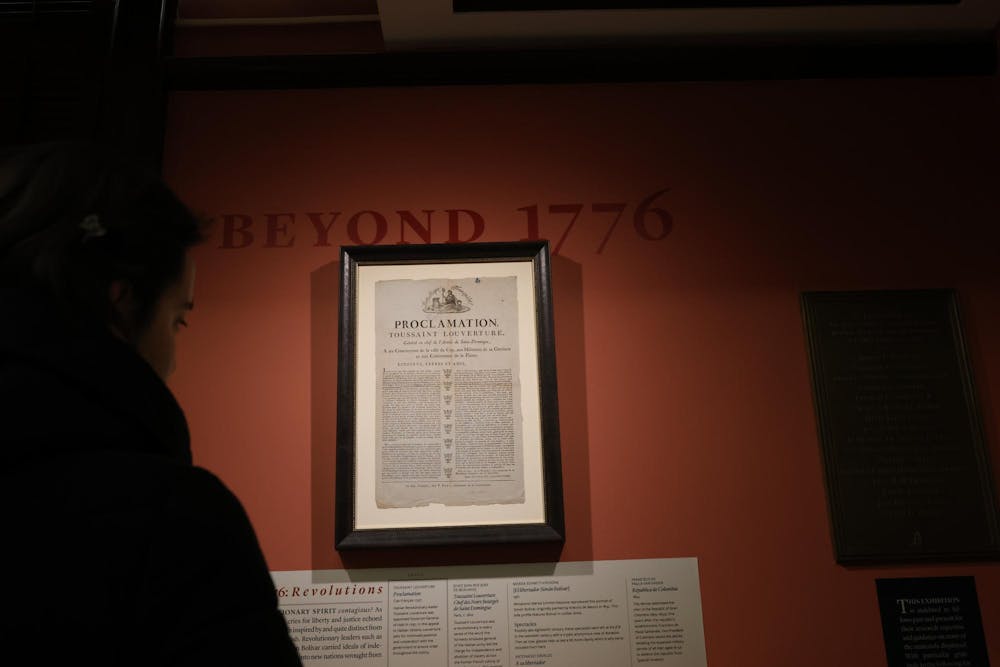
A new exhibition at the John Carter Brown Library aims to “think hemispherically” about American history, according to Director of the JCB and Professor of History Karin Wulf. On Friday, the John Carter Brown Library held an opening ceremony for its new exhibition, “1776 Across the Americas: A Hemispheric History from the Collections of the John Carter Brown Library,” which aims to extend historical perspectives beyond the 13 colonies that are traditionally studied.
The exhibit is part of the JCB’s “2026 and Beyond” initiative, which celebrates the semiquincentennial anniversary of the United States, according to Wulf. The yearlong exhibit features around 40 artifacts and is a culmination of more than two years of research, said JCB 2026 postdoctoral coordinator Kathleen Telling.
When organizing the layout of the exhibition, the curation team ultimately decided to highlight “geographic and linguistic breadth and diversity,” Wulf said. The exhibit opens with artifacts from Rhode Island, then progresses to the rest of the North American continent and then reaches to the Caribbean and Central and South America.
“As you move about the room, it expands hemispherically,” Telling told The Herald. “We end it by thinking about what happens next.”
Some objects in the exhibit were donated by Brown alums, such as the diary of Samuel Harris, an American Revolutionary War soldier who fought in the Battle of Saratoga in 1777, a turning point in American history, Wulf said.
“It’s an amazing diary,” Wulf said. “I love it that a Brown alum thought, ‘My family should give this to the JCB.’”
Another item on display is the JCB’s copy of the Declaration of Independence, and she hopes readers will view the document as “having lived a life.”
“The Declaration of Independence was not this pristine thing that lives in Washington,” she said. “It was words that traveled around in July of 1776 to ordinary people.”
Artifacts ranged from official documents to everyday historical records, including smallpox inoculation cards for the children of Nicholas Brown, the University’s namesake.
These artifacts share “an element of dealing with daily life amidst … this huge historic transformation,” Telling added, citing a letter in the exhibit from a group of women to Newport Governor Nicholas Cooke asking if they could visit their friends in the “British-occupied” town in 1777.
“1776 was both very explosive and dynamic and also very mundane,” Telling said.
Telling, who joined the curation team last June, said she examined over 100 artifacts physically and even more digitally before selecting the final objects for the exhibition.
The curation team then met with the conservation team to discuss the conditions of the objects, paying special attention to materials with sensitive pigments that are at high risk of color change, Head of Libraries Conservation Roger Williams said.
In these cases, a facsimile, or copy, is on display. But whenever possible, the original is featured, especially during high traffic periods like the first and last month of an exhibition, Williams told The Herald.
The conservation team is also responsible for structurally stabilizing the objects by creating mounts and book cradles, Book and Paper Conservator Terra Huber said.
“It’s important to have exhibits that show just the richness and depth in the materials that are here,” said President Christina Paxson P’19 P’MD’20, who attended the exhibit preview Friday evening. “For someone who’s not a historian, it makes history so alive and so exciting.”
The JCB’s collection “is a living thing,” Telling said. “We want people to come and engage.”
In Wulf’s view, the year 2026 provides an opportunity to reflect on the country’s early history.
The exhibit offers a “complicated view that helps us understand the complicated world we live in right now,” Wulf said.

Ella Piscatello is a junior from Northport, New York concentrating in English and Theatre Arts. She looks forward to continuing to write for The Herald and spending her free time performing in musicals, tap dancing and playing piano.