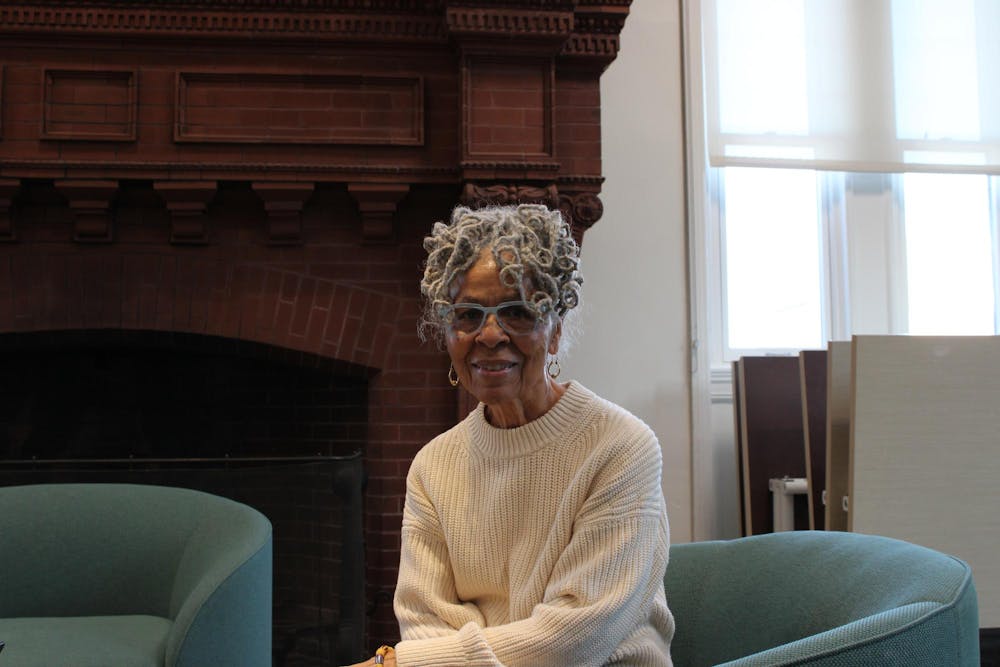
By sifting through personal archival documents of author Paule Marshall — whose work depicted the diverse Black experience beyond in the United States and across the African diaspora — Mary Helen Washington, a former English professor at the University of Maryland, discovered new insights into the complexities of her late friend.
Washington compiled her findings into a biography, “Paule Marshall: A Writer’s Life,” which she spoke about at the Pembroke Center for Teaching and Research on Women last Thursday.
Co-sponsored by the Departments of Africana Studies and English, the talk, titled “On Paule Marshall: Mary Helen Washington,” was part of the “Shauna M. Stark ’76 P’10 Out of the Archives” Lecture Series. The series invites speakers annually who have contributed or plan to contribute papers to the Pembroke Center archives, according to Mary Murphy, a Pembroke Center archivist.
In her lecture, Washington said she was first introduced to Marshall through the pages of Marshall’s first novel, “Brown Girl, Brownstones,” and later her short story “Reena.”
“The novel and ‘Reena’ were both groundbreaking stories in the way they treated Black women as centers of power,” Washington said during her talk.
When Washington was writing her anthology “Black-Eyed Susans and Midnight Birds: Stories By and About Black Women,” she reached out to Marshall to feature “Reena” in the collection. Although the two “were never close friends,” they were “always good friends,” Washington said in the lecture.
“She took me to parties and out to dinner,” Washington said during the talk. “I met all her friends in New York, and then in the early 2000s I lost touch with her.”
In 2018, Washington learned that Marshall, who had dementia at the time, was living in a nursing home in Richmond, Virginia. When Washington went to visit, she spoke with Marshall’s son, who showed her all of Marshall’s unreleased papers, Washington said.
“If you can imagine an academic being introduced to a storage room full of the papers of a well-known writer, untouched and unread by anyone else, you’re looking at a baby in the candy store,” she said.
During the visit, Marshall’s son asked Washington if she would consider writing Marshall’s biography.
But investigating Marshall’s archives was not without its challenges. Marshall was an extremely private woman, and the only evidence that conveyed any personal information came from a 14-page journal and a decades-old computer, Washington told The Herald.
While examining these documents, Washington found many contradictions between Marshall’s public and private personas.
When Marshall published “Brown Girl, Brownstones,” she said in interviews that she did not share the same rebellious qualities as the novel’s protagonist. But in Marshall’s archives, “handwritten notes marked rebellion, independence,” Washington found, filled with ways in which Marshall rebelled against her mother and the church, Washington said.
Marshall was also reluctant to describe her work as feminist, Washington told The Herald. In interviews, Marshall explained that feminism only appears in her novels to bring Black men and women together. But when reading Marshall’s work, Washington found that the role of Black women challenged Black men in the novels.
“I felt as though she was always trying not to anger the Black community,” Washington said. “She wanted to not create disruption in the Black community.”
Washington also explained how she discovered Marshall’s bisexuality through reading her journal which she kept while she was on a writer’s tour in China. In the excerpt, Marshall wrote about her “complicated feelings, desire, tinged with guilt and shame,” Washington said in the lecture.
This context enables readers to understand Marshall’s writing in a “more intelligent and sophisticated” manner, Washington told The Herald.
“The diary becomes this rich source of my ability to read her work,” Washington said during her lecture. “I see her acceptance of that self, and I see her also writing about it in her work, but publicly, she never uttered a word about same-sex sexuality.”
In her biography, Washington discusses how Marshall “tightened” veils in her own life, “disguising and concealing” aspects of her identity. But in the fictional worlds Marshall created, “she gave us access to the interior lives of Black women, removing the veils of secrecy in order to explore these women's desires and fears,” Washington said in the lecture.
But her work came “15 years too early,” Washington told The Herald.
“Brown Girl, Brownstones” was published in 1959, a time when there were very few Black studies programs, and there were rarely young African American assistant professors to advocate for authors who were Black women.
Marshall also paved a new path and wrote about the intersection of experiences between African American, Caribbean and African cultures, something her colleagues at the time were not doing.
“She insisted on viewing Black people as part of a world community,” Washington said in her lecture. “She made fierce examinations of colonialism and capitalism, as well as racism and sexism.”
“She foregrounded non-conforming, non-heterosexual women in the fiction, always portraying them as agents in their own lives,” Washington said.
Elizabeth Rosenbaum is a senior staff writer covering science and research.