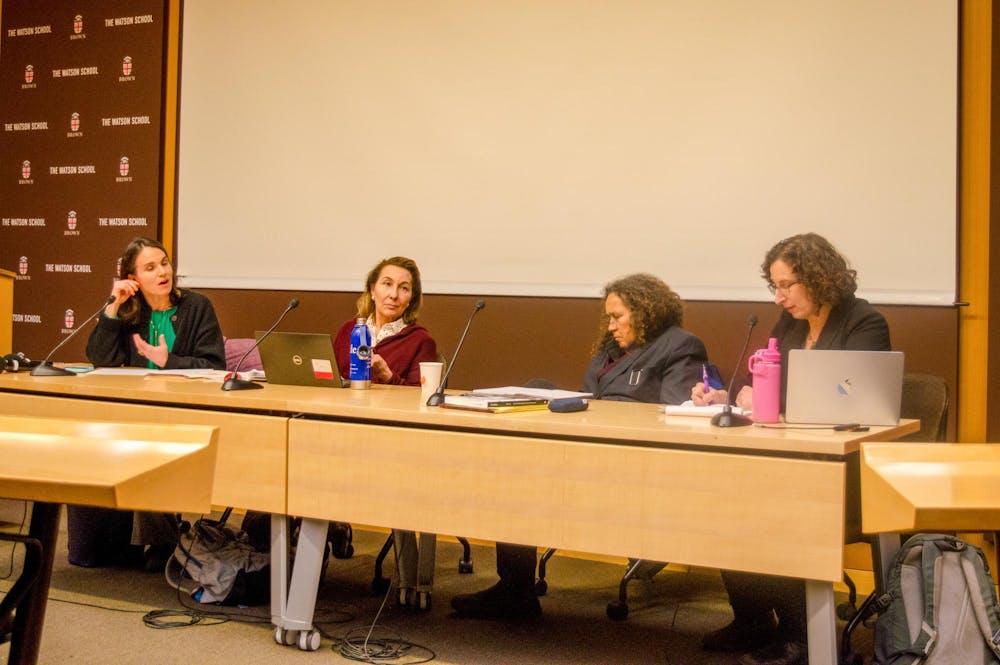
In a Thursday panel, three professors from outside of Brown discussed their research on the ripple effects of war. The panel centered specifically around the deleterious effects of war on U.S. democracy.
“In all the discussion of democratic backsliding in the (United States), there’s a major factor that’s often overlooked, and that’s the role of U.S. wars and the constant state of preparation for war in this country,” the project’s director Stephanie Savell MA’11 PhD’17 said during the opening remarks.
The panel was hosted by the Watson School of International and Public Affairs as part of the Costs of War project, a research initiative that tracks the social, political and economic impacts of U.S. military activities and spending. Although the Costs of War project originally primarily focused on the United States’ post-9/11 wars, research has expanded to cover topics including Israel’s military operations in Gaza and the rivalry between the United States and Russia.
Costs of War research often garners national attention: In recent years, work from the project has been reported on by multiple national news outlets, and in 2021, former President Joe Biden cited Costs of War research in a speech he gave.
The first speaker, Neta Crawford ’85 — a professor of international relations at the University of St. Andrews and a co-founder and strategic advisor for the Costs of War project — presented her research on the relationship between democracy, war and fear. Crawford discussed sources of democratic decline in relation to militarization.
Fear, in Crawford’s view, is “at the root” of war — “fear is the emotional lubricant” for war and, by extension, the loss of freedom by promoting an “us versus them” view. Furthermore, the fear causes people to “search for security,” which can limit their tendency to clearly evaluate U.S. military spending.
War is “antipodal to democracy,” Crawford said during the panel. “It erodes the deliberation and the oversight that is necessary for the functioning of a democracy.”
But Crawford did present an optimistic counterpoint: “Increasing democracy can help us put the restraints on violence.”
Harvard Kennedy School Senior Lecturer in Public Policy Linda Bilmes, the second speaker, began researching the costs of war about 20 years ago when a student asked her how much the United States was spending on its invasion of Iraq and she realized “no one was actually keeping track of this,” she told the audience at the panel.
During her portion of the panel, Bilmes discussed what she coined as the “ghost budget,” or paying for war with “off-budget” dollars — a practice that is “really different from the way we used to pay for wars” and that the United States has tended toward since 2001, Bilmes said.
In pre-9/11 wars, taxes were raised and non-war budget funds were cut, Bilmes said. But in the wars since 2001, these have not been the methods used to find the funds for war. Instead, wars have been paid for as “emergency” spending or through “various kinds of exempt special budgetary vehicles.” In addition, Bilmes said, war costs extend beyond “just the current cost” but also debt money — costs that are now “transferred to the next generation.”
Another issue with the ghost budget financing method is that it lacks transparency. For example, Bilmes pointed to the Department of Defense’s budget submission for fiscal year 2010, where despite the fact that 23.5% of the budget went to war funds, “zero pages were explaining where that money went.”
Because these funds have not been raised through taxes, fiscal committees in the legislative branch have spent “hardly any” time discussing that spending. Furthermore, citizens are less aware of that spending when it comes out of debt instead of tax money.
“It is much easier to turn wars into perpetual wars if you borrow and don’t feel the pain of paying for them,” Bilmes said.
The third researcher, Jennifer Greenburg, a lecturer in international relations at the University of Sheffield in England, shared her research on the connection between U.S. militarism, nationalism and everyday life. Her work involves interviewing focus groups about their perceptions of the Pentagon budget, which found that a large portion of the general public knows very little about the military budget.
“When our research team presented information about the military budget, the words participants commonly used were ‘too high,’ ‘ridiculous,’ ‘obscene,’ ‘bloated,’ ‘wasteful’ and ‘just wrong,’” Greenburg said. “But often in the same breath as these negative perceptions, people would often say, ‘But we still need it to keep us safe.’”
The fear revolving around perceived security needs “allows the government to exercise these centralized forms of authority in the name of keeping us safe,” Greenburg said.
The Department of Defense and White House did not immediately respond to requests for comment.
Elizabeth Rosenbaum is a senior staff writer covering science and research.