
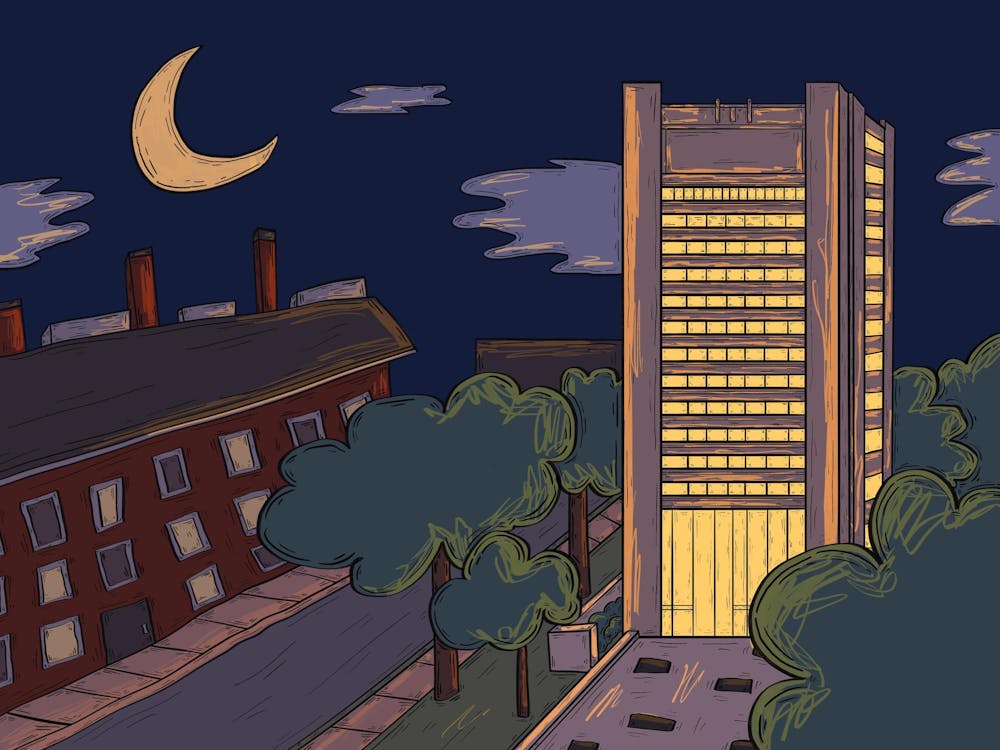
Late nights at the Sciences Library used to be a central part of my routine. It is simply my nature to stay up late, very late. Last month, however, the University quietly announced that the SciLi would no longer operate with 24-hour access on weekdays. Where once I was able to view the sunrise from the 12th floor of our brutalist library, now the event is marked only by a shift in the brightness behind my Andrews Hall curtains. The University should reverse its decision.
Brown cited increased operational costs and low early-morning attendance as justification for the change. While the University should work to reduce its deficit by cutting down inefficiencies and redundant spending, eliminating the only 24/6 study space on campus is an odd way to do so. It simply isn’t the case that the University is cutting down on inefficiencies — the SciLi was a unique resource. Now the students who utilized the amenity, even if there weren’t many of us, have nothing comparable. The strangeness of this decision is accentuated further in comparison to the other members of the Ivy League. Nearly all of our Ivy League peers have at least one library with 24-hour access.
Not everyone is productive during the day. This variation in when we prefer to sleep — known as chronotype — has a biological basis. Anthropologists suggest that diversity in sleep patterns offered evolutionary benefits to our hunter-gatherer ancestors, ensuring that some of them remained alert throughout the night. While most professional work takes place during the day, these biological differences persist, and many find it easier to focus during the nighttime hours. This may be especially true for students with ADHD. The University has a responsibility to accommodate these natural biological variations. For years, the SciLi accommodated students across the full range of chronotypes.
While the Herald reported that less than 1% of the SciLi’s yearly occupancy occurs between 2 a.m. and 8 a.m., this data was based on entry swipes during that period. This number does not account for students who swiped in before 2 a.m. and stayed throughout the night. Given how conducive the SciLi environment is for pulling all-nighters, this explanation is not only plausible but likely. Still, whether the building was crowded at 3 a.m. is beside the point. The SciLi used to fulfill the needs of a small but significant group of students who are now stranded without a stable place to study.
For individual regulars, late-night SciLi study sessions created an informal community space, where students could work alone, yet still be surrounded by others. I found solidarity in this form of parallel work. Night owls are now pushed toward academic isolation.
The SciLi used to serve the function of a sort of late-night “third space,” an “informal public gathering place” where Brunonians could brave the wee hours of the morning together. Libraries are one of the most common forms of third spaces. While there was a tilt towards a more academic “second place” attitude present in the 24-hour SciLi since it functioned as a “workplace,” it still served as an informal environment where community was fostered either actively or passively. For those seeking more active connections, group study sessions in the basement allowed for collaborative work. For those seeking a lock-in session, the atmospheric friends found in the stacks created an implicit community. Consistent among both groups was the creation of a community space where academic and personal lives could come together.
By reducing the SciLi’s hours, Brown has eroded an integral aspect of College Hill culture. The SciLi is more than just a study spot. A 2018 Atlantic article described the library as “a place where students socialize and even flirt.” Even then, an “all-nighter at the SciLi (could) end in a groggy early-morning breakfast at the off-campus, early-hours breakfast cafe Louis.” It is a shame that after losing Louis and now 24-hour access to the library, this hallmark of the Brown grindset has been erased. The article’s reference to the late great SciLi all-nighter highlights the cultural significance of the act.
Not all SciLi night-goers were likely frequent flyers, but still, many students may have had to pull occasional all-nighters to complete long-procrastinated homework or cram for tests. Even if daytime study habits are healthier, students aren’t going to stop pulling all-nighters just because the SciLi is not open. The workload remains the same — it must now be completed somewhere else. Increasingly, that somewhere will be students’ dorm rooms. What is lost is not just the ambiance of that brutalist abomination, but functionality: Having the immediate temptation of a bed so close to where the all-nighter is taking place serves to lull an already behind student further behind into the depths of sleep.
As I write to you from my dimly lit residence hall closet, I see light peeking through from the corners of my window. In moments like these, it feels like Brown has decided to leave its night owls behind. I’d be much happier if I could see this sunrise in full — perhaps from the 12th floor of the ugliest building on campus.
Avery Kaak ’29 can be reached at avery_kaak@brown.edu. Please send responses to this column to letters@browndailyherald.com and other opinions to opinions@browndailyherald.com.
Avery Kaak is a columnist for the Brown Daily Herald. He is from Orlando, Florida and is planning on concentrating in philosophy. In his free time he enjoys reading and running.


