For individuals living with fragile X syndrome — a common genetic disorder that is correlated with autism, causes intellectual disability and more frequently affects male individuals — anxiety, sensory hypersensitivity and difficulties with sound processing can cause significant disruptions in daily life.
Studying the electrical activity in the brains of individuals with FXS can guide treatment development by helping researchers better understand the cerebral mechanisms behind the disorder, according to Jack Liu, clinical research coordinator in the Cincinnati Fragile X Center at the Cincinnati Children’s Hospital.
“There’s a big push in the field to try to characterize neural dynamics and measure these phenomena that represent different brain functions that are unique to people with certain types of disorders,” said Ryan Thorpe ScM’19 PhD’24, a postdoctoral fellow at the University of Colorado Anschutz School of Medicine.
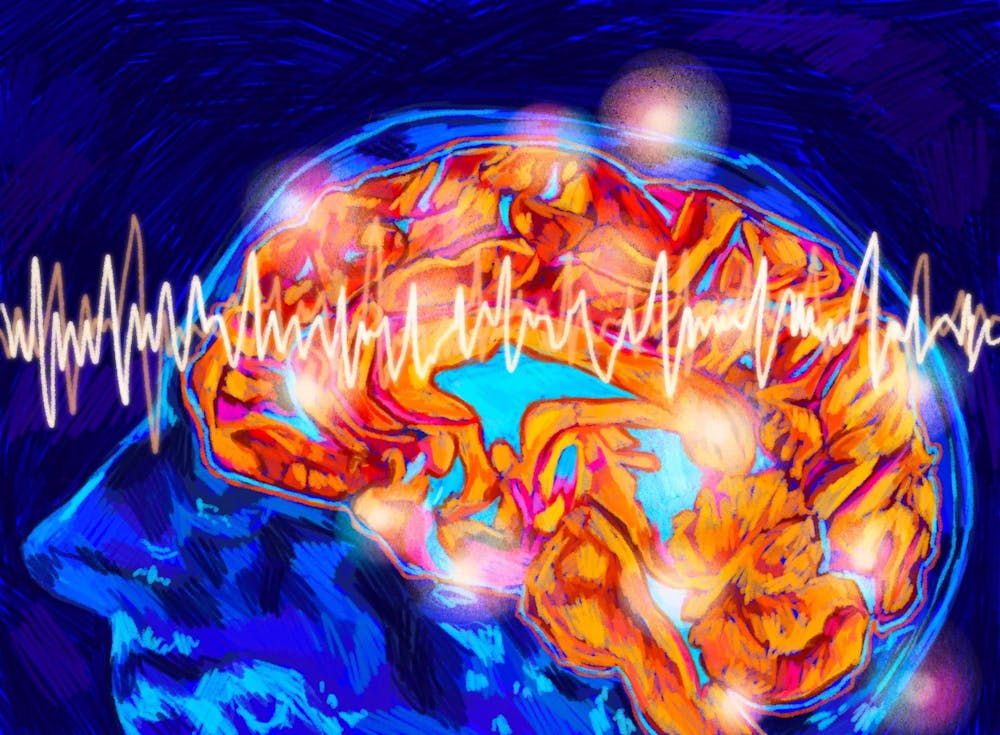
A new study in conjunction with Brown researchers investigated the gamma waves — which have the highest frequency among brain waves and are thought to be related to concentration — of individuals with FXS.
It “has been well established” that people with FXS or other central nervous system disorders have high-frequency electrical activity in their brains, Liu, the first author on the study, wrote in an email to The Herald.
But in this study, the researchers found that in male individuals with FXS, gamma waves had stronger individual peak power than in individuals without FXS — not simply an overall higher average. In addition, for non-FXS control individuals, stronger gamma bursts correlated to less brain-stimulus synchronization, but this link did not exist in FXS individuals.
The findings suggest that the sensory circuits of people with FXS are “both hyperactive and poorly synchronized,” which could explain why these individuals may find difficulty processing ordinary sounds, Liu wrote in an email to The Herald. According to Liu, this means that “the brain may be less able to organize (the gamma) activity into a clean, well-timed response to sound.”
Because the research “connects a measurable brain signal to real-life symptoms,” that signal could possibly be a biomarker for “symptom severity or treatment response,” Liu added.
Professor of Psychiatry and Human Behavior and Medical Science Justin Fallon, who was not involved with the study, explained that “while we have a very clear understanding of what the genetic abnormality is,” we have “much less insight into exactly what is going on inside their brains.”
Fallon explained that using electroencephalograms — tests also known as EEGs that measure the brain’s electrical activity — can help researchers answer this question by providing “insights into how the brain is actually functioning.”
To understand differences in neural activity between FXS and non-FXS individuals when responding to different frequencies, Thorpe said, researchers played an auditory “chirp,” or sound stimulus, and recorded brain electrical activity using EEGs for a sample of individuals with FXS and a sample without.
According to Liu, the researchers used Professor of Neuroscience Stephanie Jones’s “spectral events toolbox,” which includes an analysis method to identify gamma spectral events — temporary periods of increased power, which can be measured with peak power, duration and occurrence rate.
“For a spectral event analysis, we specifically assume that individual trials actually matter and that they’re significant,” said Thorpe, who is a co-author on the study.
The advantage of spectral event analysis is that it allows researchers to capture more of the activity across multiple trials. Traditional analysis averages signals across trials, “which can smooth over short-lived but important events,” Liu wrote.
While brain waves can follow a rhythm, the amplitude of that rhythm can fluctuate, Thorpe explained.
“Spectral event analysis is basically just a way of characterizing (or) measuring these bouts of activity of the wave-like … activity in neural signals,” Thorpe said.
This insight into brain activity through spectral event analysis is “very important” because it provides researchers with “an objective, quantitative and mechanism-linked measure of what’s going on in these brains,” Fallon said. These measures provide researchers with more “clear-cut” data than classical psychological tests such as behavioral tests.
According to Fallon, this research “adds a very important new dimension to understanding not only Fragile X syndrome, but potentially a much wider range of disorders.”

Alice Xie is a section editor for Science and Research from Los Angeles, California. She studies Applied Mathematics and Biology, and enjoys reading gut wrenching literature in her free time.