Walking into the lower level of the Rhode Island State House, visitors are greeted by walls lined with informational panels and abstract art. The building’s grandeur is juxtaposed with the solemnity of the space, which has been transformed into an exhibit focused on the history of slavery at the First Unitarian Church of Providence.
On display through March 22, the “Owning Our History” exhibit draws on the book-length report, “A Church in a Triangle,” written by Rev. Peter Laarman ’70 and Traci Picard MA’23.
Rev. Elizabeth Lerner Maclay, a minister at the First Unitarian Church of Providence who spoke at the exhibit’s March 2 reception, said the church started having conversations about its historical involvement with slavery leading up to the institution’s 300th anniversary.
According to Maclay, “nobody knew about the church’s history in regards to race and slavery, and that was an unacceptable situation.” She called this gap a “big, empty spot of (the) church’s identity.”
By investigating archival collections, Laarman, a volunteer with the First Unitarian Church, and Picard, a researcher and historian, found that many congregants of a predecessor to the church were enslavers, had served as ship captains involved in the Triangular Trade or were involved in manufacturing clothing for enslaved people.
In their review of the church’s records, the scholars didn’t find any evidence of open abolitionists at the church before the Civil War.
Picard said she wants viewers to not only look at the face-value facts of the church’s history, but also to observe the “meaning and the feeling” behind the exhibit.
“It's really grown into something that now you can see all these different people are collaborating with and participating in,” she said. “It’s become part of our community.”
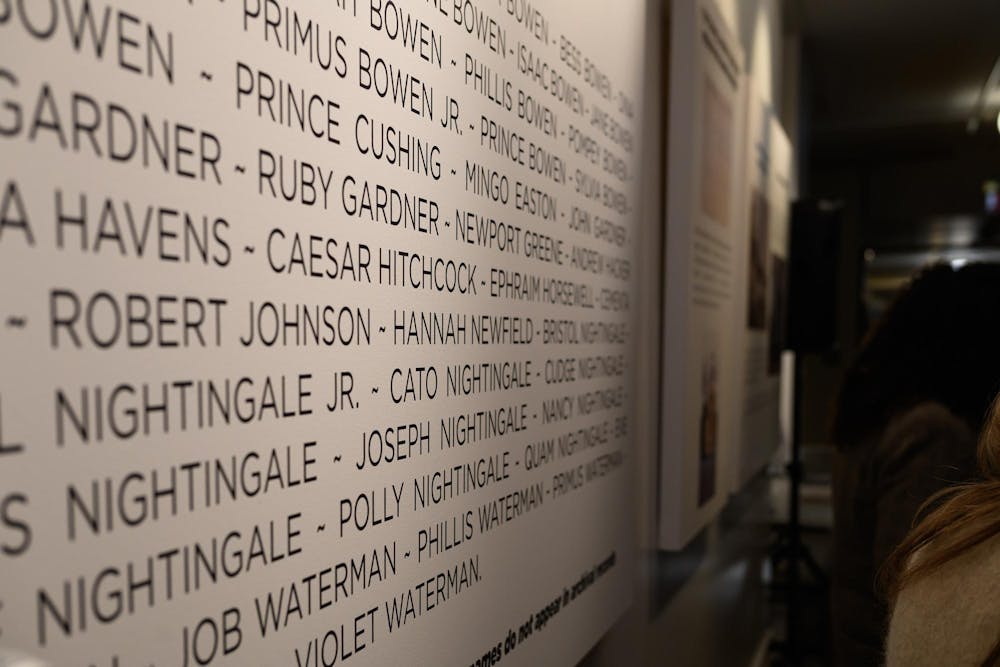
According to Laarman, the exhibit’s main focus is a large piece called “Say Their Names,” which identifies 47 people enslaved by members of the church.
“The people whose names are on that big exhibit panel have an equal ownership of this history, and they have stories to tell (that) they were not allowed to tell,” Laarman said.
The panel of names is accompanied by additional informational pieces and the painting “Do You Feel Like Shouting?” by visual artist Renée Elizabeth Neely-Tanner ’12.
Neely-Tanner created the painting while she was a resident at the Ruth J. Simmons Center for the Study of Slavery and Justice in 2023.
She said she developed the idea for an exhibition at the center — which included the painting in the State House exhibit — through her research on maroon communities, areas founded by runaway enslaved persons, in southeastern Virginia and northeastern North Carolina, near where she grew up. That exhibition was created by “looking at that community in a speculative” manner and “reimagining their existence,” Neely-Tanner said.
With her painting now at the State House exhibit, Neely-Tanner said she feels she is able to “give voice” to the enslaved peoples’ existence and the “few moments they had to be themselves.”

Kelly Ding is a senior staff writer for the community and culture beat. She is from College Station, TX and plans to concentrate in IAPA on the policy and governance track. In her free time, she loves to explore new coffee shops, curl up with a good book, and be a gym rat.