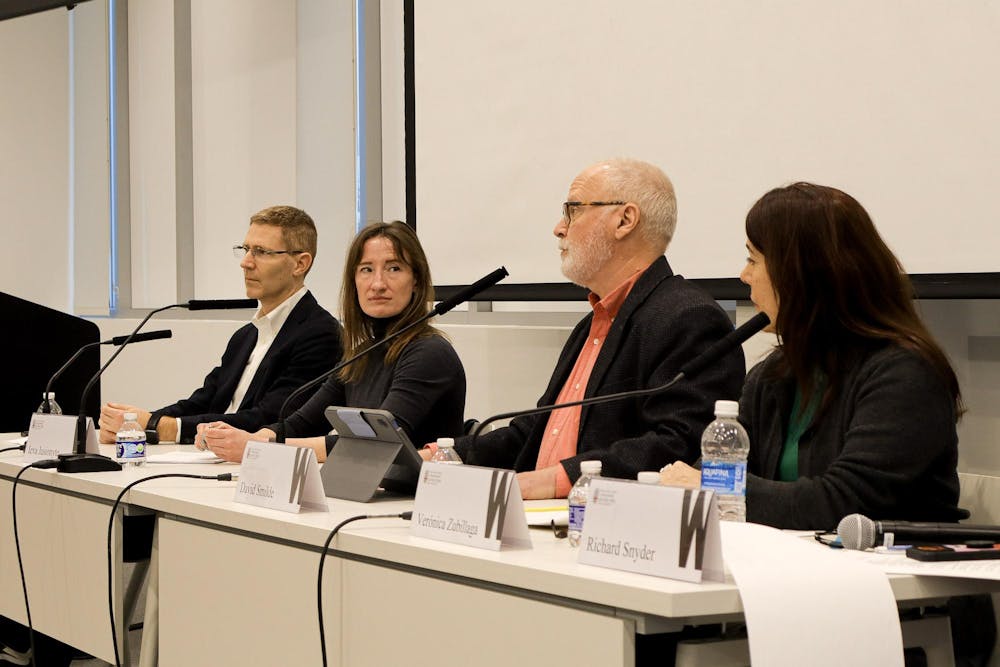
On Thursday evening, just before the United States State Department announced that diplomatic and consular relations with Venezuela were reestablished for the first time since 2019, the Watson School of International and Public Affairs hosted speakers from a range of disciplines for a panel titled “Venezuela after Maduro: What’s Next?”
At the event, panelists discussed the implications — including the driving factors behind the capture of Venezuelan President Nicolás Maduro and the potential future of Venezuelan politics — of the U.S. intervention in Venezuela with a focus on the capture of former Venezuelan President Nicolás Maduro.
On Jan. 3, President Trump announced that the U.S. military had successfully captured Maduro, citing narco-terrorism as a main reason for the operation. Following Maduro’s capture, his former vice president Delcy Rodríguez was appointed interim president by the Constitutional Chamber of Venezuela’s Supreme Court.
At the Watson panel, David Smilde, a professor of human relations and chair of the sociology department at Tulane University, noted that Trump’s support of Rodríguez as Venezuela’s interim leader — as opposed to 2025 Nobel Peace Prize winner María Corina Machado, the leader of the Venezuelan opposition — was more surprising than the intervention itself.
“This was such a surprise for many people close to Machado, that their first thought was that (Trump) had made a mistake in names,” Smilde said.
“He said that she was not respected in the country, which is not actually true,” Smilde added.
Smilde explained that Machado’s popularity rose significantly following a successful campaign in the 2024 election to oust Maduro — though Maduro ultimately remained in power.
Looking to the future of Venezuelan politics, Smilde said he believes the opposition is now “out of the game,” despite their “overwhelming victory” in the recent elections.
“This is now a two-player game between the Trump administration and the Delcy Rodríguez government,” he said.
Jeff Colgan, a professor of political science and international and public affairs and the director of the Climate Solutions Lab, followed Smilde with commentary on the role of oil in motivating the intervention.
Colgan began by emphasizing that “military actions are never about just one thing.” He said that while Trump has repeatedly cited oil as a reason for the intervention, there were likely “other elements within the White House.”
“I think President Trump said the word oil 20 times in the press conference immediately following the action against Maduro, so that's certainly on his mind,” said Colgan, who studies the role of oil in international affairs.
Trump’s direct “grievances” regarding Venezuela’s oil policies, he said, were that “Venezuela had stolen from American oil companies and kicked American oil companies out.” Colgan added that the intervention, according to Trump, was “to open Venezuela back up to American oil companies.”
Colgan noted that out of the seven countries that Trump has engaged with militarily since his inauguration last January, five are “significant oil producing states,” or “petrostates.”
“This is a complicated story here, where we’re having … in Venezuela’s case, a petro-imperialist moment where the United States wants to have some real control over the governance of Venezuela, but in a very indirect, proconsul kind of fashion,” Colgan said.
Ieva Jusionyte, a professor of international security and anthropology and the director of the Center for Human Rights and Humanitarian Studies, walked through the legality of the capture and prosecution of Maduro. Jusionyte is currently researching the procedure of extradition — the legal process of taking a person “from one jurisdiction to another to be prosecuted,” Jusionyte said.
But “Maduro was not extradited,” Jusionyte said, because “the U.S. never requested his extradition.”
“(Maduro) was — well, you can choose your own word here — abducted, kidnapped, captured, extracted,” Jusionyte said. “It is a clear violation of international law.”
But, she noted, the prosecution of Maduro in the United States is within U.S. domestic laws. In particular, the Ker-Frisbie doctrine outlines that “the manner in which the person is taken and brought to U.S. jurisdiction does not matter” when it comes to granting jurisdiction, Jusionyte explained.
“When (the) U.S. wants to get people from other countries, including Maduro, and prosecute them in the United States … the crimes they committed back in the home country — so primarily violent crimes and torture and forced disappearance and others — they are not addressed,” Jusionyte said.
Maduro was indicted in the United States District Court in the Southern District of New York — the same location that Juan Orlando Hernández, former president of Honduras, was indicted in the United States for drug trafficking — for narco-terrorism and weapons charges.
Jusionyte also said the narrative that the intervention was a “law enforcement operation” does not align with federal discussions of an “imminent threat” in Venezuela, and “the drug story doesn’t add up” either.
“The narrative is so jumbled together that this has become this self-referential knot,” Jusionyte said.
Verónica Zubillaga, a Venezuelan sociologist who has studied armed urban violence in Venezuela and Latin America at large and who currently works as a visiting scholar at University of Illinois Chicago, discussed the context behind Maduro’s indictment charges.
Zubillaga put forth that the United States is using potential justifications for the intervention: the U.S. drug crisis and gang violence.
But while the U.S. drug crisis is primarily linked to fentanyl, Zubillaga said, Venezuela does not produce any of fentanyl and rather “historically has been a hub for transit of cocaine.”
The court’s second justification for Maduro’s indictment, she said, was that Maduro was “sending criminals, and notably the Tren de Aragua.” But the Tren de Aragua is a “carceral gang” that, as an organization, operates mostly in Latin America, Zubillaga said.
Zubillaga also touched on current sentiments among Venezuelan citizens, noting that her colleagues on the ground in Venezuela have said, “It’s like everything has changed, and everything is the same.” She added that some were “happy to see Maduro handcuffed,” but others are mourning the Venezuelans killed.
“I would say that for the people on the ground, the regular people on the ground, the idea is, ‘At least we have a little hope that the economic situation would alleviate,’” she said.
Esther Whitfield, a professor of comparative literature and Hispanic studies who attended the event, said after the panel that she was “very pleased to have people with very different areas of expertise.”
“The Venezuela situation is incredibly important for Latin America and the world,” Whitfield added.

Zarina Hamilton is a university news editor covering activism and affinity & identity. She is sophomore from near Baltimore, Maryland and is studying mechanical engineering. In her free time, you can find her reading, journaling, or doing the NYT mini crossword.