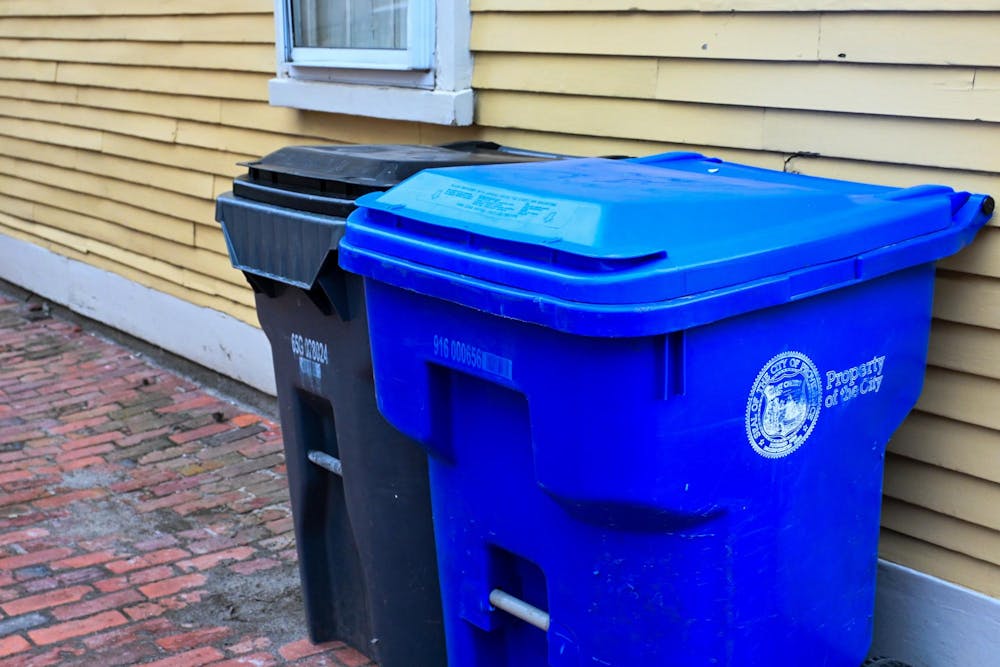
Earlier this month, Providence began distributing new trash and recycling carts as part of the city’s new recycling program, which aims to reach up to 62,500 Providence households by June.
The program is funded by a $7.4 million combined investment from Closed Loop Partners, the American Beverage Association, the Recycling Partnership, the U.S. Environmental Protection Agency’s Solid Waste Infrastructure for Recycling Grant Program and other major brands according to a Closed Loop Partners press release.
Providence has the lowest recycling rate in Rhode Island at 2.4%, according to 2024 Rhode Island Municipal Waste Management Data.
In an email to The Herald, City spokesperson Josh Estrella noted that Providence’s “aging and mismatched carts,” as well as “overflow trash in recycling carts,” caused by the small size of the bins, fuel the low recycling rates.
The new 95-gallon cans are color-coded and will be delivered by June, according to a city press release sent to The Herald.
The project “is a major step forward in a multi-year public-private partnership to address longstanding challenges in Providence’s recycling program,” Executive Director and Co-Head of Closed Loop Catalytic Capital and Private Credit Ray Hugel wrote in an email to The Herald.
The city’s contamination rate — a metric signifying the amount of items that are improperly sorted — sits at over 47%, which costs the city about $2 million every year. The city is charged for processing landfill-bound waste, whereas recycling is free.
“Contamination with non-recyclables can make it impossible to recycle the stuff in a load that would be recyclable otherwise,” Stephen Porder, professor of ecology, evolutionary and organismal biology and environment and society, wrote in an email to The Herald.
Providence’s contamination rate causes over 8,000 tons of recyclable materials to be rejected and sent to landfills annually, according to the Closed Loop press release.
“The dual investment in infrastructure and education through this SWIFR grant will make it easier for Providence residents to recycle more and reduce the amount of waste sent to landfills,” EPA Press Secretary Brigit Hirsch wrote in a statement to The Herald. The SWIFR grant is also helping fund updated recycling stream instructional materials for households and businesses.
Providence’s request for funding was “competitively selected from among 322 communities that submitted requests in 2023,” Hirsch wrote.
Porder wrote that recycling “reduces the need for raw materials,” but he added that “of all the ‘environmental’ things you can do, recycling is one of the least important.”
He pointed to other more effective means of fighting climate change, like reducing food waste, red meat consumption and unnecessary travel.
“Home and business recycling should be seen as a last resort,” Porder wrote. “It is way better to use less packaging … than it is to try to recycle the packaging.”

Kelly Ding is a senior staff writer for the community and culture beat. She is from College Station, TX and plans to concentrate in IAPA on the policy and governance track. In her free time, she loves to explore new coffee shops, curl up with a good book, and be a gym rat.