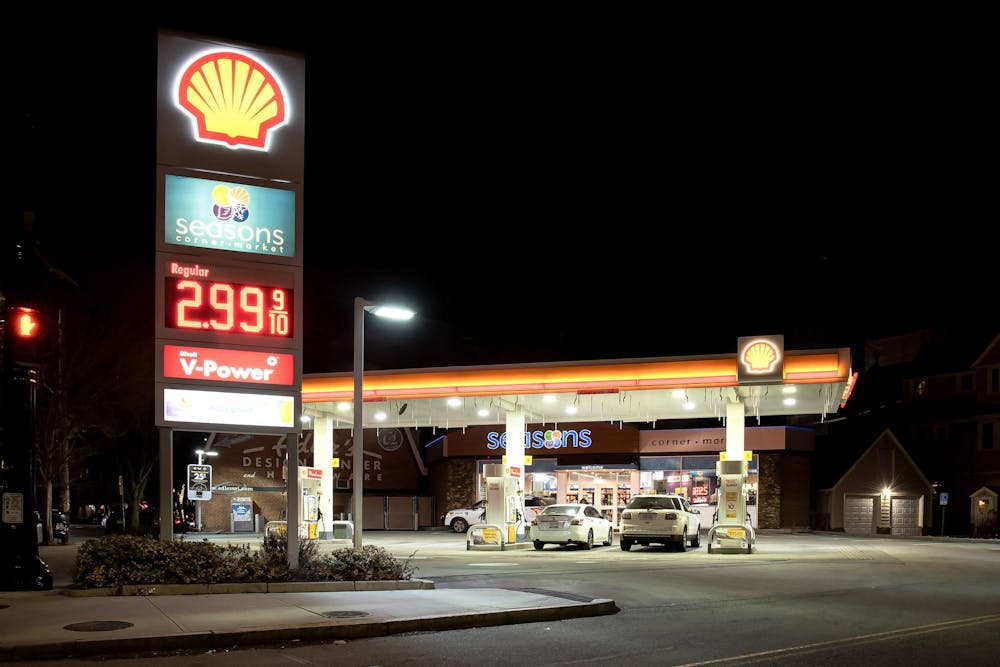
Gas prices in Rhode Island averaged $3.644 per gallon on Thursday, more than a 27% increase from a month ago. The price increases came amid the U.S. and Israeli government’s airstrikes in Iran, which first began on Feb. 28.
The rise in gas prices can, in part, be attributed to Iranian strikes on ships traveling through the Strait of Hormuz, a major channel for international trade. Prior to the war, roughly 20% of the world’s oil passed through the strait.
But Iran has threatened U.S. oil shipments traveling through the passage, meaning that trade might be paused for an indefinite amount of time, said Reid Pauly, a dean’s assistant professor of nuclear security and policy and assistant professor of political science.
The increase in gas prices is not going unnoticed among Ocean State residents and Brown students.
“The extra dollar per gallon at the pump is certainly a motivator to cut out unnecessary driving,” Alexander Korchev ’28 said in an interview with The Herald.
“If prices continue to rise and stay high, I will have to tweak my budget to account for the additional transportation costs,” he added.
U.S. Rep. Seth Magaziner ’06 (D-R.I. 2) called the war “completely unnecessary.”
“Unfortunately, it’s the American people who are paying the price,” he told The Herald, noting that prices are not only harming consumers at the pump but also small businesses that have to pay for shipping costs and heating bills.
The White House did not respond to a request for comment.
Without immediate intervention, economists warn that the war will have significant impacts on the local and global economy.
“The consequences are going to be inflation, for sure. That’s 100%,” Şebnem Kalemli-Özcan, professor of economics, told The Herald.
Without action, Kalemli-Özcan said that consumers can expect to see high levels of stagflation — when inflation is high and the economy contracts — which could lead to increasing levels of long-term unemployment.
The conflict will have an international impact because “countries are connected through the supply chain,” Kalemli-Özcan said. Because the conflict is “in the center of that global system,” it will “be economically costly for everyone.”
The strikes have also increased the cost of oil, with the price of a barrel averaging over $100, according to Business Insider. A month ago, a barrel cost about $70.
“It was very obvious to all international economists … that this war is going to create a lot of economic pain for the United States and other countries,” Kalemli-Özcan said.
The war is “unpopular,” Pauly said. It’s strange “for a president to be engaged in force abroad when a majority at the very beginning already is against it.”
The most immediate solution to reducing high gas costs is to end the war, Kalemli-Özcan said. “The longer it continues, the more sectors are going to be affected,” Kalemli-Özcan added.
Pauly said that the unpopularity of the war may hasten the end of the conflict. “We might see Congress get up and actually act to try and prevent the use of boots on the ground,” Pauly said.
Magaziner said that House Democrats are trying to “force a vote on a bill to end this war,” which he believes would save lives and allow commerce to resume.
He added that the high gas prices should be a sign for Rhode Island to prioritize energy independence and investing in green energy.
“We need to recommit to building out affordable, clean energy that is not impacted by geopolitical disruption,” Magaziner said.