
Content warning: This article includes descriptions of civilians and children being killed during war.
This year’s Oscars saw a number of socially conscious films nominated for awards, including the critically-acclaimed “The Voice of Hind Rajab.” Directed by Tunisian filmmaker Kaouther Ben Hania, the movie captures the heartbreaking final hours of six-year-old Hind Rajab. The film’s stirring performances and tense atmosphere conjure up a grounding truth: Art has a responsibility to depict the experiences of all people, especially those who are too young and vulnerable to speak for themselves.
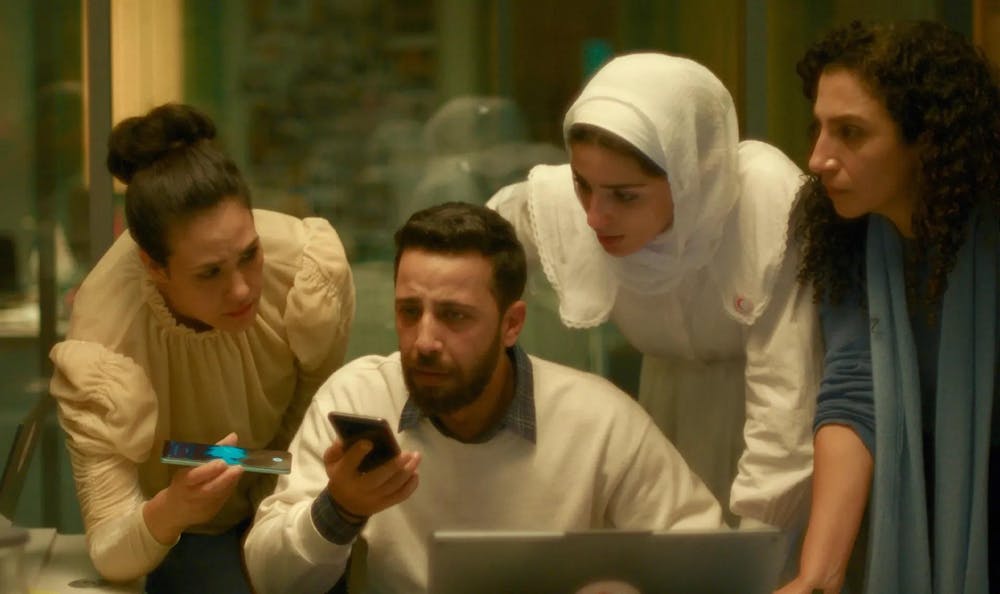
Rajab, a young Palestinian girl, made international headlines after recordings of her pleas to be rescued from a vehicle under Israeli fire — which contained the dead bodies of her six family members — circulated online. The movie takes place almost entirely within the operations center of the Palestine Red Crescent Society in Ramallah, located in the West Bank. When emergency responder Omar (Motaz Malhees) makes contact with a teenage girl attempting to flee the Tel al-Hawa neighborhood in Gaza City with her family, he hears gunfire, marking her death at the hands of the Israeli Defense Forces. Omar assumes this is the end until he is informed by a relative of the girl that a child is still alive in the vehicle. The entire Red Crescent team is mobilized as they attempt to keep the young Hind Rajab calm over the phone while they organize her rescue.
Sound is the motif that carries the quiet power of the film forward. The film’s pervasive sense of dread is translated through the sonic landscape Ben Hania creates: The sounds of weaponry in the backdrop, the mounting terror in Rajab’s voice and the anguished cries of the emergency responders reveal to viewers the isolating nature of warzones. Putting Rajab’s real voice in the film — which viewers are informed of at the outset — has a devastating effect. War reduces the wonderment of children to a single, terrified voice that crackles through a tiny headset.
As a work of docufiction, viewers are not only informed about the devastating chain of events, but are taken along as the circumstances grow grimmer. Malhees brings a visceral performance to the screen as Omar, who is unwavering in his attempts to get an ambulance to Rajab. The rage that Malhees delivers subverts any romanticization of the film’s protagonists. Instead, viewers are given a look into the reality of offering life-saving services during wartime: By highlighting the team’s limited resources and the constant threat of violence, “The Voice of Hind Rajab” pushes viewers to contend with what it means to save lives against a backdrop of indescribable loss.
The characters of “The Voice of Hind Rajab” are deeply complex. Mahdi (Amer Hlehel) is responsible for the complicated process of ensuring an approved, safe route for the paramedics. Mahdi navigates an impossible catch-22 over the course of the film: As his colleagues become more forceful in insisting that he arrange immediate transport to Rajab, bureaucratic barriers make it nearly impossible for him to safeguard the lives of the paramedics. This struggle drives the film’s nerve-racking quality forward, and the tension is pushed further since the setting remains confined to the Red Crescent Society office. Viewers are pinned down by an overwhelming claustrophobia that is never ameliorated, even by the film’s end.
The heartbreak of “The Voice of Hind Rajab” is augmented by the hope that the emergency response workers carry, even as the situation becomes more dire. Ben Hania never allows viewers to relinquish that same hope — the audience is dragged through relief and terror every time the call drops with the young girl and the emergency response team desperately reconnects.
During the film’s most stunning moment, supervisor Rana (Saja Kilani) leads the child in an emotional recitation of Surah al-Fatiha to keep her calm. This moment is not an attempt to proselytize viewers. Instead, the absurdity of a child pleading — to both the state and the universe — for her survival emerges when prayer is insufficient to calm the girl’s terror. “The Voice of Hind Rajab” demonstrates that there is nothing spiritually or politically legible about state violence through the blameless eyes of a child.
Fiction blurs back into reality as the film comes to a close: There is no dramatization to the end of this narrative. The ambulance sent to rescue Hind Rajab never makes it. The film informs viewers that the emergency response team lost contact with Rajab later that evening, and twelve days later, her body was found alongside her six family members in a vehicle peppered with bullet holes. As for the ambulance, “almost nothing remained of the paramedics’ bodies,” according to a Washington Post report — the ambulance was nothing more than “a burned-out shell” approximately 50 meters away from the family’s car.
The straightforward manner in which this information is conveyed underscores the reality of the war in Gaza, in which violence has become a fact of life. As home videos play at the film’s end, however, Ben Hania reminds viewers of their duty not to allow Palestinian war victims to disappear into statistics: little Rajab is shown happily playing at the beach as her love of the sea is recounted to the audience, so at odds with the terror and pain of her final moments.
Despite not taking home the award for best international film, the piece’s expansive reach to mainstream audiences called attention to its message about the urgency of ending violence in Palestine. Its cause was championed by award-winning actor Javier Bardem, who introduced the category. When Bardem said “No to war, and free Palestine,” he was met with resounding applause. The call to action in “The Voice of Hind Rajab” is universally applicable: War deprives children of their right to live in peace and is a wholesale violation of their innocence.

Alyssia Ouhocine is a Senior Staff Writer covering Arts & Culture. Hailing from Bayonne, New Jersey, she is concentrating in English and History with a particular interest in Algerian history and literature. When she’s not writing, she can be found listening to music and sending Google Calendar invites.


