
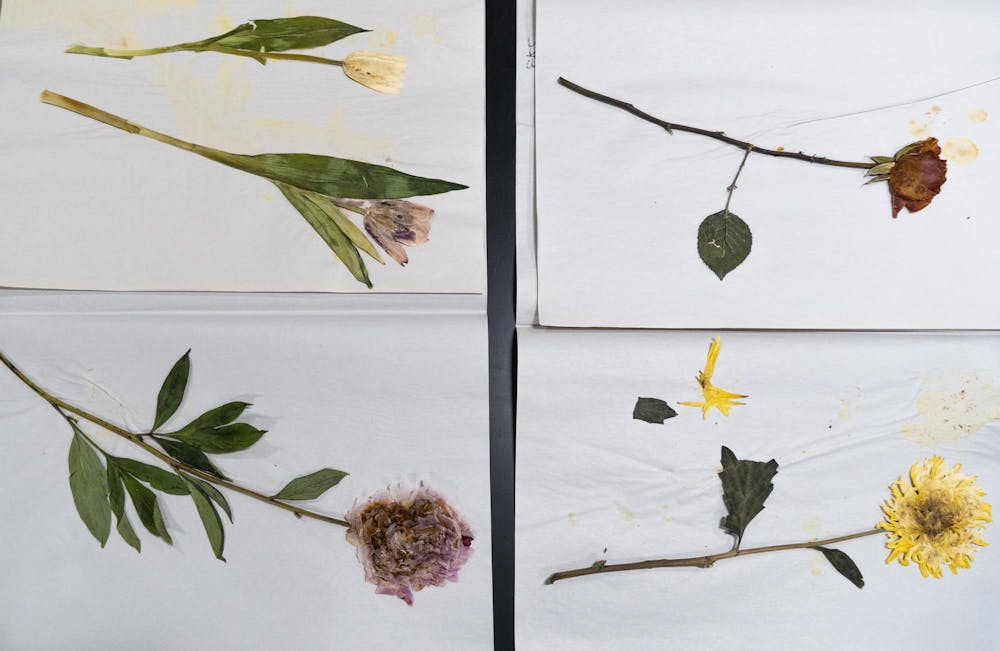
Early in the morning on Dec. 26, Rebecca Kartzinel, director of the Brown University Herbarium, and Matthew Guterl, vice president for diversity and inclusion, walked across campus in below-freezing temperatures with a unique mission.
Parsing through frozen peonies and roses, the pair aimed to collect and preserve flowers left outside of Barus and Holley and in front of the Van Wickle Gates in honor of Ella Cook ’28, Mukhammad Aziz Umurzokov ’29 and the nine additional students injured in the Dec. 13 shooting.
The preservation project is a part of “Brown Ever True,” the University’s campus-wide healing initiative that aims, in part, to provide space for “reflection, memorialization (and) conversation” surrounding Dec. 13, according to Guterl, who leads the Brown Ever True operational team.
Shortly after Dec. 13, a member of the Office of University Communications asked Kartzinel if she could preserve the flowers placed at the memorials. She said the idea was inspired by flowers preserved at Michigan State University after the school experienced a mass shooting in 2023 that left three students dead and five others injured.
“These memorials mean a lot to everybody, and I think we’re all taking care of them in some sense,” Guterl said. “It’s about making sure that we do right by those we’ve lost, and that we do right by each other and that we hold on to this stuff and to these memories for future generations.”
When Kartzinel and Guterl met to select flowers to be preserved, “the flowers looked beautiful because they had been laid recently, but they were also frozen solid,” limiting the flowers that could be picked, Kartzinel said.
Kartzinel emphasized that she was very intentional in her selections, picking flowers from different bouquets to encompass a wide variety of flora while ensuring plants were durable enough for the preservation process.
“I was picking things that I thought wouldn’t have been damaged too much by having been frozen so that the final product would still be reflective of how lovely those flowers were in life,” Kartzinel added.
She then took the flowers back to the herbarium, where she began the preservation process.
Kartzinel began by trimming the flowers so that they could fit on 11-by-7 inch sheets of paper backed by corrugated cardboard. She then layered blotter paper on top to absorb moisture and cinched the stack with straps before pressing it in a wooden press, where the flowers were left to dry.
Because the flowers were recovered when they were frozen, more water leaked out of the press than was typical, she explained. As a result, she had to replace the blotter paper and repress the plants several times.
Kartzinel completed the project independently, starting on the same day that she selected the flowers with Guterl. The flowers were left to dry for several weeks and now remain in the herbarium.
The University is still deciding how to best memorialize the specimens, Kartzinel said.
“If we have a role in whatever happens with them next, we’ll have to think really carefully about who does that work and who wants to do that work,” Kartzinel added.
Although the next steps aren’t finalized, one thing remains clear to Kartzinel: “The place we found ourselves in the one to two weeks after Dec. 13, it’s important to record that,” she said. “There’s a lot of sort of fleeting memories and fleeting things.”
“The memorials are something that were a really important part to that time period, and they still are,” she added. “This is a way to preserve a piece of that.”
Angel Lopez is a senior staff writer covering Science and Research. He’s a first-year student from Tyler, Texas and planning to study neuroscience and literary arts. In his free time, you can find him playing ping pong, listening to music, or reading.


