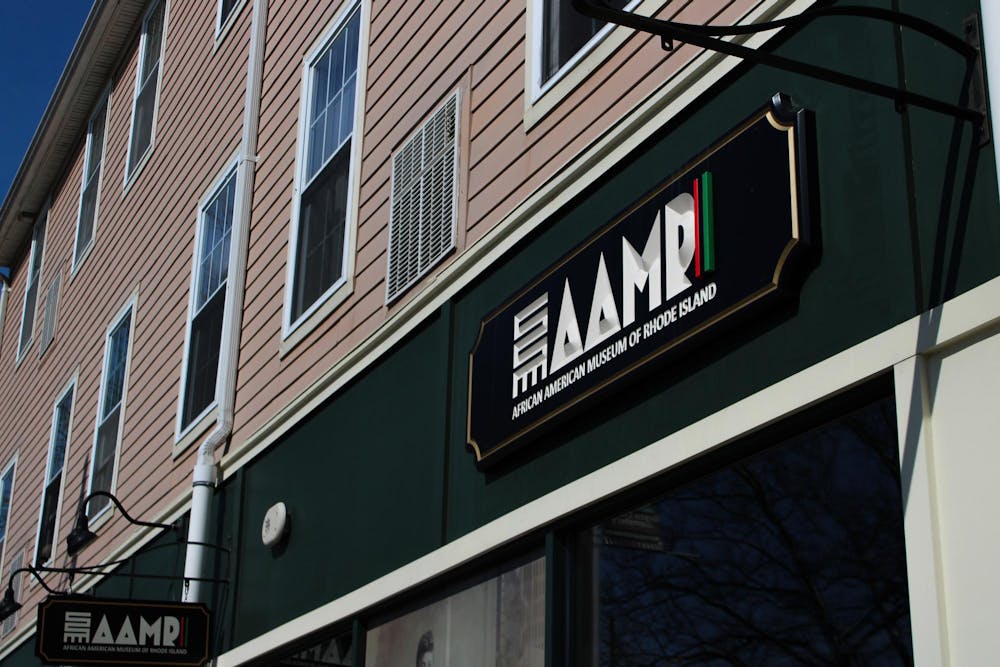
On April 4, the African American Museum of Rhode Island opened, welcoming hundreds of community members. Located at 500 Broad Street, the museum — which is one of the first of its kind in the state — aims to preserve and uplift the stories of African Americans in R.I.
“I knew that I needed this personally, so I knew that my community needed it as well,” said Helen Baskerville-Dukes, a co-founder and member of the museum’s board. “This is a place that says: ‘This belongs to me.’”
The museum had been 18 months in the making before its grand opening, according to Robert L. Bailey V, the museum’s co-founder and vice president of the board. He described the structure of the museum as “a 21st-century kind of concept, building out our exhibit through storytelling,” with a focus on “generational family stories.”
Admission to the museum is free, according to its website. It is open to visitors for varying hours Thursday through Sunday and hosts group visits by appointment on Tuesdays and Wednesdays.
The inaugural exhibition, “Welcome to the Neighborhood,” tracks Black communities in Providence from the 1940s through the 1970s, according to museum curator Melaine Ferdinand-King PhD’25.
In the mid-20th century, there was a push for “urban renewal” in Providence, Ferdinand-King said, which led to the displacement of many locals — disproportionately people of color, immigrants and working-class residents.
The exhibit focuses on the “deliberate and distinct” process of “Negro removal” in Providence, as well as “the ways that Black societies, individuals and organizations tried to keep their networks together in order to continue to combat Black disenfranchisement,” Ferdinand-King explained.
“By starting with a more familiar and contemporary narrative, we were able to invite people into our doors for the first time,” Ferdinand-King said. She stated that the exhibit encourages discussions about how current-day disenfranchisement “is an extension of a longer process” of racism perpetuated against the Black community, citing the “continued removal of Black people from (the) East Side and South Side neighborhoods” in Providence.
While “there have been other black heritage and historic societies in Rhode Island,” AAMRI is “one of the first Black-founded and Black-operated institutions in Rhode Island,” according to Ferdinand-King.
This project was not “dreamt up by people from the outside,” she added. “It was a call by community members” in response to the lack of institutions that “reflected their desires, their dreams,” and the “histories that they wanted at the forefront of Rhode Island community initiatives.”
“The task I have at hand is how to make what feels preserved and historical, contemporary and relevant,” she said.
The outside of the building features photos and artifacts from Bailey’s ancestors — his family has been living in Providence for four generations before him, he said. And “I have grandchildren. So that makes us seven generations of Black providence,” he added. Seeing his family reflected in the museum is “a dream come true.”
Bailey has been a firsthand witness to Providence’s demographic shifts. He was bussed into desegregated Providence Public Schools in the late 1960s, but has since seen the “demise of the Black community.” In particular, he criticized the lack of institutions and community centers tailored specifically to African Americans.
Part of Bailey’s goal at the museum is to provide young people with access to their history and a “sense of identity and belonging.”
Wendy Wallace, secretary of the museum board, added that a large consideration for starting the project was youth workforce development, which she defined as providing students with opportunities to engage with their history and develop professional skills.
The museum’s current youth workforce initiatives aim to help students improve their “workable skills,” including public speaking and research, she added.
Wallace, who is also the director of civic engagement at Brown, explained that the museum aims to consider “the nuances and the intricacies of storytelling” and include different community perspectives.
For Ferdinand-King, a particular highlight is the collection of historical pictures taken by African-American photographer Omar Bradley, who she said is “the central figure in the exhibition.” She added that these photos had never been seen before by the public.
Meanwhile, Baskerville-Dukes pointed to a “memory map” of Providence that invites visitors to interact with the exhibit by placing colored pins in the areas they lived, went to school or worked.
AAMRI is renting its current space from SWAP, a nonprofit organization that focuses on developing affordable housing, but Bailey said the board hopes to one day have a larger space that can house multiple exhibits at a time. Baskerville-Dukes added that an expansion would allow the museum to expand their youth workforce development program.
Ultimately, Wallace hopes that the museum will serve as “a safe space for people to share more about themselves.” She added that her favorite part of opening day was “seeing the joy on people’s faces” as they walked through the museum.
“Everyone’s voice matters,” she said. “There’s a story you should share, and this is a space to do so.”
Correction: A previous version of this article stated that photos of Bailey's family were in the exhibit. They are actually located on the outside of the building. The Herald regrets the error.