
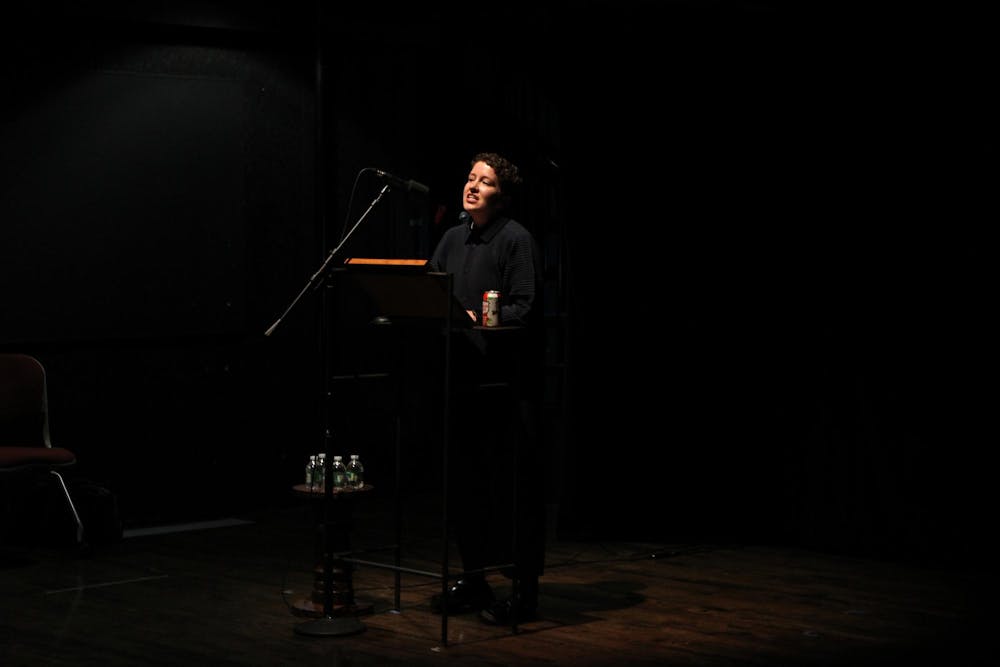
Claire Luchette ’13 writes novels to navigate the questions they can’t answer on their own.
“I don’t think I come up with the questions,” they said at a Thursday lecture at Brown. “I think that I can’t escape the questions.”
Luchette returned to campus for the “Writers on Writing” series, hosted by the Department of Literary Arts. The series is built into two courses at Brown: LITR 1200: “Writers on Writing” and the first-year seminar LITR 0710: “Writers on Writing Seminar.”
During the event, Luchette spoke about their 2021 novel “Agatha of Little Neon” and their upcoming novel “Swans.” Luchette is a Whiting Award winner and was named to the National Book Foundation’s Five under 35 list. Their work has appeared in “Best American Short Stories 2022” and the “The Pushcart Prize Anthology XLIV.”
The evening began with an introduction by Alana Craib GS, an MFA candidate in fiction, who spoke about Luchette’s work and accolades.
Luchette read an excerpt from “Agatha of Little Neon,” which was assigned reading for the “Writers on Writing” seminars. Luchette then gave audience members a preview into their upcoming novel, “Swans,” which follows a transgender teenager escaping a conversion therapy camp.
Luchette said that in their work, they focus on “things that (they) can’t let go of” or that they “fixate on and obsess over.” Luchette also spoke about how their Catholic upbringing informs their writing.
“I’m always trying to write from a place of authority, and determining what sorts of things I can do justice to on the page, and finding the right lens for communicating what I hope to communicate,” they said. “And so I’ve never been a nun, and I’ve never been alive in 1970, but I consider those vehicles for exploring what I want to explore,” they added, referring to the plot of “Agatha of Little Neon.”
In “Agatha of Little Neon,” protagonist Agatha finds purpose in the religious community but questions the decision after being tasked to run a halfway house. For Luchette, writing about Agatha’s journey was a “way of exercising some of that empathy and exploring what would bring someone” to devote their life to the church.
Luchette said their novel began as a set of short stories, but they turned it into a novel for the sake of their writing career.
“I think I had a certain idea that if you wanted to be a serious writer, you had to write a novel,” Luchette said. “Of course, that isn’t true, but it’s also still this bias that gets worked into our conversations.”
Luchette urged students hoping to become writers not to fall victim to this career-centered mentality and to instead focus on “their art, because that’s what’s got to matter more.”
Masha Malinkine ’29, who is currently enrolled in LITR 1200 and attended Luchette’s talk, said she appreciated hearing from an author who graduated from Brown. “You’re talking to someone who is in your shoes in a really direct and intimate way,” Malinkine said, adding that because of the shared experience of going to Brown, Luchette “understands the same culture and knows the same classes.”
Malinkine called Luchette’s book “such a fly-through” read, adding that it was “easy to sit down with and to digest and to appreciate.”
After the talk, Craib said that one of their biggest takeaways came from hearing about Luchette’s writing process and understanding “how to create empathy out of their language, without reducing somebody down to just the trope of what a reader may assume that they are.”
Jeremiah Farr is a senior staff writer covering university hall and higher education.


