
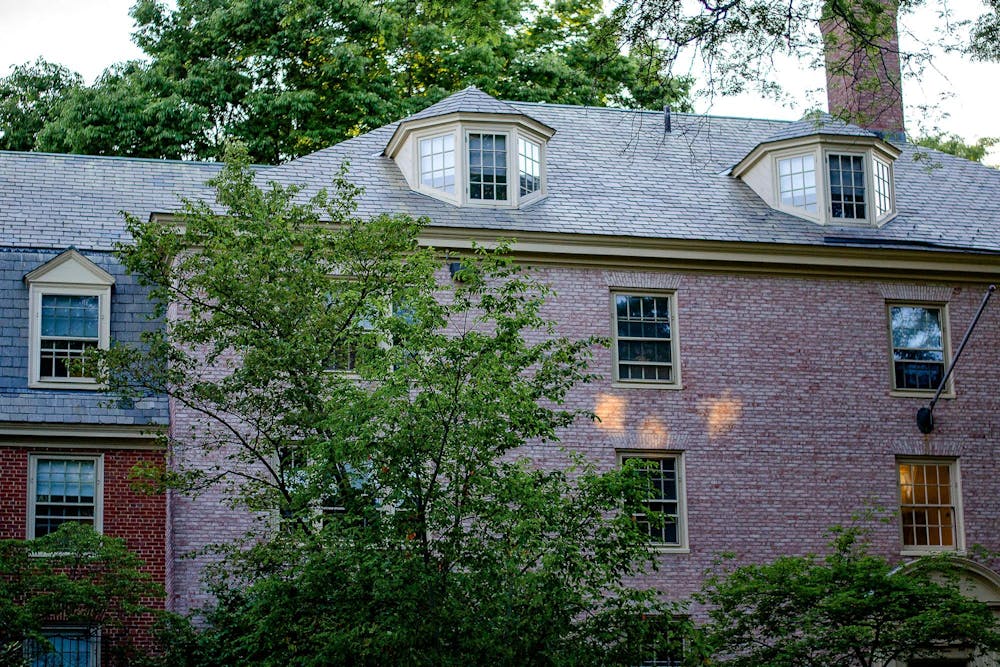
Last week was particularly stressful for many Brown undergraduates, and it didn’t even have anything to do with midterms. For rising sophomores and juniors, the stakes are high in Brown’s randomized, everyone-for-themselves housing selection. There seems to be a scarcity of desirable living situations, as hopes for singles, suites or newer dorms are left to the luck of the draw.
Aside from the assorted program and theme houses, Brown's residence feels largely like random, identity-less buildings. It doesn’t have to be this way. Other liberal arts colleges and Ivy League universities offer robust residential housing systems that create tight-knit bonds across students’ four years. To strengthen the undergraduate experience, Brown should adopt its own version of a residential college system that provides a continuous living-learning experience for undergrads.
Past editorials have noted the lack of clarity in the housing lottery process. The Office of Residential Life provides floor plans with no square footage metrics, and the service only provides two hours worth of information sessions per semester. Students had to create their own tools to decipher the university’s housing options. With a limited number of suites, one late timing slot can leave part of the community stranded across campus. While first-year students’ excitement for starting college and eagerness to meet their peers might help foster a community within our “neighborhoods,” sophomores and juniors don’t have incentives to build a dorm community before living off campus in their senior year.
A residential college system could replace the lottery system, providing students with a consistent, built-in community for the length of their undergraduate experiences. At Yale, for instance, all incoming students are sorted into one of fourteen distinct residential colleges. While most don’t move into their residential college until sophomore year, they live with a cohort of other first-year students in the same residential college and engage in its general activities. Unlike Brown, where first-years are corralled together but then separated in subsequent years, Yale’s residential colleges build a distinct community within the university for the whole of the undergraduate experience.
The structure of residential colleges at Yale makes it easier to build community. They are managed by deans specific to that college who plan events and facilitate students’ experience. They have shared dining halls, common areas and facilities — which increase students’ interactions with each other in everyday spaces — and they have traditions unique to each college that help build a tight-knit community. By combining housing with dining, advising and house-specific programming, these residential colleges create a more connected community within the larger school.
Harvard operates its housing similarly, with first-year students choosing a group of eight students and getting randomly assigned to one of the 12 residential houses on Housing Day. These houses have specific traditions, and the connections continue beyond the time spent living there. For example, in the Housing Day Challenge, Harvard alums donate directly to their undergraduate houses in a competition to raise the most funds to support undergraduate living. Brown is clearly missing an opportunity to increase school spirit and alums’ engagement.
Such a system at Brown would not only help build community and relieve some housing lottery stress — it would also help students build bonds across years. Since first-year students are housed completely separately from other students, incoming students are only encouraged to bond with other first-year students, making it harder to form friendships with more experienced seniors and juniors. While the Meiklejohn Peer Advising Program lets students receive academic advice from non-first-year students, living in a residential college could provide first-years the opportunity to mingle with and build friendships with older students who can provide wisdom beyond the academic part of going to Brown. Integrating first-year students with their more-senior peers through the residential system is a powerful way to increase support for students’ academic success. For example, in Yale’s dorms, first-year counselors are seniors whose role is specifically to advise underclassmen on their academic and social journeys, serving as critical support during younger students’ stressful transitions.
A residential college system at Brown could also allow the creation of student residence boards, or student leadership groups elected to plan events year after year, instead of the current Community Coordinator, or CC, position in ResLife. CCs are randomly assigned to a new dorm each year, leading to a lack of connection to one particular dorm community. In this residential college system, CCs could work in tandem with such student residence boards to create programming and events that grow dorm-specific community.
While there are some themed housing options available for students, such as Greek life and other identity-based spaces, they are only open to a limited number of students who must independently seek them out. Moreover, most designated residential program communities are based on distinct cultural identities. Additionally, these identity-based spaces, which serve an important role for their members, will now be subjected to a new policy that requires the randomized selection of members. Plus, these themed houses don’t provide a coherent experience for their students, as many dorms are split between multiple groups — for example, certain groups control certain lounge spaces, preventing non-members from using them.
This plan may seem ambitious, but it is not unrealistic — in the last six years, Duke overhauled its undergraduate housing experience by creating a system that matched first-year students living on one end of their campus to a permanent quad that they live in for their remaining time living on campus. If we want to strengthen the undergraduate experience at Brown and improve students’ social connections — especially as more and more young adults report having no close friends — a natural place to start is Brown’s housing system. The University has the potential to transform residence halls from simply roofs over students’ heads to meaningful social environments.
Clara Murray ’29 can be reached at clara_murray@brown.edu and Max Mooney ’29 can be reached at max_mooney@brown.edu. Please send responses to this op-ed to letters@browndailyherald.com and other opinions to opinions@browndailyherald.com.


