
Walking into the List Art Building, visitors are bathed in fuchsia light shining through the doors and windows onto a series of steel panels. Affixed to the panels are pen and ink illustrations made by the late grandfather of artist Ruanne Abou-Rahme.
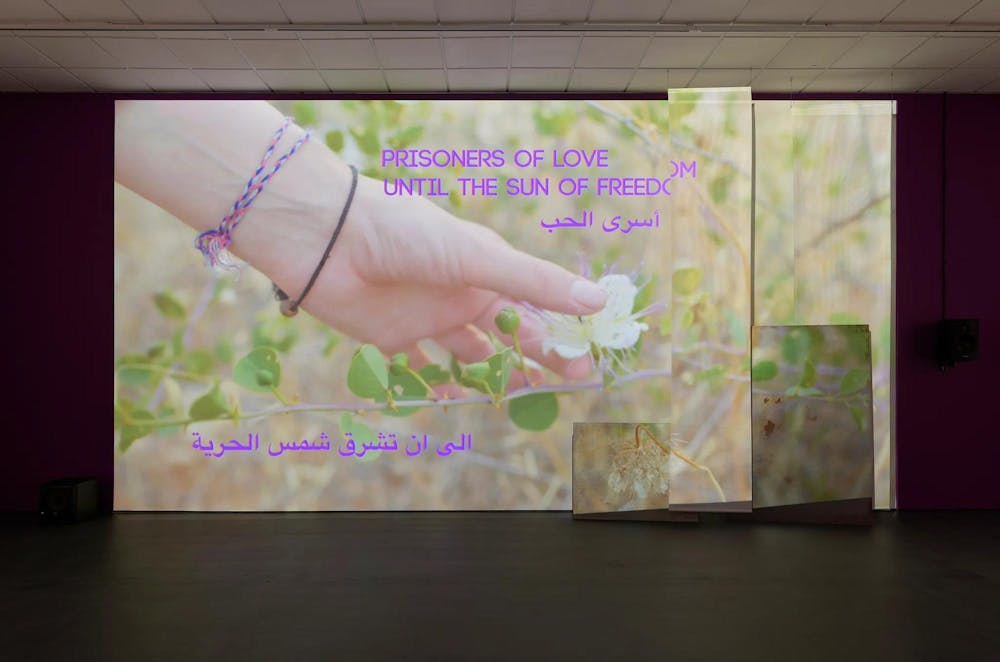
The glowing entryway is a part of artists Basel Abbas and Abou-Rahme’s exhibition entitled “Prisoners of Love: Until the Sun of Freedom,” now on display in the List’s Bell Gallery. The display centers the narratives of former political prisoners in Palestine, juxtaposing their struggles with those of Black political prisoners in the United States.
The exhibition was commissioned by the Brown Arts Institute in collaboration with Nottingham Contemporary, Kunstinstituut Melly and Museu d’Art Contemporani de Barcelona and was curated by former BAI curators Kate Kraczon and Thea Quiray Tagle.
Two major components comprise the exhibit: an immersive video and sound installation that features interviews with former Palestinian political prisoners — filmed in Palestine — and the lobby’s steel panels.
The particular shade of pink bathing the room comes from a distinct type of thorn that grows in Palestine “specifically where there’s been a disturbance in the soil,” Abou-Rahme explained during a February panel about the event.
“We first encountered these thistles when we were going to the sites of destroyed villages, and we entered one site: the thorns were like longer than us,” she added. “We became really interested in the thistles and thorns, because they’re also seen as something that’s unwanted, but also traditionally, they have a lot of medicinal use in Palestine.”
When the thistles decay, they bring nutrients back to the soil, Abou-Rahme added. This process restores “plants that might have been temporarily eradicated from the violence that happened.”
“It’s another site of thinking with land, thinking with the more-than-human about ways of surviving this apocalyptic reality they want us to endure,” Abou-Rahme said. “And creating life. We have to create life.”
The initial idea for the project came from the misattribution of a poem entitled “Enemy of the Sun” that was found in Black Power activist George Jackson’s cell at the San Quentin prison after he was killed by guards. While it was assumed and widely reported in Black Panther newspapers that Jackson was the poem’s author, Howard University professor Greg Thomas recently discovered that it was actually written by Palestinian poet Sameeh Al-Qassem and published in an anthology a year prior to Jackson’s death.
“So much of our practice is about also refusing a kind of ghettoization of Palestine, or this producing Palestine as a singularity, and really re-situating Palestine as almost the tip of the spear” of anti-colonialism and anti-capitalism, Abou-Rahme said during the panel. For Abou-Rahme and Abbas, the misattribution of the poem “was like one seed” from which the rest of the work sprouted.
The title of the exhibition refers both to the poem and “how love songs were transformed into songs of resistance,” Abou-Rahme added. Kraczon said the exhibition documents “a love that is constructed in hell, but also a love that is fueling liberation.”
The fact that the idea for the display began with text is reflective of the duo’s broader work, Abbas said. “Most important projects start with text, and we actually work a lot of the time to compose sound to the text before we film, so that the sound has its own sort of presence,” he explained. From there, the artists researched, interviewed and improvised.
For K Lin GS, a Ph.D. student who took a class in spring 2025 that was co-taught by Abbas, Abou-Rahme, Kraczon and Tagle, their work is particularly salient “amidst Israel’s ongoing genocide in Gaza,” they wrote in an email to The Herald.
“Basel Abbas and Ruanne Abou-Rahme’s works are incredibly crucial — not only because they intervene into existing state archives, but because they are assembling new counter-archives that serve as forms of witness and memory-making in the present,” Lin added.

Talia LeVine is a section editor covering arts and culture. They study Political Science and Visual Art with a focus on photography. In their free time, they can be found drinking copious amounts of coffee.


