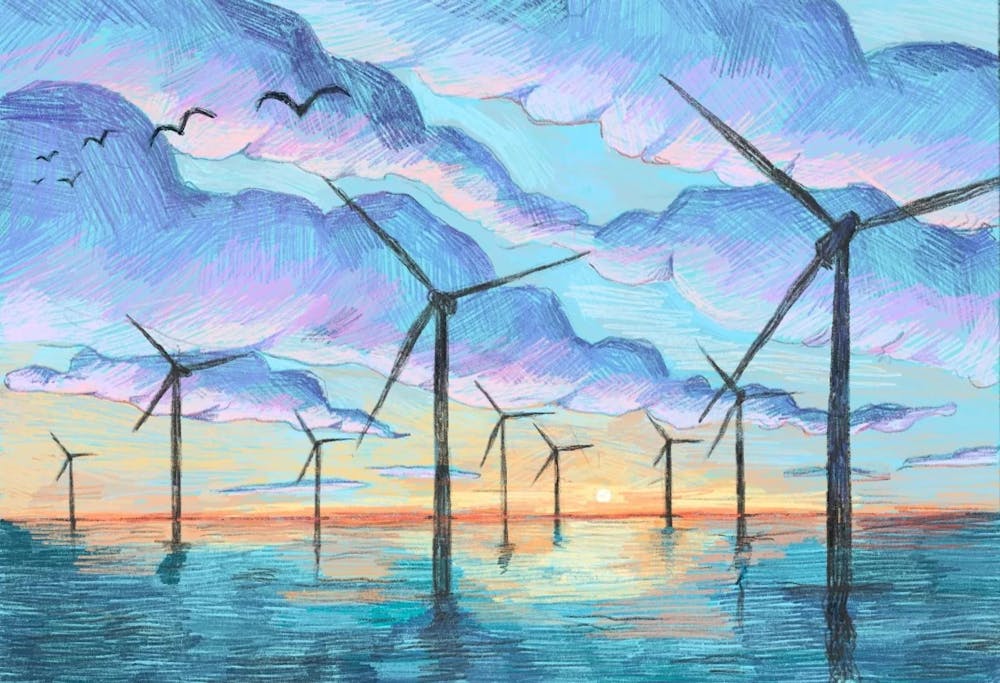
After about three years of construction — and nearly two months of delays due to pushback from the Trump administration —Revolution Wind began delivering electricity to the New England grid on March 13.
The new energy source from the 704-megawatt offshore wind farm, located about 15 miles off the Rhode Island coast, comes amid rising oil and gas costs tied to the ongoing war in Iran.
Rhode Island Energy has agreed to buy power from Revolution Wind at 9.8 cents per kilowatt-hour, a significantly lower price than what Rhode Islanders paid for in March. The project is currently 90% complete, according to Ørsted, one of the groups involved in developing the wind farm.
The Trump administration previously ordered Revolution Wind to stop construction twice, with the first order given in August 2025 and the second in December 2025. On both occasions, a federal judge allowed construction to continue.
“Revolution Wind is great news for Rhode Island,” said Professor of Political Science and International and Public Affairs Jeff Colgan, who is also the director of the Climate Solutions Lab. “It’s good news for the environment … it’s good news for lower electricity prices for Rhode Islanders, and it’s good news for energy security.”
Once fully operational, the project’s 65 turbines are expected to power more than 350,000 homes and businesses. The farm could save New England ratepayers as much as $500 million a year in energy costs, according to an Ørsted press release.
“Rhode Islanders are struggling with high utility costs, and we need to do everything we can to bring relief,” Representative Seth Magaziner ’06 (D-R.I. 2) wrote in an email to The Herald. “The delivery of affordable, reliable power from Revolution Wind to the grid is a major step towards this goal.”
“We should be incentivizing local energy projects like this that lower costs at home, not spending billions on Iran or tax cuts to billionaires,” he continued.
The White House did not immediately respond to The Herald’s request for comment.
Colgan also noted how the price of wind energy is not exposed to geopolitical shocks in the way that energy from fossil fuels is. “If Asian (natural gas) prices are very high, then North American producers are going to try to sell their cargoes to Asia and institute higher prices, and that means that our prices are going to go up as well,” he explained.
“New England relies on a mix of pipeline natural gas and imported (liquefied natural gas), and when LNG becomes scarce or more expensive globally, wholesale prices here can rise accordingly,” R.I. Energy spokesperson Michael Dalo wrote in an email to The Herald.
Brad Marston, professor of physics, noted that states on the New England coast are suited for the offshore wind industry. Though offshore wind takes advantage of stronger winds off the coast, building turbines at sea is more expensive than placing them on land.
“There’s a kind of trade-off there,” Marston said. “On the East Coast, we’re fortunate that the sea doesn’t get very deep quickly as you go offshore, so you can mount the wind turbines onto the seafloor.”
Complemented by rising battery storage, wind power and solar energy can be the “most cost effective ways of producing electricity, beating fossil fuels,” Marston said.
For Colgan, the current energy crisis serves as a reminder that energy is a national security issue. “This … should be a reminder to us of the national security advantages of solar and wind energy,” he said. “The price of sun and the price of wind are not geopolitically affected.