
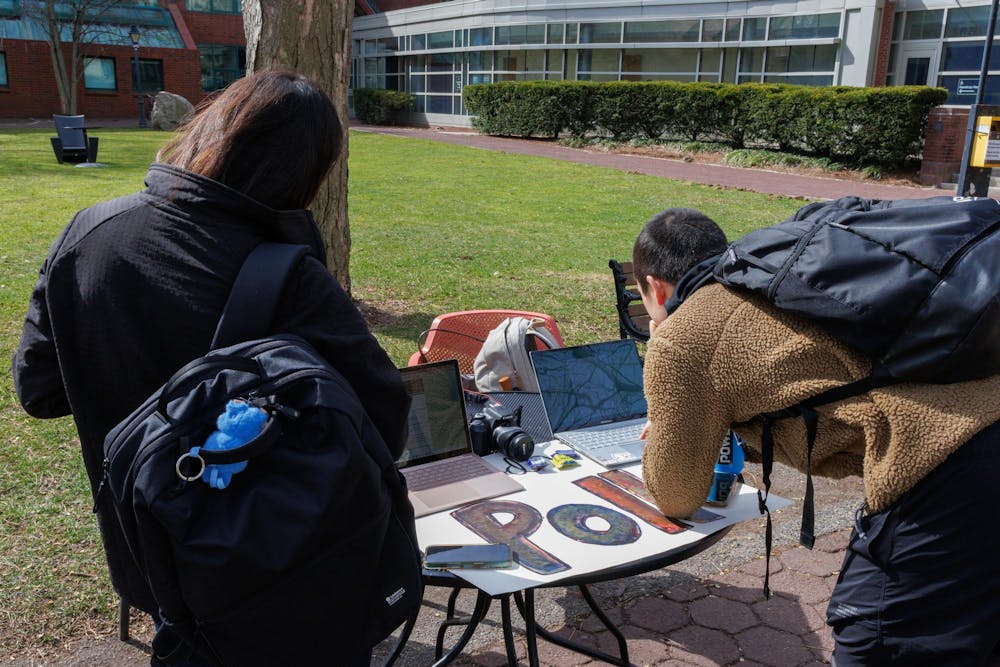
Each semester, The Herald surveys over 1,000 members of the undergraduate student body. The Herald’s Spring 2026 Poll, conducted between March 17 and March 19, comes amid ongoing questions about safety after Dec. 13, federal investigations into Brown and debate about the University’s campus climate.
The Herald polled 1,275 undergraduate students on topics ranging from academics to campus security.
Here are five key takeaways from The Herald’s Spring 2026 Poll.
Access and explore all the data on The Herald’s interactive dashboard.
After Dec. 13, marginally more students report feeling unsafe on campus compared to before
The Herald polled students on perceptions of campus safety pre-Dec. 13, and surveyed on five metrics for perceptions of campus safety post-Dec. 13. Only 6% of respondents reported feeling very or somewhat unsafe before Dec. 13. On every single post-Dec. 13 safety metric, at least 8% of respondents reported feeling very or somewhat unsafe.
Of the five metrics for perceptions of campus safety after Dec. 13, students reported feeling the least safe walking around campus and the most safe in on-campus residence halls.
In the weeks following the incident, Brown began to enforce ID swipe access to enter all campus buildings, increased the security presence on campus and installed more panic buttons and security cameras, The Herald previously reported. A majority of respondents reported that they felt very or somewhat safe around campus police and security.
Nearly 90% of students reported that they felt somewhat or very safe on campus prior to Dec. 13. Still, The Herald’s poll demonstrated that a vast majority of students felt safe on campus before and after the shooting.
Paxson’s approval ratings increases 4% from fall 2025
Since last semester, the approval rating for President Christina Paxson P’19 P’MD’20 has increased by 4%, with only 5.5% of respondents now strongly disapproving of her presidency. At Paxson’s peak disapproval in spring 2024, about 30% of respondents reported that they strongly disapproved of the president.
In the past few months, Paxson has led the Brown community through the aftermath of the Dec. 13 shooting. Under her leadership, security has been enhanced and the “Ever True” campus-wide recovery initiative has been launched.
The Herald found that Jewish and male students were the most likely to approve of Paxson. The Herald’s Fall 2025 Poll found overlapping results, specifically highlighting that white, male and underclass students were the most likely to approve of the president.
First years, seniors more likely to take classes S/NC
First-year students and seniors are most likely to be taking classes using the Satisfactory/No Credit grading system. Approximately one in four seniors were taking two or more of their classes S/NC, compared to about one in ten sophomores.
Roughly 65% of athletes who responded to the poll reported taking at least one class S/NC during the current semester, whereas a majority of non-athlete respondents said they are taking zero courses S/NC this semester.
Some students opt to take classes S/NC out of fear they won’t earn As. Others weigh whether to take courses S/NC based on its potential impact on honor society eligibility and graduate school admissions. Mandatory S/NC requirements have also deterred students from courses, but others say the system helps students shift away from a grade-focused mentality.
Male, conservative students have more widespread support for AI use in academics
Overall, a majority of students support the use of artificial intelligence in assisting with research and homework. But, just one in four students believe students should be allowed to use AI in completing problem sets — and even fewer think AI should be used in writing assignments or taking exams.
Conservative students were more likely to support AI use across every category of academic work considered by The Herald than their very liberal or progressive counterparts. Just 2.8% of somewhat or very conservative students reported that they believe AI should be used in no academic work, compared to 16.1% of very liberal or progressive students.
Male students were also more likely to believe students should be allowed to use AI in academic work than female students or those who identified as neither male nor female.
With the naming of Brown’s inaugural AI provost in December 2024, the University has been putting increased energy toward AI initiatives. AI use in the classroom has been an ongoing debate among professors, leading to a wide variety of policies within and across departments.
Students receiving full financial aid least likely to come from households with married parents
Over 82% of students arrived at Brown from households with parents that are married or together. About 8% of students come from split households with divorced or separated parents, and an additional 7% hail from single parent homes.
According to U.S. Census data, about one in three American children experience parental divorce before they enter adulthood. About 25% of U.S. children live in single parent households, according to data from the Pew Research Center.
About 85% of non-first-generation students have parents who are married or together, compared to 63% of students who identify as first generation. Students on full financial aid were less likely to have parents who were married or together than those receiving partial scholarships or no aid.
Editors’ Note: The Herald’s semesterly poll was conducted between March 17 and March 19, 2026. All responses were analyzed and weighted by class year using R Version 4.4.3. Polls were conducted at three locations around campus: Wriston Quadrangle, Sciences Quadrangle and outside the Stephen Robert ’62 Campus Center. The poll was analyzed by Ava Stryker-Robbins, Sajiv Mehta, Alice Xie, Caleb Ellenberg, Lucy Sun, Kenna Lee, Jin Cho, Laila Posner, Jasper Perlis, Rahul Sameer and James Libresco. It received 1,275 usable responses.

Ava Stryker-Robbins is a sophomore and a Metro editor at The Herald.

Alice Xie is a section editor for Science and Research from Los Angeles, California. She studies Applied Mathematics and Biology, and enjoys reading gut wrenching literature in her free time.
Sajiv Mehta is a sports editor. He is from Scarsdale, New York and plans on concentrating in English and American Studies. In his free time, he can be found reading an encyclopedic novel or watching the Yankees.


