
Content Warning: This article includes mentions of school shootings.
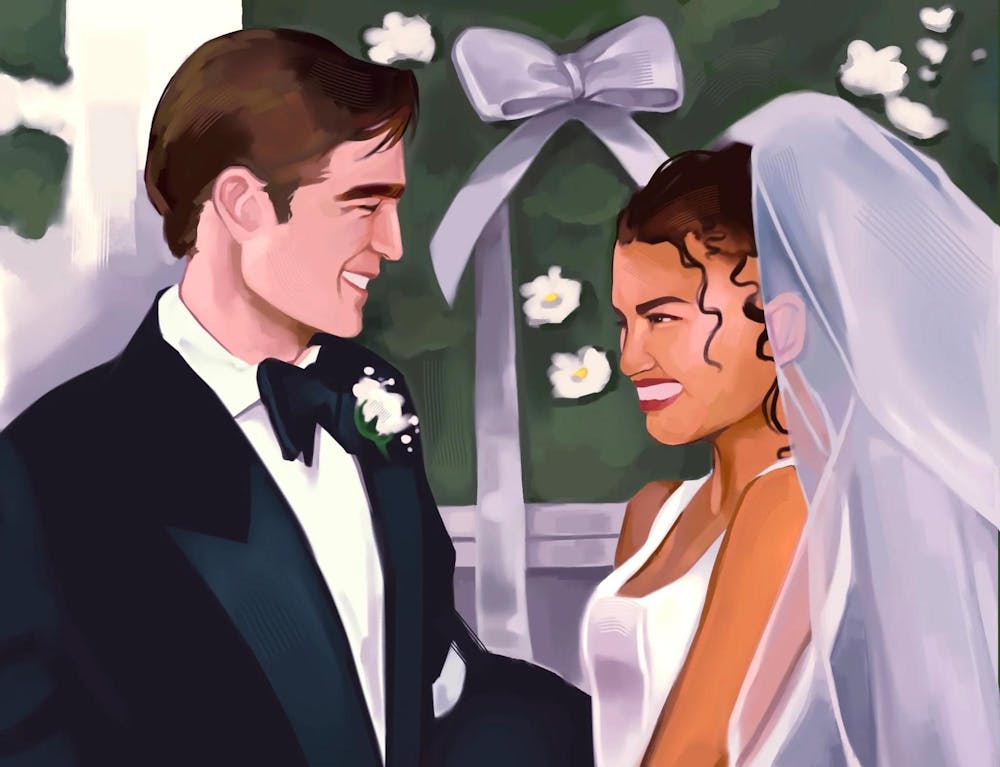
Movie-goers have flocked to theaters worldwide to watch Emmy- and Golden Globe-winning actress Zendaya walk down the aisle toward “Twilight” star Robert Pattinson. Kristoffer Borgli’s latest blockbuster, “The Drama,” stars two of Hollywood’s most charismatic actors as they navigate the tumultuous lead-up to a wedding — one that ultimately ends in a bloody tuxedo, a soggy corsage and a black eye.
Although full of enticing tension, “The Drama” is stuck in a tonal paradox — while the film wants to be a romantic comedy about “cancel culture,” it winds up reducing trauma to a plot device.
The movie opens with Charlie Thompson (Robert Pattinson) approaching Emma Harwood (Zendaya) in a cafe and asking her out on a date. Just two years later, the two are drafting their wedding vows.
Days before the wedding, Emma’s friend Rachel (Alana Haim) asks the pair to share the worst things they’ve ever done. Between sips of wine, Emma reluctantly confesses that she plotted a school shooting when she was fifteen. Charlie is appalled, and the rest of the film follows him as he frantically reevaluates his relationship with his newly unfamiliar fiancee.
Though the subject of gun violence drives the film’s central conflict, Borgli is disinterested in politics. Rather than offering a commentary on modern-day issues, “The Drama” uses the topic of school shootings merely as a prop for moral discourse, asking viewers what would it take for them to leave the love of their life.
The movie is as intentionally inflammatory as its title suggests. While the plot certainly succeeds in being divisive, the story inevitably undermines the gravity of gun violence as a result of its romantic-comedy writing. Using gunshots merely as jump scares, “The Drama” reduces school shootings to a punchline and an accessory.
Flashbacks to Emma’s childhood embody the movie’s tonal disarray. While Emma cites poor mental health as her motivation for planning the shooting, the film repeatedly shows the character aestheticizing firearms and romanticizing digital “incel” culture. The film, too, seems to revel in the aesthetics of subverting the white male shooter archetype, in one shot showing Zendaya sitting on a bed, dressed in lingerie, stroking a rifle.
While the film addresses Emma’s positionality as a woman — briefly eroticizing her dark past — the storyline fails to address the racial implications of casting the character as a Black woman.
The final act is a hard watch — the wedding is a socialite’s nightmare. Overwhelming audience members with second-hand embarrassment, the interpersonal conflicts between the characters ultimately culminate in a physical altercation. The last 20 minutes of the film are an anxiety-inducing blur, and the film’s ending is ambiguous, as though Borgli recognizes the film’s question may have no clear answer.
It comes as no surprise that the movie is receiving backlash, with many critics calling the film tone-deaf and insensitive. Ultimately, viewers’ enjoyment of the movie relies on their personal boundaries and whether they believe the film’s fundamental questions about human nature justify its premise.
Nevertheless, the film’s notions of redemption, accountability and intimacy are sure to spark conversation about whether or not true love is characterized by unconditional acceptance. Even though this exploration of relationships is thought-provoking, the analysis of the film’s essential question cannot be divorced from the sensationalism central to crafting its narrative.
Kendra Eastep is also a senior staff writer covering arts and culture.


