
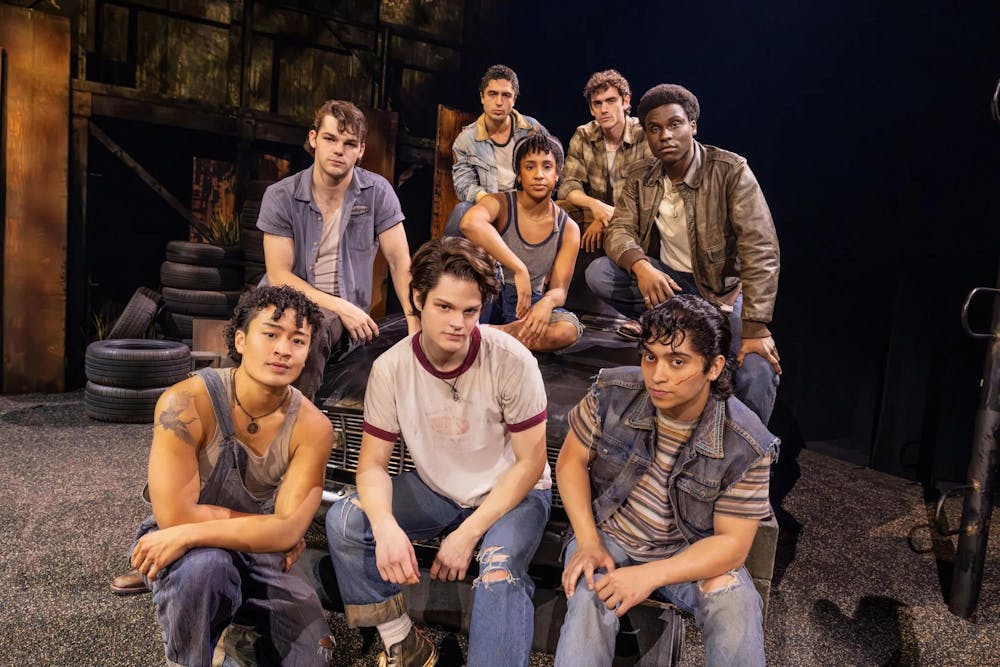
On Tuesday, Ponyboy Curtis (Nolan White) took center stage at the Providence Performing Arts Center before reading the opening lines of S.E. Hinton’s 1967 novel, “The Outsiders.” Over the show’s two-and-a-half hour runtime, the cast and crew of the Tony Award-winning musical showed innovation in bringing the text to the stage.
The show, which is part of the Taco and the White Family Foundation Broadway Series, will have its last showing at PPAC on April 19.
The show generally adheres to its source. Set in Tulsa, Oklahoma, the story focuses on Ponyboy and his found family of “Greasers” — a group of working-class teenagers and young adults who live on the city’s east side. The Greasers are the story’s beating heart, and with impactful performances all around, this production’s cast rose to the occasion.
In addition to White’s captivating depiction of Ponyboy, Travis Roy Rogers also gave an especially emotional performance as Darrel, Ponyboy’s older brother and guardian. Bonale Fambrini also stood out as Ponyboy’s best friend Johnny Cade, as did Tyler Jordan Wesley as Dallas Winston and Jackson Reagin as Ponyboy’s comedic other brother, Sodapop.
Although it is common for plays to reuse set elements in different contexts of the show, “The Outsiders” did so in a way that was both novel and tongue-in-cheek. A beat-up car, for instance, was used for three different purposes: as a platform for the Greasers, a bed for the Curtis brothers and as a concessions stand. Not only was it creative, it feels just as scrappy as the lives the Greasers live.
Beyond the props, the stage’s floor was covered in sand that was kicked up when characters danced or fought, infusing the production with kineticism and energy. Just as impactful was the show’s use of light: Multiple scenes used bright lights to simulate Ponyboy slipping in and out of consciousness, while others used darker lighting to obscure the characters behind the punches.
All of this helped bring the show to gripping emotional highs, especially in standout tracks like “Great Expectations” and “Stay Gold.”
Not everything in the show is loyal to its source material. Dallas receives an expanded role and a different ending, for instance. Additionally, while it is suggested he is white in the novel and is played by a white actor in the story’s 1983 film adaptation, the musical’s Dallas is portrayed by a Black actor.
While this diverse casting reflects Tulsa’s real history of segregation and racial violence, the show fails to totally acknowledge the implications of casting Dallas as a Black man. Some of the changes to Dallas’s character touch upon themes of racial discrimination — for example, he accuses Darrel of disliking him because of his appearance, saying “I don’t look like you.” But this and future attempts do little more than scratch the surface of an issue that warrants deeper consideration.
Still, Wesley’s performance as the character was evocative and impactful, especially during his final song, “Little Brother.”
Many of the issues with the show’s plotline — how the few female characters hold little relevance outside their relations with male counterparts, for instance — boil down to issues in the original novel. In many areas, the musical drew on threads from the original text in a way that elucidated new meaning. But that treatment felt sorely missing elsewhere in the adaptation.
Overall, the show was both enjoyable and moving — but the strength of its highs made its lows even more disappointing.


