
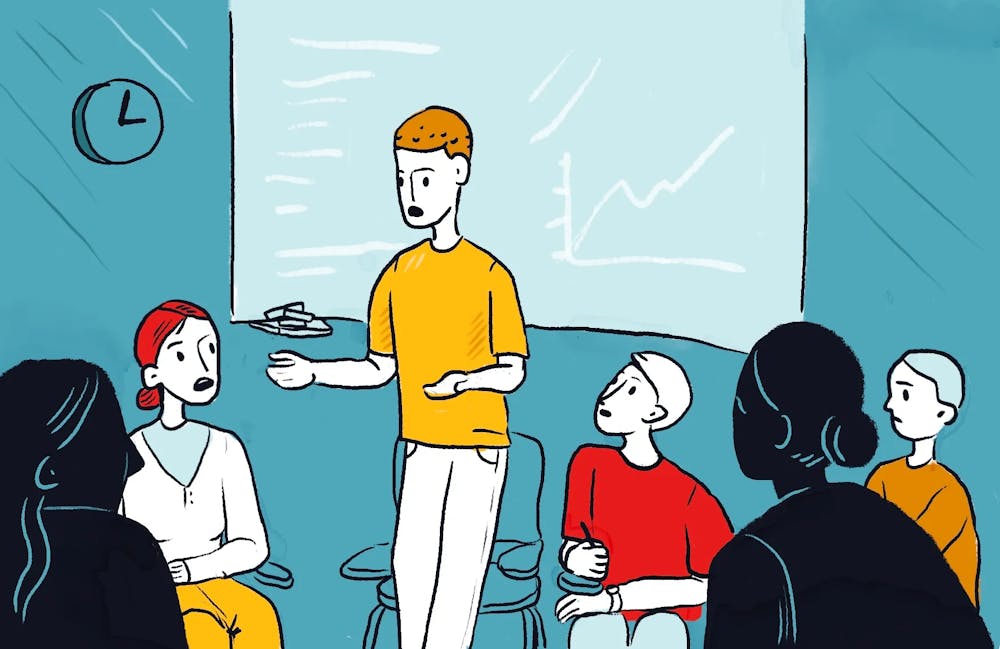
When I ask questions in my MATH 1530: “Abstract Algebra” lecture, I tend to buffer them with filler words: “like,” “wait,” “sorry.” While my friend and I raise our hands before speaking, some of our classmates are more direct with their remarks, pointing at the board when they think a plus sign should be a minus or calling out a counterexample they just thought of. They aren’t doing anything wrong — but the difference in our communication styles sometimes strikes me as comical. While lectures give a rigorous math foundation, upper-level classes lack built-in opportunities for students to engage directly with one another and develop their communication skills. The solution is clear: The Department of Mathematics should develop seminar-style courses which make more space for collaboration to improve students’ communication.
Popular culture often portrays mathematicians as solitary. For example, the protagonists of “Good Will Hunting” and “A Beautiful Mind” are both isolated geniuses. But in the real world, in order to win grants and persuade collaborators, you have to be able to explain your work. At one academic conference, researchers at Cornell were so lost during each other’s presentations that mathematician Kathryn Mann organized a four-day “Communicating Mathematics” workshop. While researchers not being able to understand each other’s slideshows may sound silly, this is a real problem in academia. Brown can set its undergraduate math concentrators up for success after graduation by giving them practice in articulating themselves in a collaborative mathematical environment.
Currently, the Math Departmental Undergraduate Group provides one of the few collaborative problem-solving scenes on campus. Friday math teas invite students to Kassar House, where many stay to finish problem sets together before the midnight deadline. But not everyone is free on Friday afternoons, and building the crucial skill of communication should not be reserved for those who can squeeze it into their schedule. The vibrant community fostered by the Math DUG shows that math students at Brown are clearly interested in working with one another — class is the perfect time to create more opportunities for practicing this essential skill.
I am not suggesting that every single math class should be taught as a seminar. Classes such as MATH 0180: “Multivariable Calculus” and MATH 0520: “Linear Algebra” are critical prerequisites for dozens of STEM classes, so covering a set amount of content is non-negotiable. In addition, their prerequisite nature means students aren’t necessarily enrolling out of their love of math. However, classes in specific topics such as MATH 1710: “Topology” or MATH 1020: “Combinatorics”— math department electives that let students dip their toes into new topics — are the perfect courses to be taught in a seminar style. Students take these classes for the love of the game. That means they are perfect candidates for a seminar where students explore material they are deeply interested in. While some may have experienced the awkwardness of a seminar with an unengaged class, students taking these seminars are far more likely to have a genuine interest in the topic.
Even better, many of these electives are entirely proof-based, creating a natural structure for how one would teach such a seminar. In high school, I took a Number Theory class taught according to the Harkness Method. We began with a dozen axioms, put ourselves in the shoes of those developing the field for the first time, and proved theorems on the fly. In sharp contrast, my Abstract Algebra class feels like a delicate balance between learning every proof in detail and covering every chapter in the textbook. Giving students time to verbally reason through each statement would help them remember all the details and provide an additional layer of learning. While fewer theorems may be covered over the semester, a math seminar could retain much of the content of a traditional lecture-based class while allowing students to work through proofs themselves with help from their professor in real time.
My coursework in the humanities has shown me how productive seminars can be. The Open Curriculum allowed me to explore my interests outside of math, but its lack of requirements also means a math concentrator could graduate without ever stepping foot in a seminar. The math department should incorporate seminars into its own classes so students have the skills necessary to become successful mathematicians.
Arya Vishwakarma ’29 can be reached at arya_vishwakarma@brown.edu. Please send responses to this column to letters@browndailyherald.com and op-eds to opinions@browndailyherald.com.
Arya Vishwakarma is a columnist for the Brown Daily Herald. She is from Belle Mead, New Jersey and studies pure math. She likes playing in the orchestra, taking the RIPTA, and enjoying dry noodle bowls.


