
In Florida, agricultural workers may labor in temperatures that feel like well above 100 degrees Fahrenheit. In the 2025 documentary “Without Shade, Without Rest” — which was screened at a Monday event — filmmaker José Jesús Zaragoza tells the story of advocacy by outdoor laborers in Florida for heat protection regulations.
The Institute at Brown for Environment and Society, the Center for Latin American and Caribbean Studies, the Climate Solutions Lab and the Swearer Center for Public Service co-hosted the screening and panel discussion for the documentary.
The 45-minute film, produced by the independent, nonprofit organization Six Eye Films, highlights two organizations — the Coalition of Immokalee Workers and WeCount! — that pushed to secure heat protection legislation for workers.
“Without Shade, Without Rest” introduces the use of the worker-driven responsibility model — a model that enforces human rights protections by emphasizing the importance of worker-led movements.
Following the screening of the documentary, an in-person panel discussion was held with Zaragoza, IBES Director of Undergraduate Studies Mindi Schneider and two members of the Coalition of Immokalee Workers — Cruz Salucio and Giselle Ramirez-Garcia. During the discussion, Salucio spoke in Spanish, and Ramirez-Garcia translated his quotes.
The panel, facilitated by environmental studies concentrator Claire Lopez ’26.5, began with a discussion about the importance of showcasing the struggle for agricultural workers’ rights through documentary and activism.
“I think that connection that we have as human beings, a lot of times, intersects with food,” said Salucio, who worked as a farmer for many years. “But we don’t think about what goes behind making that product.”
“Many times when we hear about sweatshops, we think about other countries and other industries where those are happening, but we don’t even consider that it could happen here in our country,” Salucio explained.
He added the situation has not improved for workers –– sometimes without receiving any pay.
Action needs to be taken against this form of “modern-day slavery,” Salucio said. Climate change has “had a really big impact on workers,” Salucio said. “There are workers who are dying due to the lack of protection and being pushed to work long hours under the sun.”
Salucio added that while laws protecting agricultural workers have been passed, the biggest issue is enforcement.
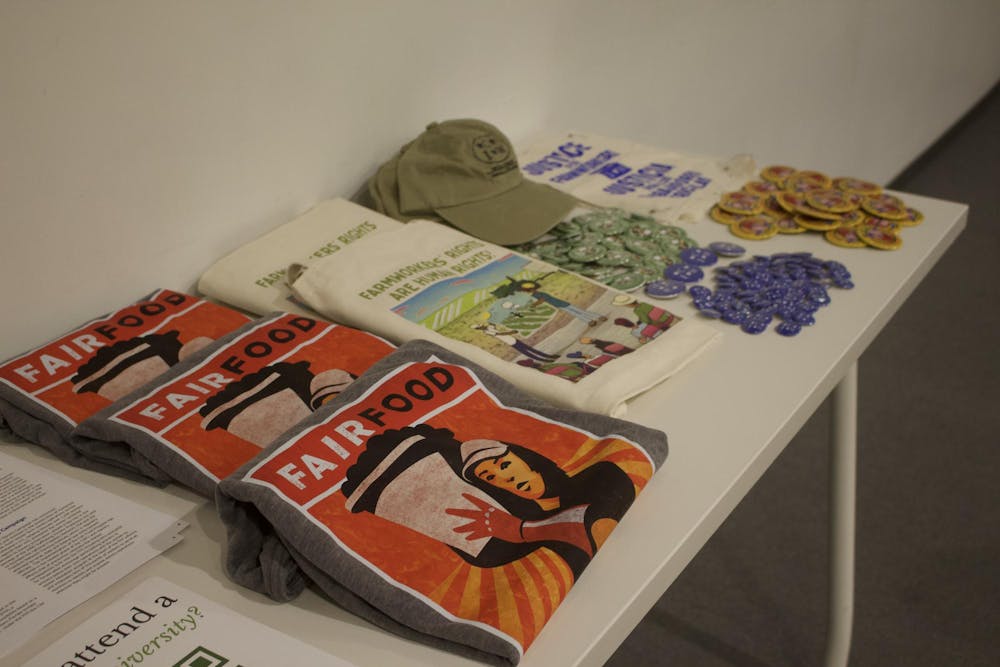
The CIW helped establish the Campaign for Fair Food, which launched in 2001 with the help of university students. The campaign aims to educate consumers on the exploitation of the food they eat. Between 2015 and 2019, there was “a lot of organizing going on in different campuses around the country.”
The Fair Food Program is modeled after the worker-driven social responsibility model, he explained. Around 90% of the program’s Code of Conduct — which covers farmer’s protections in the program — is “composed of the laws that already exist in this country, and the other 10% come from our experience as workers and what we see as issues that need to be addressed,” Salucio explained.
Now, the campaign has an agreement with 14 major food corporations. “Each of these 14 corporations has signed a legally binding agreement” with workers “agreeing to purchase bonds that respect workers rights,” Salucio said.
Ramirez-Garcia explained that some of their first campaigns began with boycotts on Taco Bell and Wendy’s.
Zaragoza highlighted the importance of the CIW’s Fair Food Program, which operates “outside of the political,” and can be useful when facing opposition.
Schneider, who currently teaches ENVS 1554: “Farm Planet: Hunger, Development and the Future of Food and Agriculture,” also emphasized the importance of global food systems: “We don’t have food if we don’t have farm workers.”
She added that the global agricultural food system is “based on and operates through the exploitation of labor in nature.”
Because food has become a commodity, the labor that accompanies food production has become commodified. “This food system operates in a way that views some people and some groups of people as expendable,” Schneider said. “The food system operates on the work of farmworkers, and the resistance of farmworkers themselves is the way that change will happen.”
Ruby Romero-Maya ’28, an event attendee and student in Schneider’s class, thought it was “powerful” to personally talk to the people involved in the movement.
“Since I’m learning in that class about worker social responsibility and injustices in the global agriculture system, I thought it was really important to hear firsthand about the people that are currently working to address the issues they’re facing,” Romero-Maya said.
According to Lopez, this event was particularly important because “film screenings like this are really huge for creating a learning experience while also not being too overwhelming.”
She also explained that these screenings help to “open the door for conversation between more academic spaces and more real life on-the-ground” spaces.

Alice Xie is a section editor for Science and Research from Los Angeles, California. She studies Applied Mathematics and Biology, and enjoys reading gut wrenching literature in her free time.


