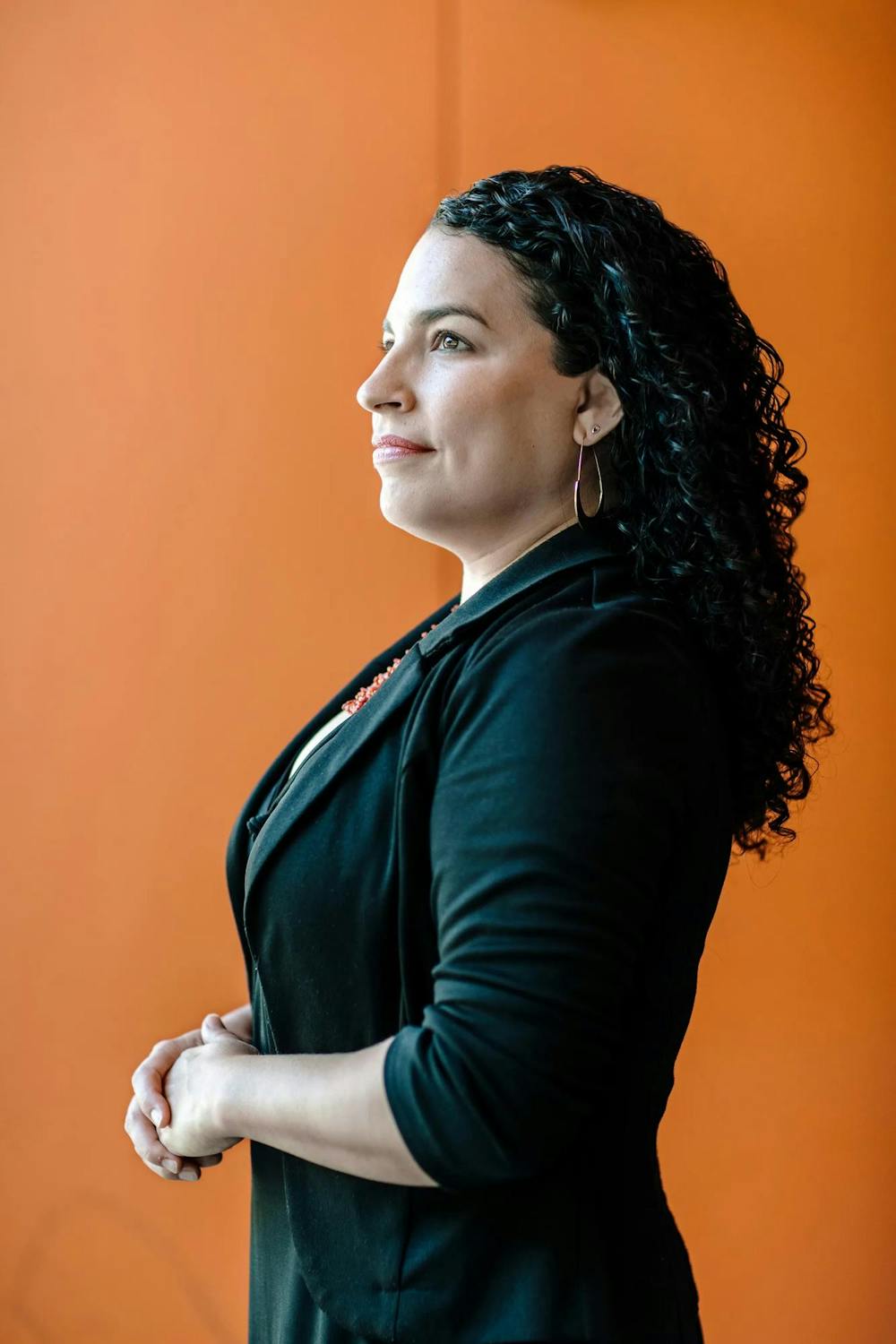
Often, research about wrongful convictions studies isolated moments in the criminal justice process, whether it be an arrest, a trial or an exoneration. In her new book, “Crime Fictions: How Racist Lies Built a System of Mass Wrongful Conviction,” Associate Professor of Sociology Nicole Gonzalez Van Cleve challenges that practice by looking at cases all the way from the day of a crime to the civil settlements.
In the book, Van Cleve examined Cook County in Chicago, Illinois, the largest hub for wrongful convictions in the country. She found that tactics used in Chicago to bury exonerating evidence were a nationwide occurrence, also happening in cities like New Orleans, Detroit and New York.
“If we don’t see the whole process, we don’t actually get to see all the evidence of how they created a wrongful conviction,” Van Cleve said.
In her 2016 first book, “Crook County: Racism and Injustice in America’s Largest Criminal Court,” Van Cleve revealed how racial disparities and abuses operate in plain sight in the Chicago courtrooms.
Her new book stems from that research, delving deeper into how authority figures in the justice system fabricate evidence or coerce confessions to convict Black youth in Chicago.
“The amount of people wrongfully convicted is scary,” Van Cleve said. “If we had that many plane crashes, we would take notice.”
Van Cleve’s interest in studying racism in the criminal justice system sparked when she was 19 years old and doing field work in Chicago courts.
“I was a light-skinned Chicana, and so the professionals really assumed me to be white,” she said. “Without realizing it, they would start to talk to me as though there wasn’t a person of color in the room.”
In these conversations, Van Cleve discovered that the officials were “punitively, or even illegally, processing cases in the court system,” she said.
“That work was driven largely by their prejudices of a Black and brown and poor underclass that they were creating,” Van Cleve said.
From this experience, Van Cleve learned to use investigative journalism techniques — such as gaining access to private interviews and archival materials — to reveal “open secrets” that people in power do not want to admit are true, she explained.
When conducting research for the book, Van Cleve began by compiling a dataset of 100 false confessions with the goal of finding patterns in these falsified police narratives. In order to ensure that there would be no debate regarding the innocence of the defendant, Van Cleve limited her dataset to cases where the defendants were exonerated.
The book featured research by undergraduate students, who were able to track down nearly 50 false confessions scattered across the Chicago area. According to Van Cleve, each student focused on analyzing one wrongful conviction case, from arrest to resolution.
“Collecting primary data in the way that Professor Van Cleve did for this project is tremendously difficult to do,” said Associate Professor of Sociology Courtney Boen, who was not involved with the research. There are a plethora of “administrative and bureaucratic challenges” with accessing the information out of the criminal legal system, she added.
Despite those obstacles, Boen said Van Cleve’s qualitative approach has advantages that quantitative research, like Boen’s own, does not. “Her work is really helpful in humanizing the (victims’) experience and showing us the lived reality of interfacing with the (criminal justice) system,” she added.
“As I said to my students, we are not just trying to create path-breaking work about wrongful conviction,” Van Cleve said. “We are trying to plant a flag on the moon as to how we study this as scholars and social scientists.”
Sophia Block ’24, who helped conduct this research while she was an undergraduate student at Brown, continues to apply the lessons shaped by her research with Van Cleve in her current job as a community engagement manager at Innocence Project Delaware.
Block’s research for Van Cleve focused on the Dixmoor Five, which was a group of five African-American men who, as teenagers, were wrongly convicted in 1997 of the November 1991 rape and murder of a 14-year-old girl in Dixmoor, Illinois. Block interviewed people involved in this case and helped write this chapter of the book.
“The main lesson (from working with Van Cleve) was this systemic lens and understanding of how wrongful convictions happen,” Block said. Now in her own work, when she looks at a case, Block understands that “it’s not just an individual incident — it’s part of this broad systemic occurrence.”
Block credits much of her shift in perspective to Van Cleve directly, describing her as a mentor who treats undergraduate researchers as full collaborators rather than just assistants working under her.
“I can say with pretty much certainty that I would not be at Innocence Project Delaware if it weren’t for her,” Block said. “She’s just an incredible leader and mentor and human.”
Elizabeth Rosenbaum is a senior staff writer covering science and research.