Dissenting Opinions: When The Herald’s editorial page board disagrees, members have the opportunity to publish a dissent to explain why they voted against the editorial. Editorials — and dissents, if any — are written by members of The Herald’s editorial page board, which is separate from those of The Herald’s newsroom and the 136th Editorial Board, which leads the paper.
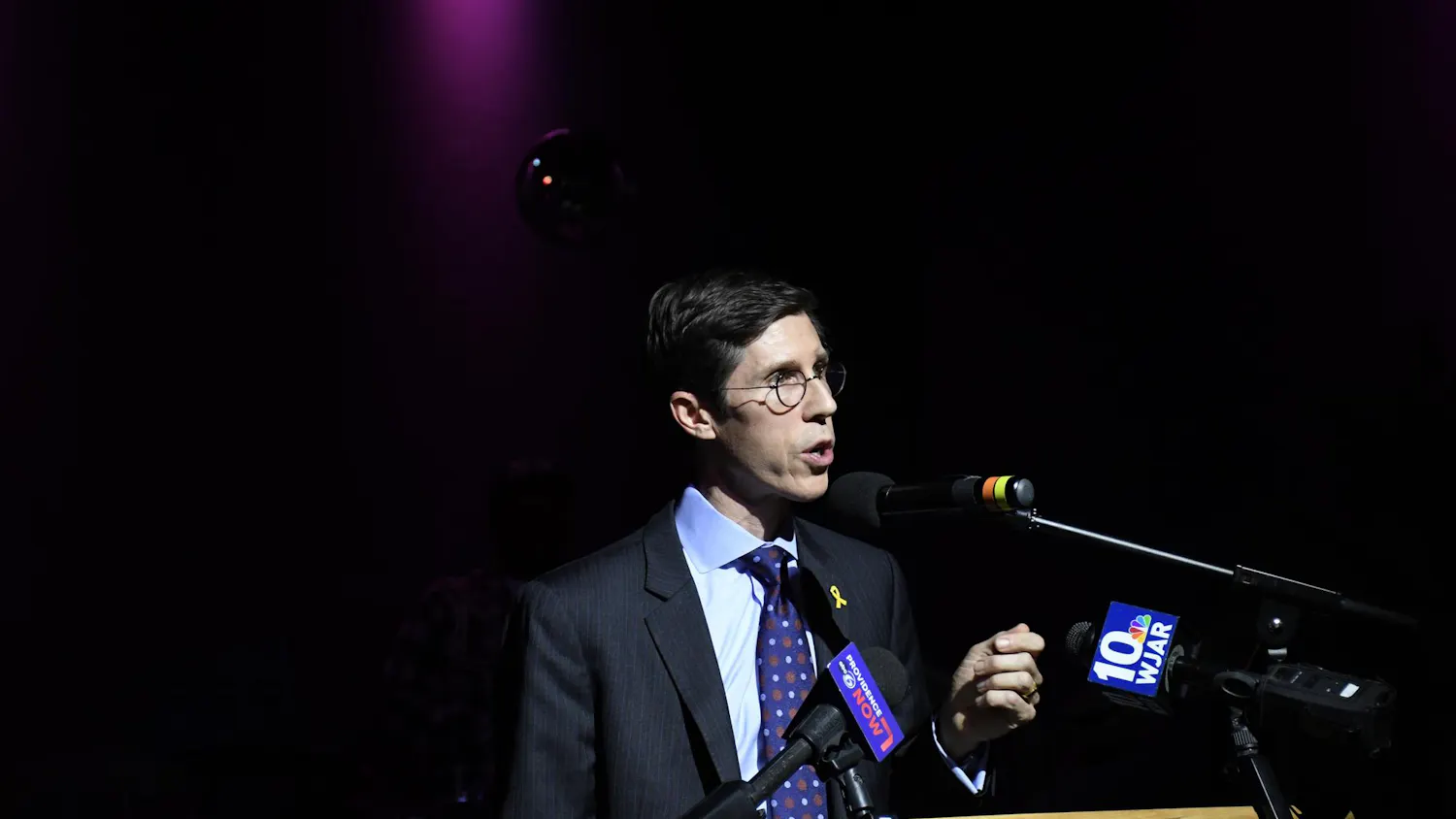
State Rep. David Morales MPA ’19 (D-Providence) should be Providence’s next mayor. The Brown alum, 5-year state representative and professional wrestler has the experience to lead our city into a new and brighter chapter. His resume as a state legislator — cracking down on wage and tip theft, capping insulin costs and preventing utility shutoffs — shows his commitment to defending our city’s most vulnerable. I have volunteered for the Morales campaign by knocking on doors around Providence this summer, and through this work I have seen that his coalition has brought together the best of our city: its healthcare workers, teachers, homeless care workers, renters, working families, immigrants, students, public servants and all those who believe that a Providence for all is possible.
Housing has become an issue at the forefront of Providence politics for two reasons: because housing policy is one of the chief responsibilities of a municipal government, and because Providence has been named the least affordable city for renters in the United States. Both Morales and the incumbent mayor, Brett Smiley, agree that increasing housing supply is necessary. But Morales’ plan pairs supply-side solutions with a smartly designed rent stabilization ordinance that provides rapid, lasting relief to residents in danger of being priced out. Where Smiley’s governance primarily serves his landlord and developer donors, Morales would rebalance power between tenants and landlords.
Although Smiley has been a generally competent mayor and delivered some laudable policy accomplishments, his administration has consistently favored the interests of the city’s landlords and real estate industry over those of its renters. This is hardly a surprise: the mayor’s donor base is a who’s who of the city’s real estate elite and industry PACs. His husband, Jim DeRentis, is Providence’s top realtor by sales volume. This creates a conflict of interest where the real estate industry can potentially curry favor with the mayor via advantageous business deals with his husband.
Accordingly, Smiley’s housing policies have been endlessly generous to landlords and developers, sometimes at the expense of the public. For example, in 2024, the city council attempted to patch a loophole in the city’s “8-Law,” which provided tax breaks to developers building low-income housing units. But the loophole allowed developers to claim tax breaks for all kinds of buildings, not just affordable units, totaling millions in lost revenue. Smiley vetoed the fix, leaving the loophole in place to funnel public dollars into private hands.
The mayor’s recent proposed rent relief fund was no better, and Morales and the city council were right to oppose it. A one-time voucher of $3,000 per household provides scant relief in a city whose average rent is over $2,000 per month. For cost-burdened renters falling behind, this wouldn't prevent eviction, it would just delay it a few months. When tenants use the vouchers, they go straight into landlords' pockets — the same ones who set rents tenants can't afford in the first place. In effect, the city would be using public funds to bail out overcharging landlords. There are much better ways to spend that money.
Smiley has accused Morales and the city council of political gamesmanship for opposing the fund, but his own motivations for starting it were also clearly political. Housing affordability has been a challenge as long as Smiley has been in office, yet the relief fund was only announced in the months before the election.
Rent stabilization, which Smiley has vehemently opposed, would have provided real relief that lasts — and is one of the main reasons Morales earns my vote. Rent stabilization has been proposed in a city ordinance that would cap annual rent increases at 4%. It was passed by a 9-6 majority of the city council, is supported by 74% of Providence Democratic voters according to recent polling by the Morales campaign and was endorsed by this paper’s editorial page board.
The rent stabilization ordinance backed by Morales is narrowly tailored to the needs of Providence, where average annual rent increases in recent years have reached 16%. To avoid discouraging development, the modest ordinance caps price hikes rather than prices themselves, exempts newly constructed homes and creates pathways for landlords to receive exemptions, following in the footsteps of successful case studies in Portland, Maine and beyond. Reasonable minds may differ on the merits of this policy, but Smiley’s uncompromising stance on it, even against supermajority popular opinion, suggests that he is unwilling to pass any policy that would risk the profits of the real estate industry.
Smiley’s housing agenda has been best where developer and renter interests intersect: increasing housing supply. Smiley’s progress here has been laudable: he has devoted public money to affordable housing construction and allowed “upzoning” for more dense housing in certain parts of the city. Economically, it’s true that expanding supply will eventually lower prices. Politically, however, it’s a poor promise to make because it takes so long to bear fruit. Smiley’s stated goal is to increase supply until prices fall, but this hasn’t happened yet and probably will not for years. Statewide, Rhode Island spends exorbitant amounts on affordable housing construction and has the slowest rates of construction in the country. It shouldn’t be surprising that voters don’t buy Smiley’s promise to build our way out of the affordability crisis.
Morales’ plan to build housing would expand on Smiley’s progress by bringing innovative strategies like using the Providence Redevelopment Agency as a public developer. The PRA is a quasi-public agency overseen by the mayor’s office which can acquire vacant or blighted properties and sell them to nonprofit developers to build affordable housing. Under Smiley’s leadership, it has been underutilized, completing just one project. In one instance, Morales accused Smiley of backing out of a PRA acquisition deal to let four of his real estate donors take it. Scaling up public agencies to create a competitive developer independent of profit motives is exactly the kind of innovative policymaking that our city needs.
In closing, I’ll respond to some points in the editorial. Smiley’s touted “record low homicides” is a lot less impressive in absolute terms: there were four in 2025, down from eleven the year before. With a number that small, there’s bound to be variance. Second, it’s not clear that Smiley can take credit for it. Violent crime has been declining nationwide for decades, not just in Providence but in cities with different mayors, policies and socioeconomic conditions.
Renegotiating the Payment In Lieu of Taxes, or PILOT, agreement with Brown and other schools is morally and economically imperative. As of 2022, Brown University owned an estimated $1.3 billion in property within city limits, but as a 501(c)(3), is exempt from property taxes, depriving the city of roughly $50 million per year. Smiley’s administration negotiated the largest ever PILOT agreement in 2024, but it is full of inequities: it totaled an estimated 11% of what Brown would owe in property taxes, allows Brown to count student volunteering and financial aid as monetary contributions to the city and hands Brown several properties to sweeten the deal. Smiley has acknowledged that it’s insufficient, but claims it’s the best they could get. Morales wants a more generous deal, with funds earmarked for public school staffing.
Although it’s true that the city can’t force Brown to renegotiate, the editorial board failed to ask why Brown agreed to pay the city anything in the first place. Precedent shows that Brown cares enough about its public reputation to contribute willingly. Stepping up funding for Providence’s public schools would be a good look for Brown at a time when elite schools are distrusted, and would align with the university’s mission of serving the community through education. If Brown is tightfisted, negative public pressure from a mayor with a loud megaphone highlighting the unfair terms of the current deal is an alternative form of leverage.
Our city needs a mayor who will fight for the interests of its people, not the donor class. Vote for David Morales on September 9.
Evan Tao ’27 can be reached at evan_tao@brown.edu. Please send responses to this column to letters@browndailyherald.com and other opinions to opinions@browndailyherald.com.