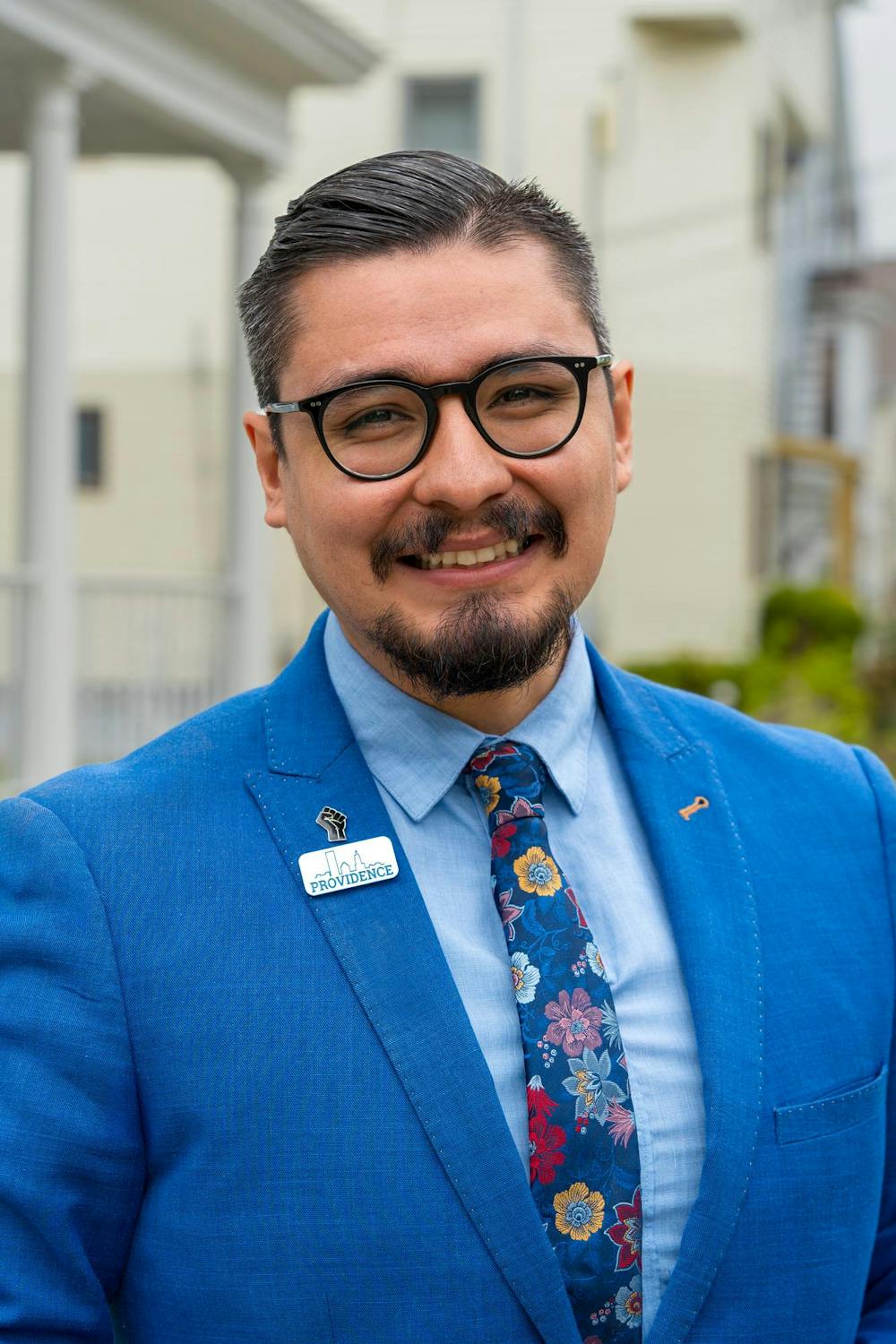
State Rep. David Morales MPA’19 grew up couch surfing at his aunt’s house and watching his mother struggle with rising rents. Now, he says those experiences are empowering him in his race for the Democratic mayoral nomination against incumbent Brett Smiley.
In the midst of a heated primary that has divided Providence Democrats, The Herald sat down with both candidates on Friday to discuss their backgrounds and visions for Providence’s next four years.
Morales, who has been historically affiliated with the Democratic Socialists of America, has received endorsements from Sen. Bernie Sanders (I-Vt.) and Rep. Ro Khanna (D-Calif. 17).
Morales graduated from the University of California, Irvine in 2018 with a bachelor’s degree in urban studies. One year later, he became the youngest person ever to graduate from Brown University’s Master of Public Affairs program.
For the past five years, Morales has represented Providence’s Mount Pleasant, Valley and Elmhurst neighborhoods in the R.I. House of Representatives. In this role, he has led the passage of legislation prohibiting insurers from requiring co-payments for COVID-19 vaccines and treatment, providing health insurance to all low income children in R.I. regardless of immigration status and prohibiting employer seizure of employee tips. He has also sponsored legislation to raise Rhode Island's minimum wage.
“I grew up to a working mom who had to balance a multitude of minimum wage jobs at once, and so to me it was very important” to raise R.I.’s minimum wage to “as close as to a living wage as possible,” he said.
Solving Providence’s housing crisis with rent stabilization
Morales is a fierce proponent of rent stabilization as part of the solution to Providence’s housing crisis, which has become a flashpoint in this year’s race for control of City Hall.
In a 2025 report, the City Council's Housing Crisis Task Force found that almost half of renters and over a third of homeowners in Providence are spending more than they can afford on housing costs. Recent years have seen rapid increases in rents across the city, pricing out tenants and exacerbating the issue of homelessness.
The City Council approved a rent stabilization ordinance in April 2026 that would have enforced a 4% annual cap on rent increases. But Smiley has been a staunch opponent of this policy. His veto — and the council’s subsequent failure to gather a supermajority overriding vote — prevented the ordinance from passing.
“Our neighbors have to watch as a lease renewal essentially serves as an eviction notice,” Morales told The Herald. “I’ve spoken with countless families and seniors during my time as a state representative who have called me, sharing their concern that they are finding themselves priced out because their rent just went up $300 or $400 at a time.”
If elected mayor, Morales has promised to work with the City Council to sign rent stabilization into law and establish a board to enforce the policy. He criticized Smiley’s choice to veto the ordinance, describing him as “a mayor that would rather cater to corporate interests than the actual needs of working people.”
“Mayor Smiley has made it a priority to make building the housing Providence residents need,” Smiley’s Press Secretary Carl Austin Miller Grondin wrote to The Herald.
“Last year Providence permitted new housing at a faster per-capita rate than cities like Boston and New York, nearly doubled the number of new homes coming online in the last fiscal year, and almost 40% of those new homes were affordable,” he wrote.
Additionally, Morales stated that his administration would aim to adopt a “public developer model.” He explained that under this system, the city would work to actively purchase vacant buildings and lots, team up with nonprofit housing developers and construct “deed-restricted mixed-income housing units that will serve the needs of neighbors from various backgrounds.”
Staffing support for Providence public schools
Morales also aims to improve staffing conditions and offer financial support for Providence public schools. After seven years under state control due to reports of widespread instructional and social issues, the Providence Public School District returned to local control this summer.
“Right now, we have a shortage of counselors and social workers all across elementary school, middle school and high school,” Morales said. He aims to work with nonprofit partners such as Family Services Rhode Island and Tides Family Services to increase the number of social workers and psychologists in the PPSD.
To support this hiring, he added that he hopes to work towards an agreement with the city’s private colleges “so they're actively contributing more financial support to Providence public schools.” Currently, Brown and other private universities in Providence are not subject to property taxes due to their nonprofit statuses, but pay voluntary payments to the city each year.
A holistic approach to public safety and protecting immigrants
During his interview with The Herald, Morales also expressed a desire to seek legal action against Immigration and Customs Enforcement. In recent months, ICE activity has increased in Providence, with several detainments occurring on College Hill. Legislators and activists alike have said agents patrol R.I. courthouses and arrest individuals entering and leaving the buildings.
If elected mayor, Morales plans for his administration to collaborate with local advocacy groups — such as the Deportation Defense Network — that organize against ICE activity. He wants to collect documentation and evidence of “the incidents where our neighbors are having their rights violated,” with the goal of eventually taking legal action.
ICE did not immediately respond to The Herald’s request for comment.
Morales denounced the Providence Police Department’s existing network of 60 Flock cameras, license plate readers linked to the city’s Real Time Crime Center, as an added risk for immigrants.
Flock operates about 120,000 cameras across the United States that conduct about two billion scans monthly. The company has drawn widespread backlash from both citizens and legislators after reports of officer abuses and sharing data with ICE.
“Flock has proven to be a for-profit company that cannot be trusted with data privacy or ensuring that the information — sensitive information of our neighbors — is not improperly shared,” Morales said. “I do not believe that we should wait for information to be improperly leaked.”
He vowed to “work towards terminating our existing Flock agreement” if elected mayor.
“Flock does not sell customer data or independently decide to share it with outside agencies; those decisions remain with the customer that owns the data,” Flock spokesperson Paris Lewbel wrote to The Herald.
“Since Providence deployed Flock, the city has reported significant reductions in crime and the technology has also played an important role in major investigations,” Lewbel added. “Providence Police says Flock was instrumental in the Brown University shooting investigation, helping investigators identify the suspect’s vehicle and ultimately locate the suspect in New Hampshire.”
Morales’s critique of Flock cameras contrasts with Smiley, who has stated that, with current data protection safeguards in place, the technology is important to public safety in Providence. “Access to LPRs data is tightly controlled and governed by department policy,” Miller Grondin wrote. LPRs “ have a role to play in keeping our neighborhoods safe,” he added.
As an alternative method to reducing rates of violent crime, Morales plans to expand partnerships with social work organizations such as Project Weber/RENEW and the Providence Center.
“This is going to be one of our approaches to public safety: making sure that there's more of an emphasis on social and emotional care for those that are experiencing substance use disorder, unmet mental health needs and chronic homelessness,” Morales said.
Smiley and Morales are the only two Democratic mayoral candidates on the ballot this Wednesday. The winner will face off against Republican nominee Dave Talan in the November 13 general election.
“We ran a very positive campaign centered around a vision and hope for our Providence community, and for that reason, I feel very excited as we head into Election Day,” Morales said. “I believe a lot of our neighbors are going to choose hope over fear.”

Michelle Bi is a metro editor covering City Hall & Crime and State Politics & Justice. She is a sophomore from Oak Park, CA and studies English and IAPA. In her free time, you can find her playing guitar, the LA Times crossword or one of her 115 Spotify playlists.