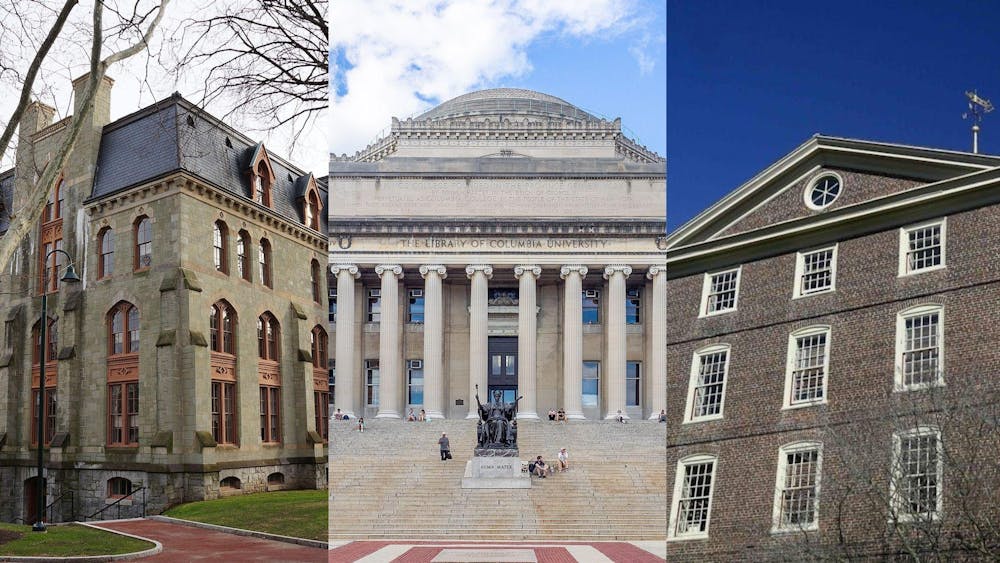
When media outlets reported in late July that Brown was in discussions with the White House over the University’s federal funding, many community members’ first thoughts were about the Trump administration’s previous deals with Ivy League peers Penn and Columbia.
“The agreement between Columbia University and the Trump administration is not a settlement — it’s a shakedown,” wrote Daniel Souweine ’01, founder of alumni organization Stand Strong Brown, in a statement to The Herald after news surfaced regarding the discussions. “We call on Brown University to reject this model entirely.”
Less than a week later, Brown announced it had reached an agreement with the Trump administration to restore the University’s federal research funding and resolve government investigations into antisemitism on campus but not without a list of concessions.
Some, like eliminating discrimination in admissions or complying with NCAA policies on transgender athletes in women’s sports, mirrored the White House’s agreements with Columbia and Penn, respectively. Others, like distributing $50 million in workforce development grants to local organizations, seemed unique to Brown.
The Herald spoke to several higher education experts to unpack the key differences between the agreements and to understand how the future of higher education may change with the White House’s new practice of leveraging federal funding to strike deals with top universities.
How Brown’s deal stacks up
The Trump administration’s agreements with Brown and Columbia are very similar, multiple higher education experts told The Herald.
Specifically, Brown’s resolution to prohibit “unlawful” diversity, equity and inclusion programs and the University’s commitment to not consider race in admissions mirrored agreements in the White House’s agreement with Columbia, wrote Sara Partridge, associate director of higher education at the Center for American Progress, in an email to The Herald.
Both agreements also outlined commitments to supporting Jewish life on campus, but Brown’s deal requires the University to engage with an external firm to conduct a campus climate survey and a social media harassment study by the end of the year. According to University Spokesperson Brian Clark, the study will “collect information on the climate for students with shared Jewish ancestry.”
In a 2024 resolution of a Title VI complaint, the Department of Education raised concerns about antisemitism on campus and Brown agreed to implement a number of actions to improve its response to discrimination and harassment. The letter specifically noted instances of harassment via social media, namely Sidechat — a platform that allows members of the Brown community to post anonymously. This 2024 resolution also required the University to review its climate surveys and provide a report to the Education Department’s Office of Civil Rights.
The survey mandated by the new agreement “aligns with planning by the Office of Diversity and Inclusion to assess campus climate, and will build on campus climate surveys we have conducted in the past,” Clark wrote in an email to The Herald.
Both Brown and Columbia also agreed to disclose admissions data to the federal government. The concessions were followed by an executive order that requires all colleges and universities receiving federal funding to report their admissions data as well.
Brown was the second Ivy League university, following Columbia, to make a financial settlement to restore federal funding. Columbia will pay over $200 million to the federal government while Brown will pay $50 million to state workforce development organizations over the next decade.
None of this funding will go to the federal government, and Brown will maintain full control over fund distribution.
Penn — the first Ivy League university to strike a deal with the Trump administration — was not fined. Instead, the university’s agreement is “narrowly focused on complying with Title IX,” wrote Jay Greene, a senior research fellow in the Center for Education Policy at the Heritage Foundation, in an email to The Herald.
Title IX is a federal statute that prohibits sex-based discrimination in educational programs or within organizations that receive federal funding.
Penn’s agreement centered around the university’s decision to allow transgender swimmer Lia Thomas compete in women’s swimming, which the Department of Education found violated Title IX. In exchange for the restoration of $175 million in federal funding, Penn issued a statement saying it would comply with Title IX.
Brown similarly agreed to comply with NCAA rules on transgender athletes, which ban student-athletes who were not assigned female at birth from competing in women’s sports.
The University also agreed to prohibit gender affirming care for minors, but few minors are enrolled at Brown, Clark explained, and Student Health Services does not have surgical facilities. He added that Health Services “does not typically prescribe” puberty blockers, because they are intended for pre-pubescent patients.
“New prescriptions for hormones for minors will now be provided by external medical providers,” Clark wrote. “The University will refer to area specialists those affected students who are minors who seek care from Student Health Services or the University Pharmacy.”
Academic freedom
Some higher education experts are split on the deals’ impacts on academic freedom — a major concern for many when federal funding freezes were first announced.
“The most striking thing about these three agreements for Brown, Columbia and Penn is that they do not do anything that affects academic freedom,” Greene wrote. “All of the over-wrought worries before the agreements were struck, as well as many of the criticisms afterward, raise alarms about problems that simply do not exist in these agreements.”
Greene added that the Brown and Columbia agreements have provisions that emphasize that academic freedom will not be impacted.
Brown’s agreement specifically states that the agreement will not allow the government “to dictate Brown’s curriculum or the content of academic speech.”
“There is nothing in them that represents an inappropriate intrusion on academic freedom,” Greene wrote.
For Partridge, Columbia’s agreement was the “most far-reaching of the three and the one that most clearly infringes upon academic freedom.” Despite the clause related to academic freedom, “there are ways that the implementation of this agreement may impede faculty members’ rights to freely teach and conduct research,” she wrote.
She cited the provision in Columbia’s agreement requiring administrators to review its programs in Middle Eastern studies, which “may represent an intrusion into academic curricula, particularly if decisions about what should be taught and how are made for political or ideological reasons.”
“Academic materials are generally assessed through peer review by other experts in the same field, not university administrators,” she added.
But Jonathan Butcher, the director of the Center for Education Policy at the right-leaning Heritage Foundation, believes the deal will level the playing field for academic freedom.
“All students, including Jewish students, should be protected from harassment, giving them the same academic freedom as other students on campus,” he wrote in an email to The Herald. “Universities can explore new issues and hold debates or lectures on a wide variety of topics, but harassment must be prohibited and students should be protected from it.”
The future of higher education
Partridge believes that these deals could have a widespread impact on other universities and colleges navigating the Trump administration’s threats to higher education.
“Unfortunately, many institutions of higher education may follow suit and voluntarily take up practices adopted in these agreements in an effort to avoid being targeted by this administration,” she wrote.
When the Trump administration expressed its desire to eliminate DEI programs, many colleges and universities followed suit, changing or even eliminating mentions of DEI on websites or scrapping programs altogether.
“The administration may also use this same playbook against other institutions, in spite of its dubious legality, because it has so far proven effective in accomplishing some of its goals,” Partridge added.
Schools like Harvard and University of California, Los Angeles have reportedly remained in negotiations with the federal government over millions of dollars in federal funding.
For Greene, the deals are an “important step toward removing racial preferences from higher education and ensuring enforcement of Title VI protections for Jewish students and Title IX protections for female athletes,” he wrote.
But Partridge says she sees these changes as “unprecedented, targeted attacks on institutions of higher education that leverage the federal government’s role as a funder of scientific research in order to accomplish the Trump administration’s ideological goals.”
“Colleges and universities should not back away from their missions to provide equal educational opportunities to students from all backgrounds, and should not pre-emptively comply with dangerous and overreaching demands from the administration,” she added.
Luther Spoehr, senior lecturer emeritus in education at Brown, said that the “the unprecedented and arbitrary nature of these actions makes it more than difficult to project future events in these areas.”
He pointed to other Trump administration policies as potential signs of what is to come in higher education.
Last week, the White House announced plans to review the Smithsonian Institution’s exhibitions and materials to “ensure alignment with the President’s directive to celebrate American exceptionalism, remove divisive or partisan narratives and restore confidence in our shared cultural institutions.”
Spoehr worries that this move could be a warning sign for the administration intervening in areas of higher education, such as curriculum and faculty hiring.
“Things could get ugly very fast,” he wrote in an email to The Herald. “ Let’s hope it’s not a harbinger of things to come.”

Cate Latimer is the editor-in-chief and president of The Herald's 136th editorial board. She is from Portland, OR, and studies English on the nonfiction track. She previously served as a University News editor covering faculty and University Hall and higher education. In her free time, you can find her playing ultimate frisbee or rewatching episodes of Parks and Rec.