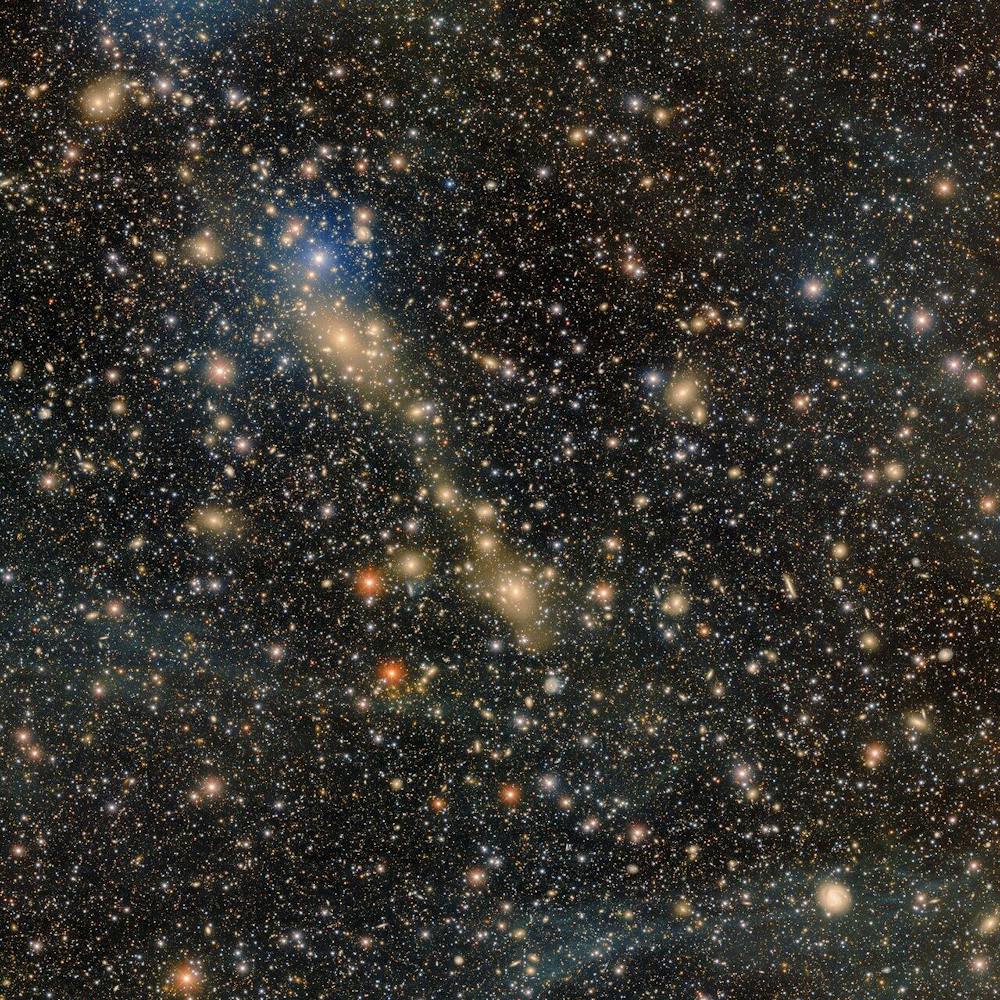
When studying local galaxy cluster Abell 3667, Anthony Englert GS, a Ph.D. candidate in physics, noticed something unique. Connecting the brightest galaxies in two small clusters within Abell 3667 was a faint bridge of light. This bridge, he explained, is evidence that the two galaxies are actively merging — a phenomenon that has not yet been observed in local galaxies.
“When you’re the first person ever to see this region of the sky at this depth, you’ll see things that nobody else has ever seen,” said Professor of Physics Ian Dell’Antonio, the principal investigator of the lab that conducted the study.
Englert’s results about Abell 3667 were published last month in the Astrophysical Journal Letters.
Galaxy clusters, Dell’Antonio explained, are “the biggest things that the universe has fully made by the present epoch.” Abell 3667 contains a multitude of smaller clusters. Each of these smaller clusters contains multiple galaxies, and the biggest, brightest one is called the “brightest galaxy cluster” or BCG.
When two galaxy clusters are merging, differences in gravitational forces will pull objects unevenly, causing stars to be “ripped” from one BCG to another. This forms the light bridge that the team observed, Englert explained.
“In the future, (the galaxy clusters) will merge, creating a much bigger galaxy in the center of” Abell 3667, wrote Mireia Montes, a fellow at the Institute of Space Sciences in Spain and coauthor of the paper, in an email to The Herald. Montes helped interpret the data from telescopes at the Cerro Tololo Inter-American Observatory in Chile, which captured the images of this galactic interaction.
According to Dell’Antonio, this phenomenon should actually be “a fairly common thing” based on numerical simulations of gravity. “Almost every galaxy that’s crashed into or passed by another galaxy should have these very faint streamers of stars,” he said.
But Englert’s findings mark the first time this merging has actually been observed in a “local galaxy” — a galaxy in the Milky Way’s immediate cosmic neighborhood. Abell 3667 is located about 800 million light-years from Earth, Englert explained.
Discovering the light bridge was not easy, he said, as the bridge itself was very faint and difficult to see.
“Low-surface brightness astronomy is really, really challenging to do because when you take an image through a telescope, usually you have to do lots of corrections” due to other artifacts in space interfering with the image, Englert said.
But an algorithm that Englert built enabled the astronomers to create images that depicted the merging galaxies. Without these “amazing images,” scientists would not have such detailed information on the current state of the cluster, Montes wrote.
But “there is a lot that we are still not seeing hidden in the faintest regions of the galaxy,” she added. She noted future data from the Vera C. Rubin Observatory — a federally funded project that began observations this year — may provide “a lot of information about what our universe looks like (and) how it evolves.”
Dell’Antonio explained that the bridge of light observed in Abell 3667 could be indicative of future merger events between the Milky Way and Andromeda, our closest galactic neighbor.
But “that’s five billion years in the distance,” he said. “So it’s not a personal worry of anyone alive.”
Elizabeth Rosenbaum is a senior staff writer covering science and research.