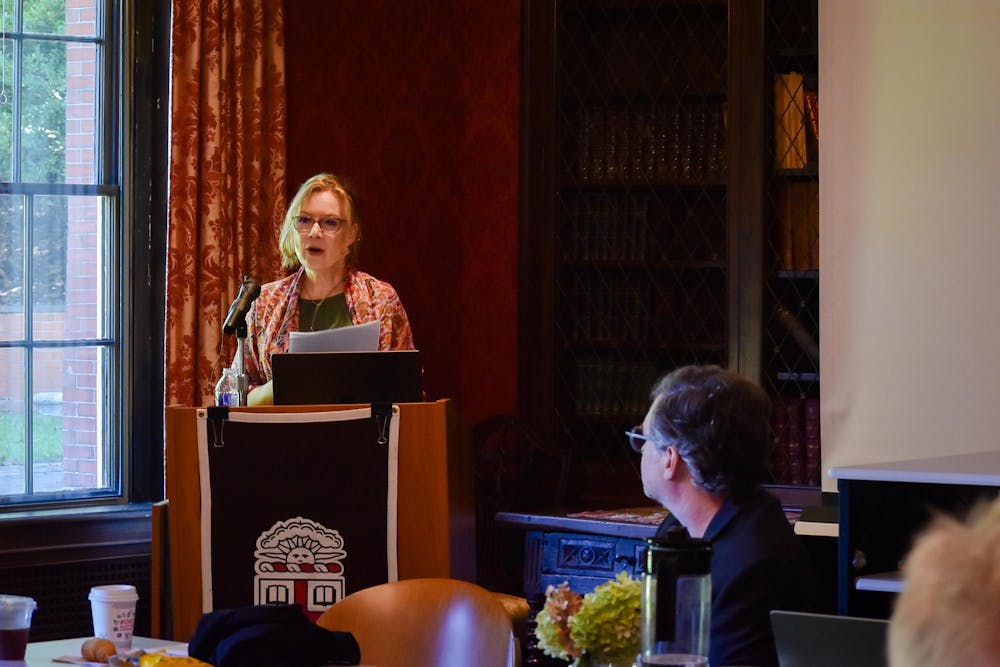
At the end of last week, the Department of English hosted “Fictions of the American Revolution” — a symposium that showcased literary, cultural and historical research associated with the American Revolution — at the John Nicholas Brown Center for Advanced Study.
The Friday and Saturday event consisted of three panels titled “Origins Stories,” “Re-groundings” and “Revolutionary Legacies.” It featured about a dozen scholars from Brown and various universities, each of whom delivered insight on literature and history related to the American Revolution and the Age of Revolutions.
The symposium was part of the Brown 2026 initiative, which explores “the historical and contemporary meanings of 1776” as the 250th anniversary of the signing of the Declaration of Independence approaches next summer, according to the event programming. Elsewhere on campus, the initiative is also shaping course content and launching informal book clubs for students to discuss faculty work.
“Why are we here today?” Drew Lopenzina, a professor of early American and Native American literature at Old Dominion University, asked in his talk. “I believe that (the) reason is to consider and perhaps evaluate the values of the American Revolution, anticipating its 250th anniversary… and to think about the ways literature has communicated those values.”
In his presentation titled “‘I Appeal to the Lovers of Liberty’: William Apess, Prophet of Democracy,” Lopenzina explained how 19th-century Pequot writer and activist Apess fought back against the American settler colonial regime’s attempts to assert spiritual and cultural superiority against the Indigenous people who lived on the land.
Apess’s eulogy on King Philip, for instance, “presented not just a retelling, but a reconstruction, and perhaps even a deconstruction of colonial history that found within its colonial narration the tools of its own dismantlement,” Lopenzina said in his talk. King Philip was a Wampanoag chief called Metacom who led a coalition of Native American peoples against colonial expansion in the 17th century.
Rodrigo Lazo, a professor of literature at the University of California Santa Cruz, presented on “The General in His Labyrinth,” a novel by Gabriel García Márquez that reimagined the last few months of the life of Simón Bolívar, the leader of Gran Colombia — a short-lived 19th-century country that covered parts of northern South America and Central America.
“It is a novel about the disintegration of the human body, which I find quite relevant to the topic of the symposium, because, like human bodies, revolutions can get creaky and wither,” Lazo said.
In his talk, “Generals in Their Labyrinths: Bolivar, Washington and the Mythic Age of Revolutions,” Lazo also compared the mythologizing of Bolívar to the American myth-making of General George Washington .
“The image of a great general and the first president influences the ways people perceive Washington into the present,” Lazo said.
Thomas Koenigs, an associate professor of English at Scripps College, examined two antebellum fictions focused on the anti-slavery struggle: Jabez Delano Hammond’s “The Life and Opinions of Julius Melbourn” and Hannah Crafts’s “The Bondwoman’s Narrative.”
In his talk, “‘Natural Histories of the Heart’: Fiction, Racial Interiority and the Revolutionary Legacy in the Antebellum Struggle Over Slavery,” Koenigs discussed how the two novels’ fixations on Thomas Jefferson’s legacies are “part of their interventions into the intertwined antebellum debates about slavery and racial interiority.”
According to Koenigs, these novels — one of which was written by a formerly enslaved Black woman in the 1800s — challenged the racist ideologies of pro-slavery advocates during the period, who argued that Black people were incapable of literary achievement.
For Visiting Senior Faculty Fellow at the John Nicholas Brown Center for Advanced Study Katherine Jewell, who attended the symposium, it is “really important to preserve intellectual exploration and deep research” at events like this one.
“You can start to really not only discover truths about the American experiment or intellectual life, but you can (also) start to create knowledge and new ways of imagining ways forward in the present,” Jewell said.

Ivy Huang is a University News and Science & Research editor from New York City. Concentrating in English, she has a passion for literature and American history. Her favorite authors include Marilynne Robinson, Vladimir Nabokov, and Toni Morrison. Outside of writing, she enjoys playing basketball, watching documentaries, and beating her high score on Subway Surfers.