
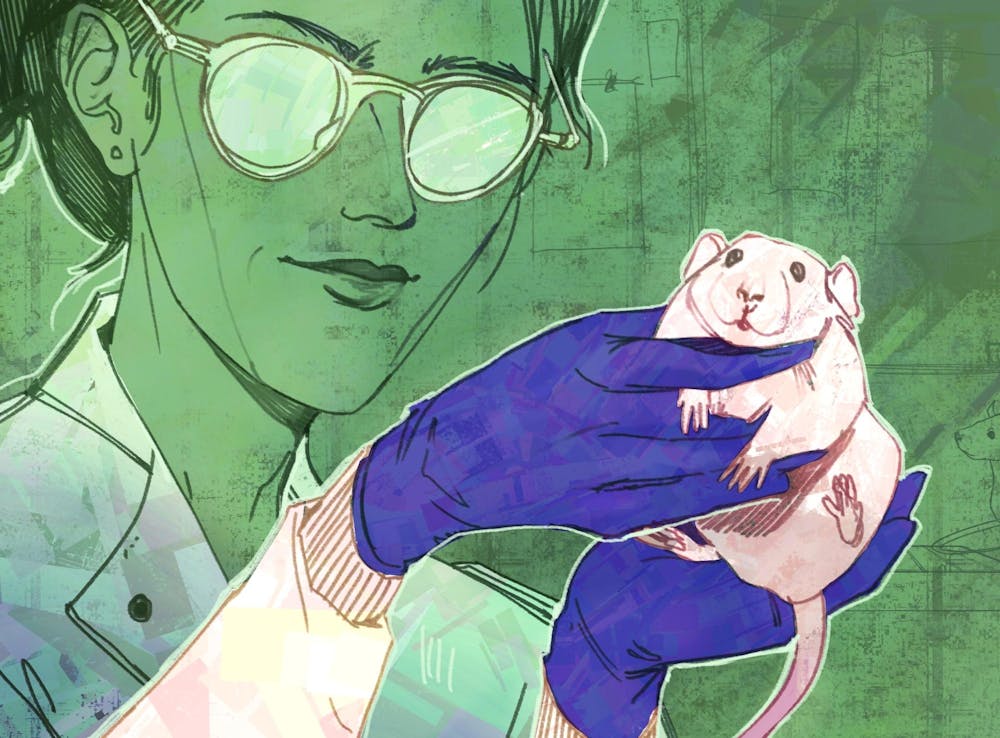
Once the school year ends, while some Brown students pack their bags and drive off College Hill, others stay in Providence for the summer to work on an Undergraduate Teaching and Research Award.
Known as an UTRA, these grants allow students to collaborate with faculty members on research projects or course development during the academic semester or summer break. Students of all disciplines have the opportunity to explore a topic that interests them.
The Herald spoke with three UTRA awardees to learn more about what they did this summer.
Remy Dufresne ’27: Melding quantitative modeling with environmental justice in the Salton Sea
Remy Dufresne ’27 worked in the Freilich Lab and spent his summer modeling hydrogen sulfide gas production in the Salton Sea, a hypersaline lake in Southern California.
“My job was to get to the bottom of why it was releasing foul odor smells and causing adverse health impacts on surrounding communities,” Dufresne said.
Dufresne investigated this question by using a computational model to map gas production based on various environmental factors.
Although the project is still ongoing, Dufresne gained some preliminary insight. After completing a parameter sweep of different variables, he concluded that low oxygen and high biomass were factors that lead to higher hydrogen sulfide gas outputs from the lake, which negatively affect surrounding communities.
Dufresne compiled a graph conveying his findings, which he shared with a community organization and residents in California for educational purposes.
Dufresne appreciated the opportunity to make an impact with his research, noting how quantitative evidence can lead to real change to “get caps or limits on these gas outputs.”
“I was really drawn to this project because it had such a foot in not only quantitative analysis and computation, but also environmental justice,” Dufresne said. “This is an issue that’s affecting real people.”
Hilary Nguyen ’27: Understanding the connections between gut microbes and host metabolism
Hilary Nguyen ’27 started her involvement in research with a cold email to the Chellapa Lab, where she spent the summer studying metabolic processes in the intestines of mice. The lab studies nicotinamide adenine dinucleotide, or NAD, which is a cofactor related to cell signaling and metabolism.
“The precursors for NAD, which is an important cofactor in a lot of the biochemical pathways that your body needs to make energy and break down the food you’re eating, can be shared between the microbes (in the gut) and the host,” Nguyen said.
Nguyen’s work investigated how changes in the composition of microbes in the gut and NAD metabolism affect each other.
To visualize this process, her activities included labeling bacterial RNA with fluorescent probes that allowed her to observe shifts in microbial communities under varying metabolic conditions.
The microbiome of a host impacts health, she said, and the necessity of NAD makes it fundamental to the field’s research.
This work has applications to fields like aging and regenerative medicine, cancer and ulcerative colitis and other intestinal diseases, according to Nguyen.
As a biochemistry concentrator, Nguyen appreciated how her coursework supplemented her lab experience and vice versa. The two realms of learning “help each other become more interesting because I’m able to see connections,” she said.
Nguyen, who hopes to become a pharmacist, noted that research is often important for graduate school applications, but she said the best part of her work was the colleagues and mentors she met.
“The people are what make the science worth it to me,” she said.
Paola Chapilliquen ’27: Supporting bilingualism in Rhode Island
Paola Chapilliquen ’27 spent her summer working on a project titled “En Comunidad: Amplifying the Voices of Latinx neighbors” with Assistant Teaching Professor of Education Tricia Kelly. Her project focused on supporting bilingual youth education in Rhode Island.
Much of Chapilliquen’s work was done with the Coalition for a Multilingual Rhode Island. With the coalition, she helped develop a community map highlighting how and where bilingualism is thriving in Rhode Island.
She also contributed to research aiming to improve Spanish-language development for community members, interviewing local teachers about how bilingualism shows up in their classrooms.
Chapilliquen spent time volunteering at Progresso Latino, a social services organization that supports Rhode Island’s immigrant community. Chapilliquen worked at the organization's daycare center.
“It was so great to … see their gears turning in Spanish and in English,” she said.
Chapilliquen also worked with the Mount Pleasant and Washington Park Libraries to aid in developing a curriculum for bilingual story hours. She read stories to children and engaged them in bilingual activities, and “loved being with the kids every week.”
She also helped create a digital bilingual book repository, filled with a collection of books, resources, discussion questions and activities as a resource for caregivers and community members.


