With the odds of a federal government shutdown increasing with each passing hour, Rhode Island’s all-Democratic congressional delegation is among others in their party looking to use public outrage from a shutdown as a bargaining chip to prevent health care premiums from increasing.
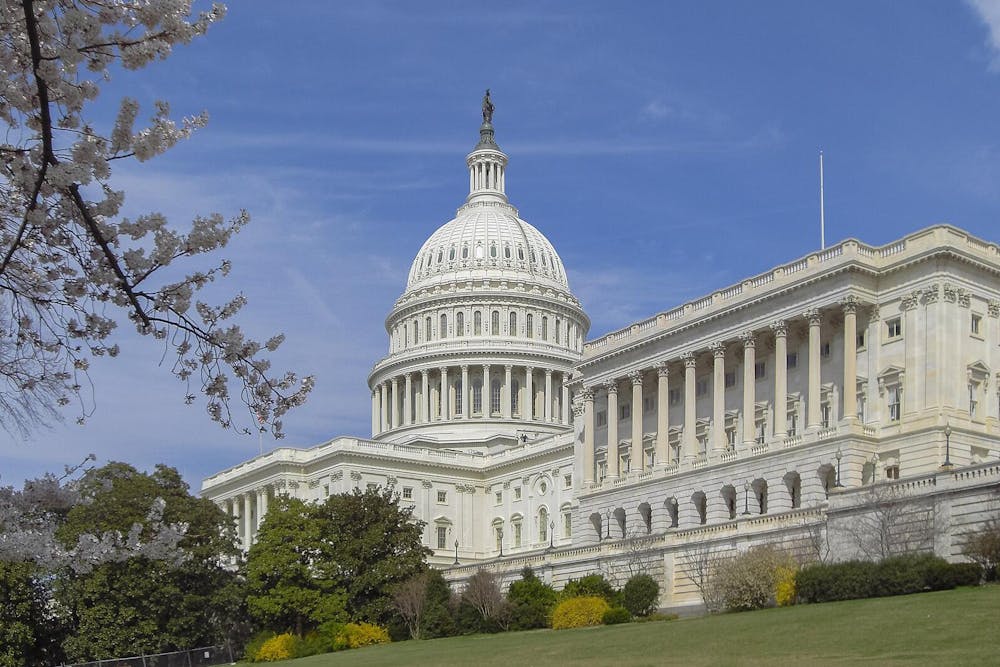
To pass a short-term stopgap funding bill and keep the government open before the funds run dry at midnight on Wednesday, Republicans are on the hunt for at least seven Democratic senators to join the Republican majority in voting for the funding, reaching the critical 60-vote threshold required to overcome a Democratic filibuster.
But Democrats aren’t looking to give away their votes for nothing. In exchange for their support, Senate Minority Leader Chuck Schumer (D-N.Y.) and other Democrats are looking to extend some Affordable Care Act subsidies that are set to expire at the end of this year. President Trump and congressional Republicans have rebuffed this demand — a politically risky move that Democrats believe they can use to heap responsibility for a shutdown onto their opposition.
Rhode Island’s four-person congressional delegation is taking this bet.
“The health care system in Rhode Island and across America is in a crisis with costs to patients spiking because of massive cuts that Republicans have made across the system,” wrote Noah Boucher, director of communications for Rep. Seth Magaziner ’06 (D-R.I. 2), in an email to The Herald.
He emphasized the vital role the health care credits play in helping “millions of Americans afford their health insurance.”
“If congressional Republicans and Donald Trump fail to extend health insurance tax credits, millions of Americans will face impossible choices, forcing many to forgo needed care,” said U.S. Rep. Gabe Amo (D-R.I. 1) in a press release.
U.S. Sen. Jack Reed (D-R.I.) said that 25 million U.S. citizens dependent on ACA insurance would see an increase of around 75% in insurance premiums.
“Millions more with employer-sponsored coverage could face equal or even higher price increases,” Reed said in a press release.
In a post on X, U.S. Sen. Sheldon Whitehouse (D-R.I.) said that it is “hard to blame Democrats for the shutdown when sources close to Trump say out loud that the president ‘welcomes the prospect of a shutdown.’”
In a statement sent to The Herald, R.I. Senate Minority Leader Jessica de la Cruz (R-North Smithfield, Burrillville, Glocester) sounded the alarm on a shutdown, saying that it would negatively harm the state’s residents, urging them to contact Reed and Whitehouse and “insist they put Rhode Island citizens over party politics.” She blamed Senate Democrats, calling the attempt to include health care subsidies “a reckless use of political leverage to pass partisan reforms.”
A looming U.S. government shutdown may also affect federal employees and the availability of federal services across Rhode Island, though Providence city services and operations will remain unaffected, according to city and state officials.
The shutdown would affect services and agencies funded by 12 discretionary spending bills currently under consideration in Congress, including many federal employees’ salaries. Providence residents who are full-time federal government employees “may be directly impacted,” Providence City Council Communications Director Marc Boyd wrote in an email to The Herald.
Roughly 8,600 Rhode Islanders are full-time, non-postal federal employees.
The White House is also preparing mass layoff plans for some federal workers in the event of a shutdown, POLITICO reported. It is unclear whether these plans will be carried out or will directly impact Rhode Island federal workers.
City operations will remain unaffected. The Providence “budget process … is unrelated to the federal budget process,” Boyd wrote.
Federal buildings, such as the courthouse on the east end of Kennedy Plaza and the Roger Williams National Memorial, may be closed to the public during the shutdown. It may also impact federal services — including financial lending and food inspections — and furlough thousands of workers.
But national benefit programs such as Social Security and Medicare will continue to receive funding, as will federal law enforcement and border patrol agencies.

Lev Kotler-Berkowitz is a senior staff writer covering city and state politics. He is from the Boston area and is a junior concentrating in Political Science and Economics. In his free time, Lev can be found playing baseball or running around with his dog.