
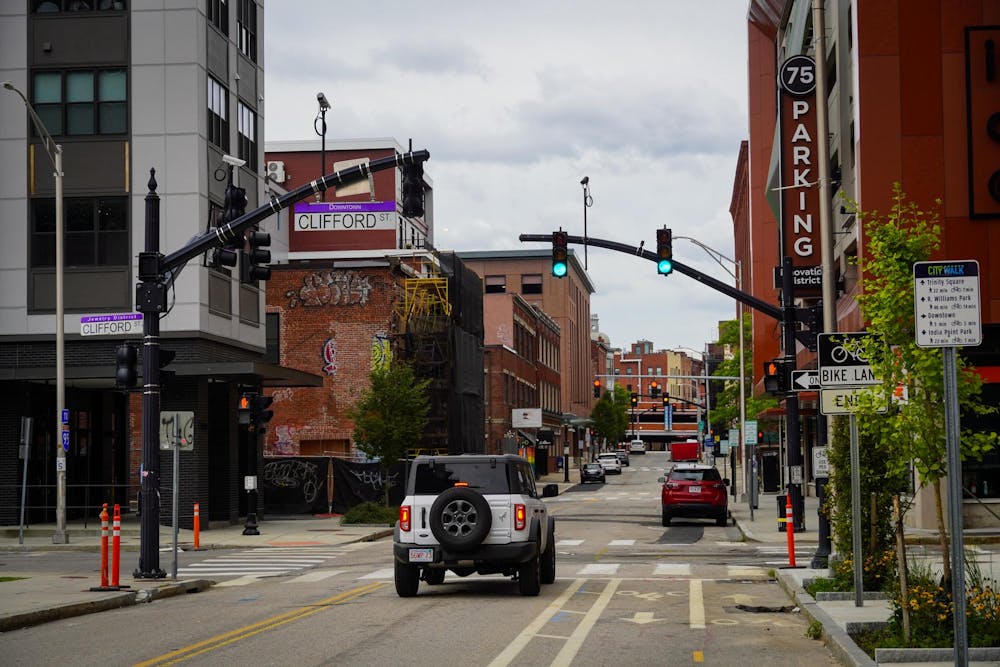
Last summer, Brown continued its expansion into downtown Providence, beginning construction on a seven-story lab with the approval of the Downtown Design Review Committee. This new construction, which followed several other Jewelry District projects, aligns with a greater vision that Providence leadership has latched onto for the past twenty years: the creation and expansion of a knowledge economy.
The relocation of the I-195 highway in the 2010s opened up several downtown-adjacent plots for development. The Jewelry District — or the 195 District — became the development hub of Providence’s knowledge-based future. The focus homing on institutions such as Brown, RISD and healthcare facilities. However, the city and the University shouldn’t seek to establish a knowledge economy microcosm in the 195 District — the area should also be developed for existing Providence residents. To enrich the city beyond the boundaries of university campuses, the downtown appendage must be built on a greater commitment to mixed-use development and economic diversity.
University expansion is not new. Brown has expanded far beyond its original plot. But these efforts weren’t without controversy or consequence. Neighborhoods on the East Side, such as Fox Point and Lippit Hill, experienced cultural overhauls and large-scale displacement as a result of city (re)development, including Brown’s campus expansion. Entire communities, many built by Providence’s vital immigrant workforce, were squeezed out of College Hill to make room for more students, faculty and staff.
This displacement and gentrification isn’t a one-off occurrence. Universities across the nation, especially ones in urban areas, can dominate local policy to the point of overlooking the needs of native residents. Economic development can funnel some money into the city — such as encouraging consumption and providing customers to local businesses — but this economic activity is often restricted to campuses. Local residents rarely see economic revenue, and instead are left with rising prices and less housing. A classic example of this wealth consolidation can be seen in New Haven. Despite Yale’s abundant wealth, the areas surrounding it face disproportionate poverty rates and worse standards of living.
Similar disparities can be seen among Brown students and Providence natives. This divide is especially obvious observing the struggles of Providence public schools. Steps away from campus, students and teachers are failing to receive adequate support, and local youth lack the resources to even learn at their grade level. Existing issues could be exacerbated by ongoing federal education funding threats, further stratifying the city.A private knowledge economy solely based on higher education will hardly address these inequalities.
Brown is one of the most visible, resourced and impactful institutions in Providence — and all of Rhode Island, for that matter — and the University’s new expansion efforts will continue to impact our local economy and those who rely on it. Providence residents currently face one of the worst housing crises in the United States. Private institutions like Brown and Providence College occupy many renter-friendly homes, whether through explicit ownership or the influx of student renters. Members of the “knowledge economy” are taking over family neighborhoods and starter-level rental housing, forcing residents out or leaving them to fight against soaring rents. Although Brown’s recent expansion isn’t directly displacing many people — the Jewelry District is largely empty of long-term residents — an increase in student traffic will ripple throughout local markets.
The Jewelry District also presents an exceptionally unique development opportunity. Most of the new housing growth in the United States has depended on expanding existing suburbs. Although there is a push for mixed-use neighborhoods, most of them are forced to develop as enclaves, still secluded by suburbia. The recently freed 195 District is urban planning gold: a large plot of undeveloped land that is already connected to the heart of a city. In order to truly enrich Providence, the new development must incentivize both students and native Providence residents to traverse the new walkways, parks and public spaces.
In communications with the Brown community, administrators have repeatedly focused on how new construction can transform the student experience and how these goals align with the expansion of Providence’s economy. Russell Carey, the executive vice for planning and policy at Brown, said in 2023 “as we consider Brown’s investments and footprint in the Jewelry District, we continue to do so with city and state goals in mind, including significant promise for increased economic activity.”” However, these vague promises of economic enrichment are not consequential — or beneficial — to the average Providence resident. Hosting new businesses in the Jewelry District is hardly a sacrifice or contribution from the University; it is simply a commitment to being a landlord for businesses that will likely cater to wealthier students and staff.
To responsibly follow through with the expansion into the 195 District, administrators and city leadership must consider the first-person perspective of someone who lives in the city. The average resident won’t benefit from the student-centered economic development in the district. But if city planners and University members collaborate to create a more dynamic neighborhood designed with the city’s residents in mind, the new area can be more than an extension of College Hill. Economic diversity and mixed-use housing won’t appear just because the area is targeted as a “mixed-use” zone — specific efforts from the city and the University are necessary. Reserving space for non-University or non-student housing, incentivizing developers not affiliated with Brown to build community resources next to academic buildings and creating open-use resource centers are all ways to encourage diverse foot traffic in the area.
Although the University has committed to putting money back into Providence, that will not offset the wasted potential of new urban development, not to mention the potential cost of living increases that could result from an influx of academically affiliated transplants all residing in one area. Creating a better, more expansive Providence is not only to the benefit of the city, but also Brown students. Flourishing city life that is independent of student activities will allow students, especially those in graduate programs, to make a deeper connection with their new home and the residents who were here long before them.

CJ Lair is an opinions editor at The Brown Daily Herald. He is from Gettysburg, Pennsylvania and plans to study Political Science at Brown. This is his second year writing for a publication, and is especially interested in political developments and their impacts on the Brown community.


