
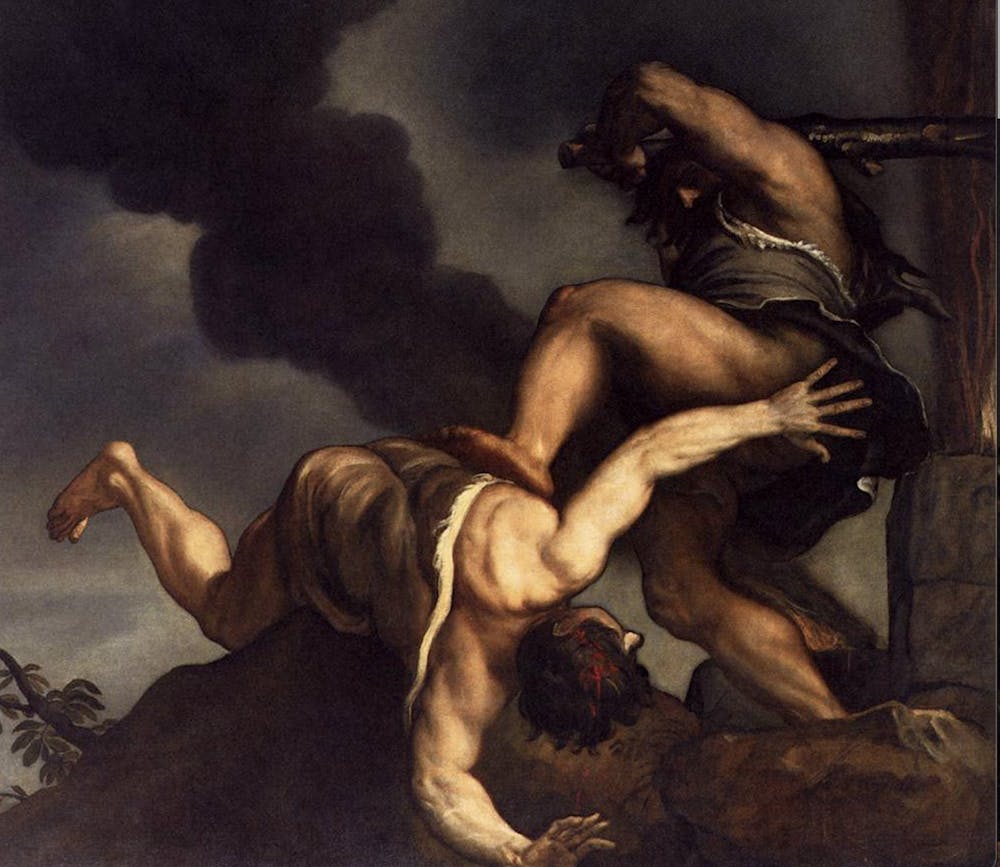
In one of the earliest stories of the Hebrew Bible, God asks Cain, “Where is Abel your brother?” Feigning ignorance, Cain responds, “I do not know. Am I my brother’s keeper?” But Cain did know what had happened — he and his brother had fought in jealousy, and Cain had killed him. It was humanity’s first murder. When God realized what had happened, God said, “What have you done? The voice of your brother’s blood cries out to Me from the ground. Now, cursed are you from the ground that opened its mouth to take your brother’s blood from your hand.” The entire Abrahamic tradition can be summed up as an affirmative response to the question Cain posed: We are our brothers’ keepers.
On Wednesday night, the ground opened its mouth once more. In a cowardly act of political violence, Charlie Kirk, a conservative political activist who founded Turning Point USA in 2012, was shot dead while speaking at Utah Valley University. Kirk, only 31, left behind two young children and a wife, Erika. My thoughts are with Kirk and his family.
When I first learned about Kirk’s death, I was disturbed but not particularly surprised. This is America after all, a country where political violence has become horrifyingly routine. A place where children are murdered in schools by the scores, and no one so much as bats an eye, or offers more than obligatory thoughts and prayers. In honesty, my second thought was about the irony of Kirk’s death, given his belief that gun deaths are the necessary cost of the Second Amendment. And then I saw the video.
A single shot rang out, inflicting a large laceration to the jugular and a near instant death. His blood, shooting from his neck, and literally crying out from the ground. In honesty, it was one of the more disturbing things I have ever seen. At that moment, whatever I thought about Kirk went out the door. He was a person who suffered and was therefore deserving of sympathy.
I, of course, in the abstract, am no stranger to death. I live in 2025, a world where suffering is abound, incomprehensible and yet paradoxically distant. One of the less scrupulous facts about modern life is the uncanny ability to stumble upon graphic footage of death on social media. Of course, when I normally encounter death online, it is impersonal. A bomb here, a car crash there or a natural disaster in some far away corner of the world. This great suffering is reduced to statistics that describe the countless faceless victims whose pain we will never see or whose names we will never know. In other words, death has become uninspiring, even banal.
This reality is not new. From the dawn of the Stone Age and the introduction of the bow and arrow, human beings have become more and more attuned to killing other human beings from a distance, both physical and psychological. We suffer from the inability to bear witness to what it is we have done, or to see upon ourselves our mark of Cain. This depersonalization of violence is ever more true of a drone strike piloted halfway across the world.
I have witnessed this same banality of death here at Brown. In the wake of the Oct. 7 massacre, there were students on our campus whose first impulse was to ignore clear war crimes and shamefully reframe them as a “victory.” Today, amid manmade famine and the expansion of a seemingly never-ending war, others dismiss Palestinian suffering as mere propaganda. In each case, the commitment to ideological purity comes at the expense of our own humanity. Perhaps this is why the video of Kirk’s assassination is so shocking — there is something uniquely irrefutable about a gunshot wound to the neck broadcast to millions.
I did not particularly like Kirk, and I will not eulogize him, but he did not deserve to die. No more than Melissa Hortman, the Democratic Minnesota House Speaker, and her husband, who were murdered in June in cold blood. No more than the children at the Annunciation Catholic Church who were gunned down two weeks ago, or the more than 250,000 children who have died since Trump dismantled USAID. And no more than Hersh Goldberg-Polin or some unnamed woman buried under the rubble. They are all deserving of every bit as much outrage, flag-lowering and sympathy as this country will inevitably give toward Kirk.
We live in a world where death is constant, yet invisible — abstracted away by distance, statistics or ideology. But we cannot look away. The question, “Where is your brother?” is one that must constantly weigh heavy on our souls. Even though we did not shoot Charlie Kirk, our mere acceptance of the absurdity of reality is violence in and of itself. Our task, then, is simple but difficult: to bear witness, to refuse to look away and to affirm in word and deed that we are, in fact, our brother’s keeper.
Tas Rahman ’26 can be reached at tasawwar_rahman@brown.edu. Please send responses to this opinion to letters@browndailyherald.com and other op-eds to opinions@browndailyherald.com.

Tas Rahman is an Opinion Editor and a member of the Editorial Page Board. He hails from Detroit, Michigan and is concentrating in Computational Biology and Judaic Studies. In his free time, you can find Tas hiking and reading the Atlantic (alongside the Herald).


