Astronomy, contemplative studies and critical Native American and Indigenous studies are among some of Brown’s smallest and most unique concentrations. And, according to data from The Herald’s First-Year Poll, they may get smaller: Zero students in the incoming first-year class indicated interest in pursuing them.
Even with limited interest, the programs’ offerings foster personal growth and intellectual exploration, students and professors say.
The College Curriculum Council, which takes input from both students and faculty, oversees Brown’s educational offerings. But the decision to eliminate a concentration is made at the departmental level, according to Dawn King, deputy dean of the College for curriculum and a voting member of the CCC.
“It’s okay if a concentration doesn’t graduate anyone this year, because what we look at is the faculty: Are faculty still passionate about teaching courses in that concentration?” King said.
All concentrations and certificates are reviewed in seven-year intervals, but this review is “nothing more than a conversation to help departments see how they may or may not be able to improve,” King said.
The council, she added, sees a lot of “ebb and flow” when it comes to student declarations in small concentrations. Meanwhile, larger concentrations like economics and computer science boast approximately 300 concentrators per year, according to Brown’s Degrees and Completions Factbook.
Despite limited enrollment in concentrations like CNAIS and contemplative studies, King believes there are benefits for the students pursuing them. “Students tend to have really great one-on-one advising,” she said. “We really hold up our small concentrations and want them to do well.”
Contemplative studies: Mindfulness and transformation
Contemplative studies — led by Harold Roth, professor of religious studies and East Asian studies — examines reflective practices through intellectual and experiential learning.
“We study contemplative states of experience across cultures and across time, from humanistic, scientific and artistic perspectives,” Roth said. Some of the methods used in the classroom include “various forms of sitting and moving meditation,” as well as yoga.
Roth built the concentration from scratch over a decade ago. “It started with one course … and then faculty joined to form an informal contemplative studies initiative,” he said. In 2014, the initiative was accepted as a formal concentration. Now, the concentration graduates approximately six students every year.
But the small program has its challenges. It is not officially a department, meaning that the concentration is not financially supported by the University. As a result, Roth focuses on networking and fundraising to maintain the program.
In an effort to draw students in, Roth said they host open houses, lectures and workshops. He also hopes more students will explore the Mentors in Residence program, where trained professionals lead virtual contemplative meditation workshops three times a week.
Isaac McDonald ’27 has been exploring the concentration since his first year at Brown, when he took COST 0560: “Contemplation and Social Action.” He would walk into the seminar with “anxiety and worries” and walk out “feeling so peaceful and happy,” he said.
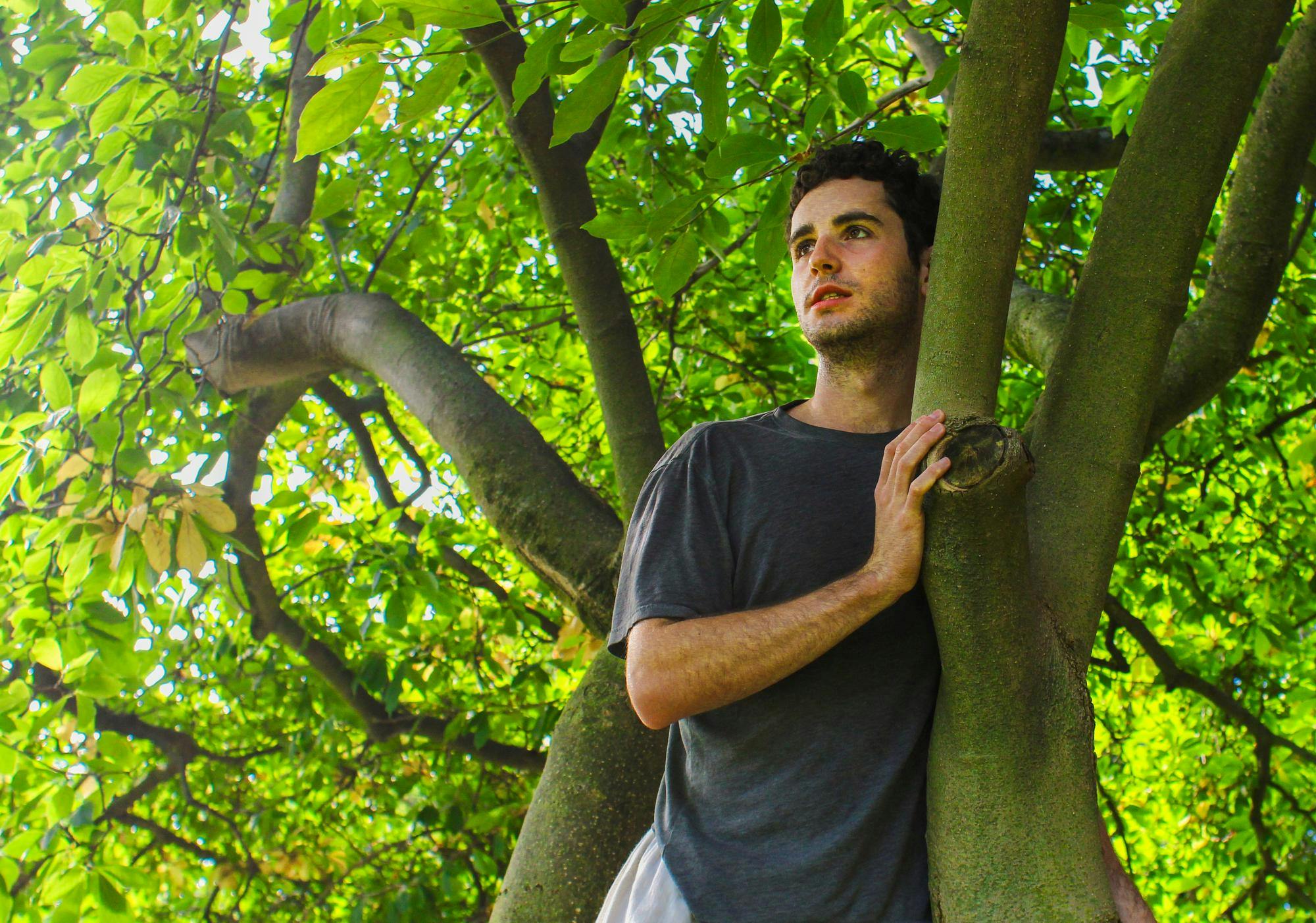
Isaac McDonald ’27 on Sunday. Because of the contemplative studies concentration’s smaller size, McDonald said he has “a genuine relationship” with his peers and professors.
Because of the concentration’s smaller size, McDonald said he has “a genuine relationship” with his peers and professors. “I don’t believe any other concentrations provide spaces for deep personal transformation like contemplative studies does,” he said.
Joshua Gerber ’26, who chose contemplative studies as his only concentration, also said the smaller concentration size has its benefits. “I feel like I have super close relationships with the professors and the students,” Gerber said.
But since the concentration is niche, he often has to explain his studies to peers and family members. “It’s a conversation starter,” he said.
For Gerber, the concentration has transformed the way he experiences the world. “I think I’m more attentive, and I listen to others more. Everything is more interesting,” he said.
The concentration has “changed my life, how I interact with the world and how I approach every single thing I do,” McDonald said.
Critical Native American and Indigenous studies: Resistance and community
Critical Native American and Indigenous studies focuses on centering Indigenous perspectives and histories in a landscape that has often ignored or overlooked them. Mack Scott III, the director of undergraduate studies for the concentration, explained that students learn to develop a critical lens in order to think about “why we know what we know.”
The concentration allows Indigenous people to “talk back to and intervene in a narrative that has tried to erase or marginalize their histories and experiences,” he said, adding that the techniques that are taught can provide students with a different perspective that “can be applied to various disciplines.”
The concentration graduated its first class in 2024, and both graduating classes thus far have included five students. Still, Scott said, “getting the word out there is challenging.”
To recruit more students, Scott often attends events like Brown’s Academic Expo, which encourages students to learn about the variety of courses and concentrations offered. At these events, he likes to ask students if they can name three Native Americans beyond Squanto, Pocahontas or Sacagawea, he said. This “opens up the conversation and draws interest.”
Skyler Recel-Chang ’27, who comes from a Native Hawaiian background, explained that the concentration formed as a result of “student, faculty and community activism” calling for more Indigenous representation in the curriculum.

Skyler Recel-Chang ’27 on Monday. In an email to The Herald, Recel-Chang wrote that the “classes and community” motivated her to concentrate in critical Native American and Indigenous studies.
In an email to The Herald, Recel-Chang wrote that the “classes and community” in the concentration motivated her to declare it, adding that the program’s small size makes it easier to access faculty advisors and peer mentorship opportunities.
But the department’s infancy means that “the promotional work often falls on the shoulders of student concentrators,” she said.
Last spring, students formed a Departmental Undergraduate Group and hosted events in collaboration with faculty supervisors to spread the word about the concentration. According to Recel-Chang, students promote courses in events such as the Third World Transition Program, engage in advocacy and coordinate with other departments on campus.
“There are courses within NAIS that can be of interest to students from all backgrounds,” Recel-Chang said.
Astronomy: Flexible and explorative
Astronomy, a concentration that graduates an average of one student per year, is intended for students who “have interest in astronomy, but do not want to do the preparatory work in physics,” according to Director of Undergraduate Studies and Concentration Advisor Ian Dell’Antonio.
He explained that while astronomy culminates in a Bachelor of Arts degree, students concentrating in physics — which includes an astrophysics track — often receive a Bachelor of Science.
Astronomy concentrators can take advanced courses and “learn about properties of stars, galaxies and how the universe works, with a slightly less demanding schedule than the Sc.B. in physics,” Dell’Antonio said.
The concentration also requires fewer credits than the Sc.B. in physics, which allows it to accommodate students who discover their passion for the subject later in their undergraduate careers.
To recruit students, “we try to make sure the courses are as attractive as possible and that the opportunity exists on the bulletin,” Dell’Antonio said.
He added that the low number of concentrators don’t threaten the existence of the program because astronomy requires no new courses and doesn’t incur an additional cost.
“It’s within the physics department,” Dell’Antonio said. “It doesn’t hurt to keep it in the books.”