On Wednesday, Yale Professor of Law and Political Science Akhil Amar introduced his new book, “Born Equal: Remaking America’s Constitution, 1840-1920,” at Brown’s annual Constitution Day Event. The book is tentatively the second installment in a trilogy on United States history.
The event, hosted by the Center for Politics, Philosophy and Economics, is held annually to commemorate the signing of the U.S. Constitution on Sept. 17, 1787. Each audience member received a free copy of Amar’s book.
This is Amar’s second year as the guest speaker for this event. In last year’s address, he primarily focused on originalism as a judicial philosophy, as well as the first installment of his trilogy: “The Words That Made Us: America’s Constitutional Conversation, 1760-1840.”
Amar began this year’s lecture by speaking about why Constitution Day is so significant, giving a brief history of the signing of the Constitution. In his summary, Amar noted the importance of releasing the founding document to the public as a digestible, concise paper designed to allow every American to understand the founding intentions for the country.
Amar noted the challenges of maintaining a cohesive American identity and argued for “a national narrative that is comprehensive and candid, that acknowledges the flaws and truth.”
“Without a national narrative, we don’t have enough in common to go forward. We need to remember who we are,” Amar said. “We don’t have race in common. We don’t have religion in common. We don’t have a first language. We’re politically polarized. We need a national story.”
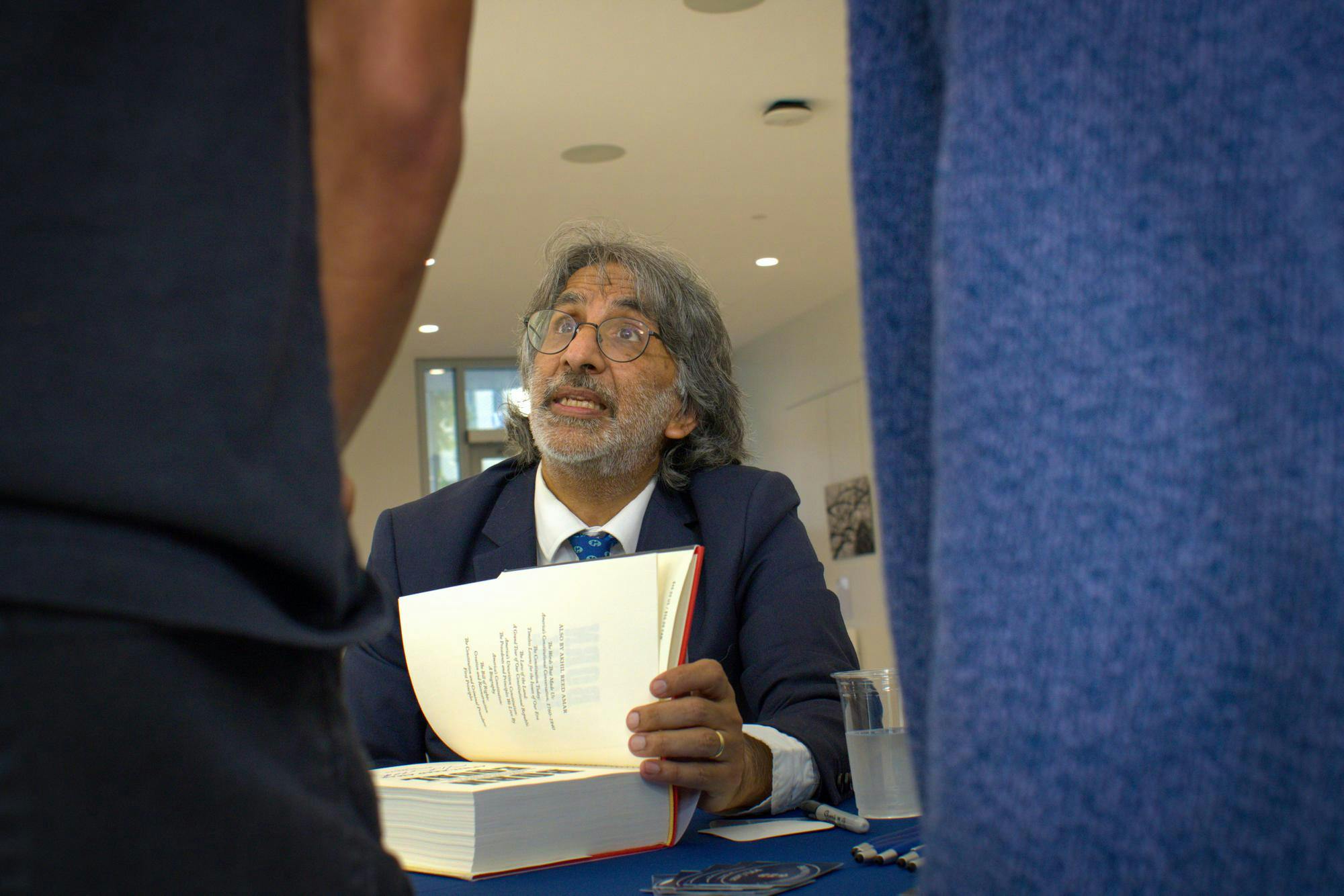
“Born Equal: Remaking America’s Constitution, 1840-1920,” his most recent book, explores the unrealized potential for a society where all are treated equal at birth in the American Constitution, Amar said.
In his book, Amar traced this narrative from the Declaration of Independence to the 13th, 14th, 15th and 19th Amendments, following four key historical leaders who encapsulated the fight for citizenship and suffrage in the late 19th and early 20th century: Abraham Lincoln, Harriet Beecher Stowe, Elizabeth Cady Stanton and Frederick Douglass.
That era marked “the unfolding of the radicalism of the American Revolution project. An enlightenment project about how people, in the end, should not be defined by who they are but by what they do,” said Amar.
David Skarbek, director of the Center for Politics, Philosophy and Economics and professor of political economy, called Amar “one of the most important constitutional scholars of his time” in an interview with The Herald.
The annual Constitution Day event spotlights different speakers and “aspects of the Constitution” each year, Skarbek said. But each talk centers on “the values, institutions and incentives” embodied in “the way the Constitution governs our society,” he added.
Nik Greborunis ’28, a political science concentrator, recalled being struck by Amar’s description of Abraham Lincoln: “He was never the most radical person of his era, but he’s … the most radical person who can get elected,” Amar said of Lincoln during his talk.
Greborunis attended last year’s Constitution Day Event and “really enjoyed it,” which motivated him to register for Amar’s second talk. He said that he looks forward to reading Amar’s new book.

Amber Marcus-Blank was a senior staff writer covering undergraduate student life. She is a junior from outside of Boston studying Political Science and Public Health on the pre-law track. She is interested in working in politics and journalism in the future and enjoys playing soccer and making playlists in her free time.