
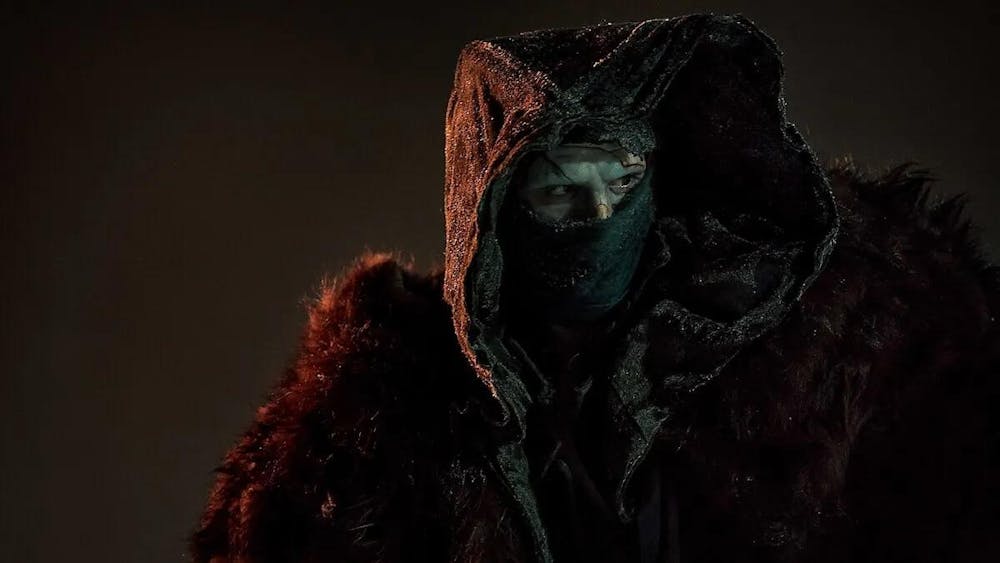
Guillermo del Toro and monsters are a match made in heaven. The colorful director behind “The Shape of Water” and “Pan’s Labyrinth” has solidified himself as an auteur with a keen eye for the twisted and appalling, consistently adding to a collection of irresistible horror films. Del Toro has mastered feeding the audience’s morbid curiosity while also acknowledging the human instinct to sympathize and find solace with the otherworldly.
It’s a little surprising, then, that del Toro’s summer Netflix release “Frankenstein” only works because of a knockout performance from Jacob Elordi as Frankenstein’s monster, offering a fresh new take on the lead creature’s plight.
The familiar tale centers around the creation of a reanimated life form by fictional scientist Victor Frankenstein. In the source material — titled “Frankenstein; or, The Modern Prometheus” — author Mary Shelley paints Victor as an ambitious man who abandons his happy, complacent life to achieve his lofty scientific aspirations. Readers don’t necessarily sympathize with his hubris, but they also don’t recognize much ill-intent in his actions. He’s a charismatic man that makes the fatal mistake of playing God.
On the other hand, del Toro’s Victor (Oscar Isaac) is the result of a cruel father whose lack of approval serves as the impetus for his son’s ambition. Isaac effectively plays the character as a wild egomaniac whose destruction of everything around him stems from his own perceived inadequacy, not the unholiness of his creation.
At first, Frankenstein’s creation — referred to as “the Creature” — is emblematic of a newborn baby: harmless, curious and intrinsically peaceful. But after he’s abandoned by his creator, the Creature embarks on a voyage in which he learns of humanity’s cruelty firsthand. As he becomes more intelligent, he subsequently turns to despair and violence himself.
But where this newest adaptation differs from most others is in how it explains the Creature’s downfall. In del Toro’s film, the Creature’s plight is not a product of the world’s prejudices, but of his creator’s — his father’s — cruelty. Elordi’s monster is violent and miserable primarily because of his own low self-worth and distorted self-image as an abandoned and abused amalgamation of the dead. Even though many of the film’s characters treat the Creature kindly, he believes he’s worthless anyway. Whatever issues both Victor and his creation have here, they seem to stem more from their upbringings than from anything else.
Del Toro’s take on the film, while interesting, would’ve come across better in a more grounded, intimate production — not a $120 million Netflix blockbuster. Elordi brings a deeply nuanced, emotional complexity to the role, sometimes commanding the screen with just his eyes. It’s startling and by far the highlight of the film. Thankfully, his performance takes up a big chunk of the almost two-and-a-half hourlong runtime.
But del Toro’s odd directorial approach dampens Elordi’s — and the entire film’s — brilliance in a manner almost reminiscent of the “daddy issues” present in relationships between the Creature, Victor and Victor’s father. The director overextends his visual panache to an almost contrived degree: There are so many painting-like visuals, overacted confrontations and gory CGI action scenes thrown at audiences that things start to feel hollow. Whatever intimacy Elordi’s performance creates is diminished by the director’s efforts to live up to the film’s astronomical budget.
This is a shame especially because of del Toro’s track record. Originally an animator, del Toro has perfected his craft in part because of how much passion and originality he puts into creating unique worlds and odysseys. The film does contain scenes and characters reminiscent of del Toro’s past work: A dreamlike angelic figure in “Frankenstein” looked as though it came straight out of his recent adaptation of “Pinocchio.” But so much of the film feels like an attempt to make the plot appeal to a general audience — in spite of the fact that the screenplay deviates from the much-loved gothic novel in favor of an unconventional, trauma-driven story.
At the very least, del Toro’s “Frankenstein” is entertaining. Audiences are unlikely to get bored at any point during the film. But it’s disappointing that such a talented cast and director made a project that lacks any real cohesion. Nonetheless, audiences will walk out of the theater moved by the incredible craftwork of its starring creature. Elordi is the film’s saving grace — and the only thing that truly makes “Frankenstein” worth the watch.


