
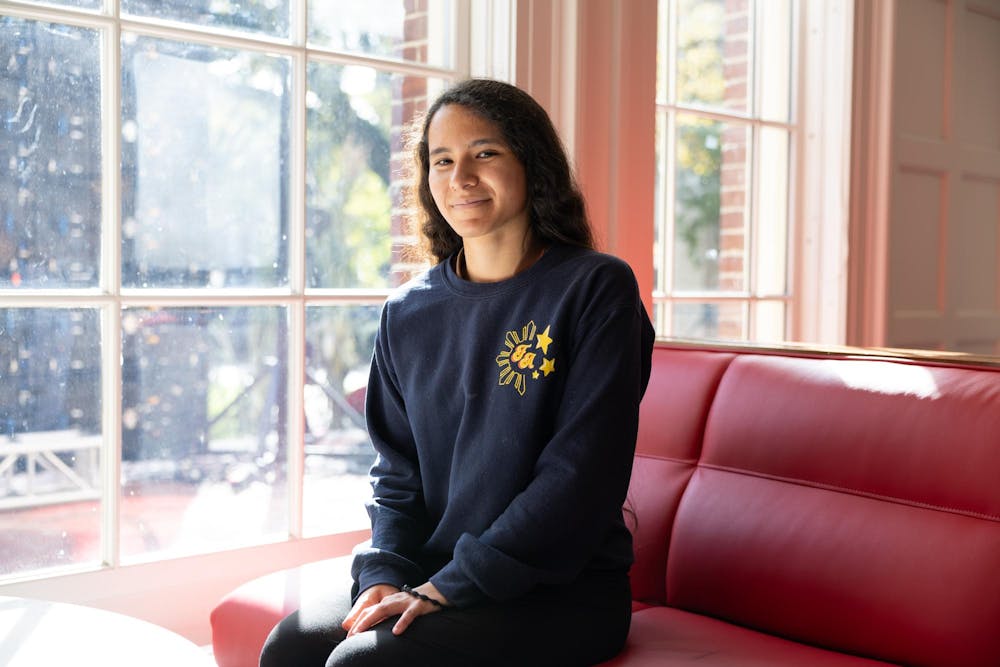
For the past year, Alexa Theodoropoulos ’27 — vice president of the Brown Filipino Alliance — has been leading the charge for Filipino@Brown (Tagalog@Brown), an initiative advocating for the University to offer a Tagalog language program. Last week, she received confirmation that the Philippine Consulate General would offer the University a contract of around $18,000 to jumpstart a Tagalog language program.
The funding offer was extended by Senator of the Philippines Loren Legarda, a representative from the consulate wrote in an email to The Herald. The grant would require the University to provide a list of proposed programs and allow the consulate to monitor the programs’ implementation.
Theodoropoulos first reached out to the Philippines’s Department of Foreign Affairs on the advice of Charlie Veric, a professor from Ateneo de Manila University, after he mentioned that the department often sponsors Filipino language initiatives in the United States.
Dean of the Faculty Leah VanWey wrote in an email to The Herald that “the University’s current financial situation does not permit the addition of a robust sequence of courses from introductory to advanced Tagalog.”
VanWey noted that while the University is still reviewing the contract from the consulate, the contribution does not meet the amount needed to offer “a full suite of courses and associated programming in any language that we offer.”
The University told Theodoropoulos that they would come to a decision within a few weeks.
If not accepted by the end of the year, the offer will be forfeited, Brown Filipino Alliance Co-President Anna Zulueta ’25.5 wrote in an email to The Herald. Zulueta is also an organizer with Filipino@Brown.
The money provided by the consulate would be enough to cover “almost all of the first year” of the five-year plan Filipino@Brown organizers presented to the University, Zulueta said.
“We are very disappointed that getting this grant has so far not persuaded the University to take more action on our cause,” she added.
Funding for the remainder of the program could “come from alumni or external donations,” Theodoropoulos said.
Though Theodoropoulos began working toward the language program last year, calls for the University to offer Tagalog trace back to 1988, when the Filipino Alliance was founded.
Theodoropoulos revitalized these demands last October — the anniversary of the arrival of the first Filipino immigrants in the United States — by drafting a letter to the University, requesting the development of a Filipino language program.
In the letter, she argued that “language representation empowers” students and referenced the recent addition of Tagalog courses at Harvard and Yale. Her letter also mentioned that Brown students have conducted nine group independent study projects in Tagalog or Filipino culture since 2001.
“It’s time for Tagalog to be its own, regularly-offered class,” Zulueta wrote.
Students cannot retake a GISP on the same topic, so “it’s a huge burden on students to reinvent the wheel every time they want to take a language class,” she added.
Over the fall and spring semesters last year, Theodoropoulos collected around 1,100 signatures for a petition campaigning for the language program. “We tried to get any relevant stakeholder we could possibly think of,” she said, adding that she reached out to undergraduates, alums, faculty and staff.
By the end of the spring semester, she sent the University her letter, attaching testimonials, the petition, a detailed curriculum proposal and an anticipated budget.
Zulueta and Theodoropoulos have also received support from various faculty members.
Rick Baldoz, associate professor of American studies, helped Filipino@Brown build support “both on and off campus,” he wrote in an email to The Herald.
Visiting Lecturer Trang Tran, who teaches Vietnamese at Brown and serves on the Filipino@Brown board, shared the petition with her professional network and her students. Vietnamese was added to Brown’s course catalog in 2021, The Herald previously reported.
Tran wrote in an email to The Herald that “there have also been ongoing discussions about aligning potential funding with existing academic initiatives,” such as the Filipino Studies Fund, the Diversity and Inclusion Action Plan funds and partnerships with other universities.
Daniel Ibarra, assistant professor of earth, environment and planetary sciences and engineering, also voiced his support for the initiative. “As a part of the Filipino diaspora at Brown,” he wrote in an email to The Herald, “I am very supportive of establishing a language course.” He added that though he teaches in STEM fields, he hopes that Brown will offer Tagalog, “like our peer institutions.”
Center for Language Studies Director Jeremy Lehnen said that while he is “supportive” of the initiative, it is “important to build a sustainable program that will generate the interest and enrollments necessary for continuation.”
Lehnen wrote that all new courses must undergo a standard approval process, obtaining the approval of the College Curriculum Council.
Theodoropoulos said that despite obstacles, organizers “want to put pressure on the administration to make the right decision and realize how important this is.”
She described the language program as “reparations,” referencing Brown’s role in cultural suppression in the Philippines. Many of Brown’s alums, she said, were “soldier-teachers who moved to the Philippines during the war and forbade the use of Filipino languages.”
Zulueta and Theodoropoulos have been working on “a report on Brown’s ties to the Philippines and Filipino diaspora, inspired by the Slavery and Justice Report,” Zulueta said.
“Brown sees reparations and critical reflection as a priority,” Theodoropoulos said, “but it needs to extrapolate this mode of thinking to all global issues it has been a perpetrator in.”
The consulate wrote that they are waiting on the University to send comment on the draft memorandum of agreement. If approved, the consulate will then plan a signing ceremony with the University.

Alejandro Ruiz is a university news senior staff writer covering academics and advising. He is a junior from Edison, NJ studying biochemistry and philosophy. In his free time, he can be found with his friends or with an AirPod in.


