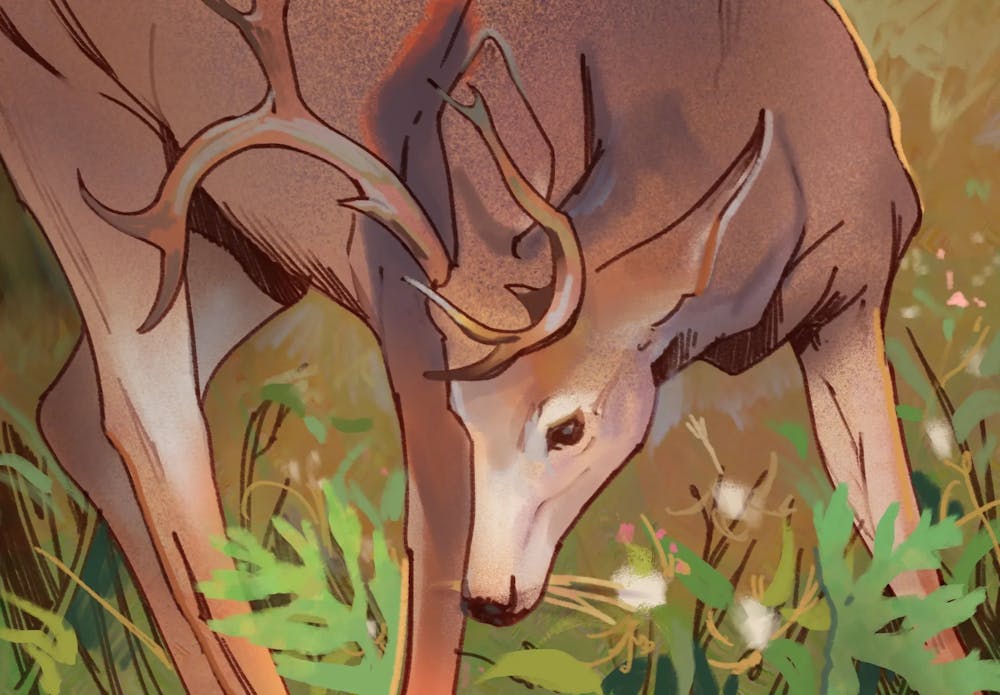
For most, animal dung may appear unassuming.
But Bethan Littleford-Colquhoun, a molecular ecologist at the University of Bath, couldn’t disagree more. Rather, she views animal dung as “an incredible resource for understanding wildlife.”
This year, Littleford-Colquhoun joined researchers from Yellowstone National Park and Brown’s Genomic Opportunities Lab on a study that found that large herbivores in Yellowstone, like bison, follow a wider diet than previously thought. As part of their research, the team analyzed fecal samples from a variety of animal species.
The Genomic Opportunities Lab is headed by Tyler Kartzinel, an associate professor of ecology, evolution and organismal biology.
The paper, first authored by Hannah Hoff GS, utilized dietary DNA metabarcoding — a DNA sequencing technique that identifies species within a sample — and GPS tracking. The study also used a machine-learning algorithm to compare the diets of five large herbivore species in Yellowstone: pronghorns, bighorn sheep, mule deers, elks and bison.
“The problem that this study addresses is a classic ecological paradox: How do Yellowstone’s abundant herds of large herbivore species divvy up the available plant resources without starving each other out?” Hoff said.
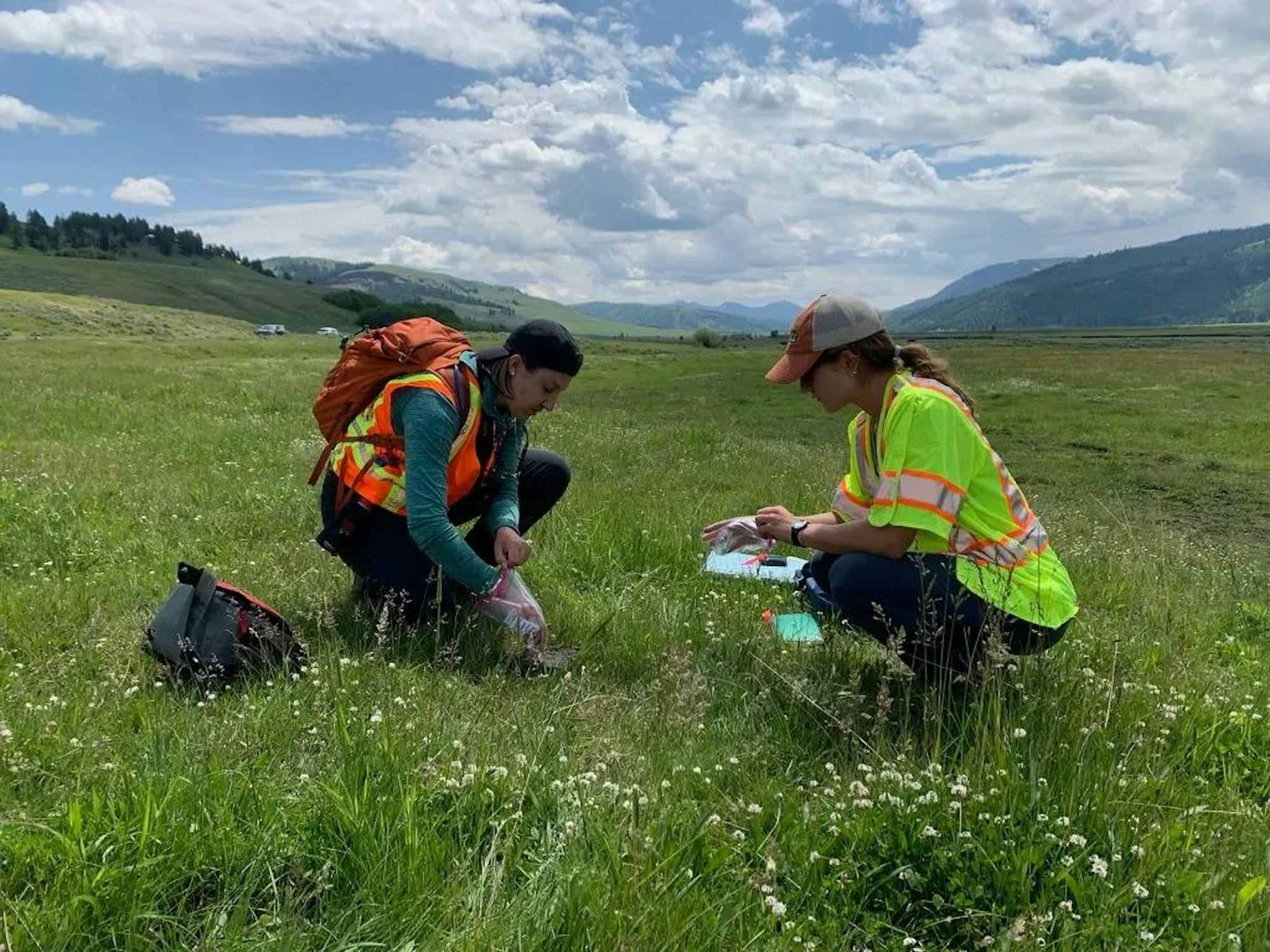
As part of their project, researchers from Yellowstone National Park and Brown’s Genomic Opportunities Lab analyzed fecal samples from a variety of animal species. Courtesy of Hannah Hoff
The traditional model used to answer this question, Hoff explained, has relied on the division of species into “grazers” — who primarily eat grass — and “browsers” — who eat little to no grass. But the research performed by Hoff and her team complicated the grazer-browser continuum by identifying three statistically different diet clusters.
The first cluster includes animals that eat graminoids — grass-like plants — and forbs, which are flowering plants. The second cluster consists of animals that eat forbs and deciduous shrubs, which are leaf-shedding plants. Finally, the third cluster encompasses animals that eat gymnosperms, which are woody, non-flowering plants like conifers.
“One of the long-standing rules in ecology is that no two species can stably coexist if they compete for exactly the same resources on equal terms,” Kartzinel wrote in an email to The Herald.
These results, Hoff said, challenge “us to consider the roles of other factors, like spatial separation, seasonal migration and eating different plant parts, that allow (the mammals) to inhabit the same landscape.”
The new clusters of herbivores also raise questions about how mammals’ diets change seasonally, Littleford-Colquhoun wrote in an email to The Herald.
“Our findings suggest that dietary variety is the norm, not the exception, and that instead of asking, ‘Do bison eat grass?’ a better question might just be, ‘Are they eating grass right now?’” Hoff said.
The researchers took two major steps to gather data during their fieldwork at Yellowstone. The first was collecting fecal samples — which required waiting for GPS-collared animals to defecate.
“Once the animal moves out of the area, we rush out to grab the sample and bring it back to the lab,” Hoff said.
The second step involved investigating plants at Yellowstone that were collected on-site and from herbarium specimens. The data then undergoes DNA barcoding, which identifies all different DNA sequences in a given sample using laboratory and computational techniques, Hoff said.
“Once we have a library of unique DNA barcodes for each plant species, we can compare these barcodes to the DNA found in the animal dung,” Hoff explained. “This allows us to determine exactly which plant species the animals have been eating.”
Combining DNA barcoding with machine learning allowed the researchers to “‘see’ the invisible,” Kartzinel wrote, “in the sense that we could know where animals were going and what they were eating, even when it was impossible for us to watch them directly.”
The findings of this project could have far-reaching effects, including the reimagining of wildlife management principles “as animal communities … respond to changing seasons or climates,” Littleford-Colquhoun wrote.
“I hope it helps ecologists — and really any scientist who relies on simplifying categorizations in their work — remember to check their assumptions and keep an open mind when it comes to considering alternative possibilities,” Kartzinel wrote.
These findings are not only important in the context of Yellowstone, but also in the broader field of ecology and wildlife biology, potentially improving the fidelity of ecological models, said Littleford-Colquhoun.
“This is much bigger than Yellowstone,” Hoff said.

Alice Xie is a section editor for Science and Research from Los Angeles, California. She studies Applied Mathematics and Biology, and enjoys reading gut wrenching literature in her free time.