On Oct. 20, the Office of Information Technology launched Transcribe, the first artificial intelligence tool developed for the broader University community by the Brown AI Sandbox project
The release is part of a broader initiative to integrate AI tools into the University’s resources, as Brown shifts to institutional adoption of the new technology.
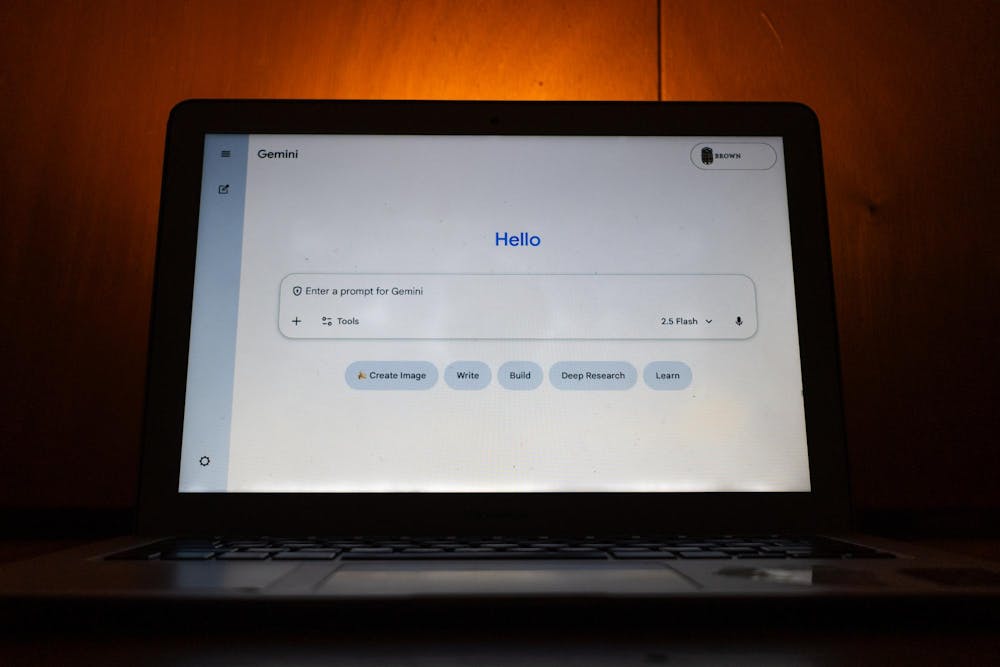
Last spring, the students also gained free access to Google AI services through their Brown accounts, including Google Gemini Chat and NotebookLM.
Transcribe was developed in the University “in partnership with a number of faculty and staff,” Christopher Keith, the vice president of information technology and chief information officer, wrote in an email to The Herald.
“It performs better and costs much less than similar commercial transcription services,” he added.
Michael Littman PhD’96, the associate provost of artificial intelligence, noted that he thinks this service will be particularly useful for faculty in the social sciences “who do some of their experimentation in interviews.” It is available in Arabic, Chinese, Dutch, Spanish, Italian, German, Russian, Portuguese, Japanese, French and Vietnamese.
“We think these tools are extremely relevant to the business” of universities, Littman said. “They shouldn’t just be available to people on campus who have their own personal resources to pay for them.” The pricing for premium large language models typically falls around $20 per month.
He added that “students and faculty are really creative about coming up with ways of using this tool.” While there is a concern of increases in students using AI to cheat, Littman believes that students at Brown “don’t want to undermine their ability to actually learn material” by relying on AI.
The OIT cleared Gemini and NotebookLM for level three data, the highest safety clearance possible.
This clearance ensures that Google cannot train their models with any University data, according to Littman. The institutional accounts are better suited “for anyone who handles sensitive University data” and for protecting student personal data, Keith said.
Transcribe has not yet received this clearance, Littman said. According to the announcement, Transcribe is cleared for sensitive data from level 1 to 2.
While Gemini cannot repurpose any Brown user data, Keith said that a select few OIT staff can access individual usage logs — including the content of chat queries — in “specific and rare situations.”
Brown can “monitor, access, preserve, disclose and secure” any data without prior notice, the Acceptable Use of Information Technology Resources Policy reads. But the policy also states the University “respects the reasonable privacy expectations of its students, faculty and staff.”
Keith shared that the University plans to continue to develop its own AI services within the AI sandbox suite, including a service called Librechat, which will provide a large language model that consolidates popular models into a single chatbot.
As the University launches new AI tools, the OIT plans to work closely with the Sheridan Center for Teaching and Learning, including via the Generative AI in Teaching and Learning Committee, chaired by Littman and Eric Kaldor, director for assessment and interdisciplinary teaching programs at the Sheridan Center.
“I hope more students and faculty will feel comfortable exploring the capabilities and limitations of LLMs in their fields of expertise,” Kaldor wrote in an email to The Herald. “It will be important for them to develop critical AI literacy.”
Some students that The Herald spoke to were unaware of Brown’s partnership with Google AI, despite the fact that it was announced to the campus community last spring.
Hilary Nguyen ’27 recently noticed she had access to premium features on Gemini services while using it, but she was not aware this was because of Brown’s partnership with Google AI, she said. She noted that she occasionally uses AI to help her understand figures from her biochemistry readings, but she more consistently uses ChatGPT.
Nick Burleson ’29, who also prefers ChatGPT, was unaware of his ability to access Gemini through Brown. As AI continues to evolve, he believes the University should have “stricter measures” to prevent abuse.
Before the semester began, Seth Rockman, professor of history and the department’s director of undergraduate studies, wrote a memo to the history faculty voicing concerns about the growing presence of AI in classrooms, advising faculty to anticipate an increase in AI use.
He also expressed concern about the technology’s impact on students’ preparation for careers after graduation. “The only way you’re going to get a job is if you have the skills, sensibilities and instincts that exceed AI,” he wrote in the memo.
Some faculty have already begun to incorporate Gemini in their curriculum.
Professor of Physics James Valles allows students to use AI for various assignments in his course. His syllabus states that he uses AI to generate course activities and resources. He also provides guidelines for properly crediting and reflecting on AI usage.
“I support the efforts that the University… (is) making to assess the current use of Gen AI and expectations about how it might be used in the future,” he wrote in an email to The Herald.

Alejandro Ruiz is a university news senior staff writer covering academics and advising. He is a junior from Edison, NJ studying biochemistry and philosophy. In his free time, he can be found with his friends or with an AirPod in.