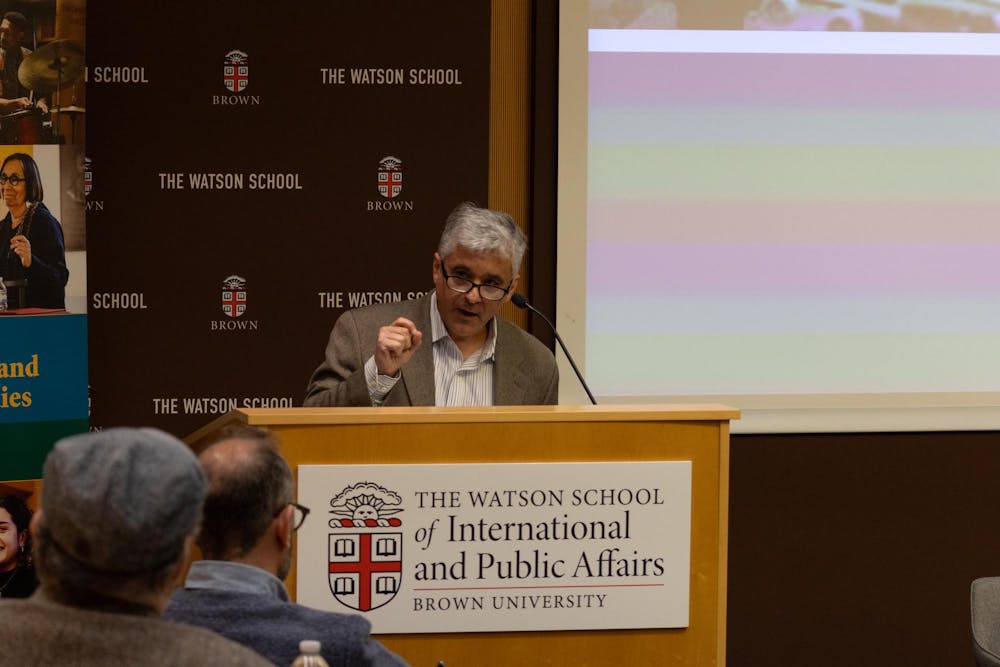
In an era when “it’s simply easier to be an autocrat” than it was three decades ago, Steven Levitsky P’26, a professor of Latin American studies and government at Harvard, views the survival of some Latin American democracies as a remarkable display of resilience, he said at a Monday event sponsored by the Center for Latin American and Caribbean Studies.
During the lecture, titled “The Resilience of Democracy in Latin America,” Levitsky argued that capitalist economic development and weak state power may explain why some Latin American states have eluded a global wave of authoritarianism.
Levitsky, who co-authored the 2018 New York Times bestseller “How Democracies Die,” has emerged in recent years as a prominent academic voice on the erosion of democracy. The event began with an introduction from Neil Safier ’91, the director of the CLACS and associate professor of history, and featured Levitsky’s lecture followed by a moderated discussion with audience questions.
To Levitsky, Latin America stands out from other regions because it is “about as democratic as it was a decade ago.”
“There were really good reasons to expect Latin American democracies to fail in the early 21st century,” Levitsky said, noting that many democracies in the region survived despite an “unfavorable international environment,” poor economic performance, the COVID-19 pandemic and violent crime.
For example, Levitsky said he and other scholars “worried a lot about Brazil” as a potential site for democratic backsliding, but these concerns were eased when the country’s legal systems blocked former Brazilian President Jair Bolsonaro’s attempts to stage a coup after losing the 2022 presidential race.
For Levitsky, “the key recipe for autocracy” comes when “resources are concentrated in the hands of the state.”
“When the state controls the main sources of wealth and income, citizens and businesses are going to depend on the state,” Levitsky explained. “Governments can always exploit that dependence by denying essential resources to their critics.”
But in Latin America, capitalistic economic development has limited the region’s dependence on state-controlled resources while creating a wealthy private sector that can stand up to the government.
“All of those things build countervailing power,” Levitsky explained. “That means that opposition forces have deeper pockets. It means they’ve got stronger organizations. It means they’ve got larger activist and voting bases.”
“Like it or not, a decent-sized capitalist class is pretty close to being a necessary condition for stable democracy,” he added.
Levitsky also argued that “the source of democratic resilience is less societal strength than it is state weakness.”
“Autocrats with weak states or aspiring states have a very difficult time governing — or at least governing well,” he said. “When autocratic governments fail to deliver the goods, they also face problems of public discontent,” undermining their stability.
But despite their success at evading democratic erosion, Latin American countries still must confront a growing appeal of populist political figures worldwide, Levitsky said.
He attributed this narrowing divide between politicians and voters to avenues like social media, which have made “gatekeepers” — like political parties and media — less relevant.
Additionally, modern politics “is much, much more democratic than the old,” Levitsky said, offering another explanation for the rise of populist leaders. “It opens the door to politicians who wouldn’t have had a chance” 50 years ago.
But this development, he warned, may have unanticipated downsides.
“What happens when people are so angry that what they want is someone who will take a wrecking ball to existing institutions?” he asked.
Professor of Political Science Richard Snyder, who previously served as director of the CLACS, said he appreciated that Levitsky’s theories drew on a breadth of existing democratic theory and case studies.
“Very few people can give talks like that,” Snyder said in an interview with The Herald following the event.
María Palacio, a postdoctoral research fellow at the Pembroke Center for Teaching and Research on Women, said she found Levitsky’s model “interesting,” but was unsure if she agreed with it because it is “a very top-down model.”
“It doesn’t take into consideration other processes of democratization that are more bottom-up,” she said.
But if Levitsky is correct in arguing that capitalistic economic development is “an inoculation, to some degree, against democratic collapse,” Snyder said there is good reason for optimism.
“We should feel comfortable that the dispersion of power across civil society and other actors is quite great in this country,” he said.

Ethan Schenker is a university news editor covering staff and student labor. He is from Bethesda, MD, and plans to study International and Public Affairs and Economics. In his free time, he enjoys playing piano and clicking on New York Times notifications.