
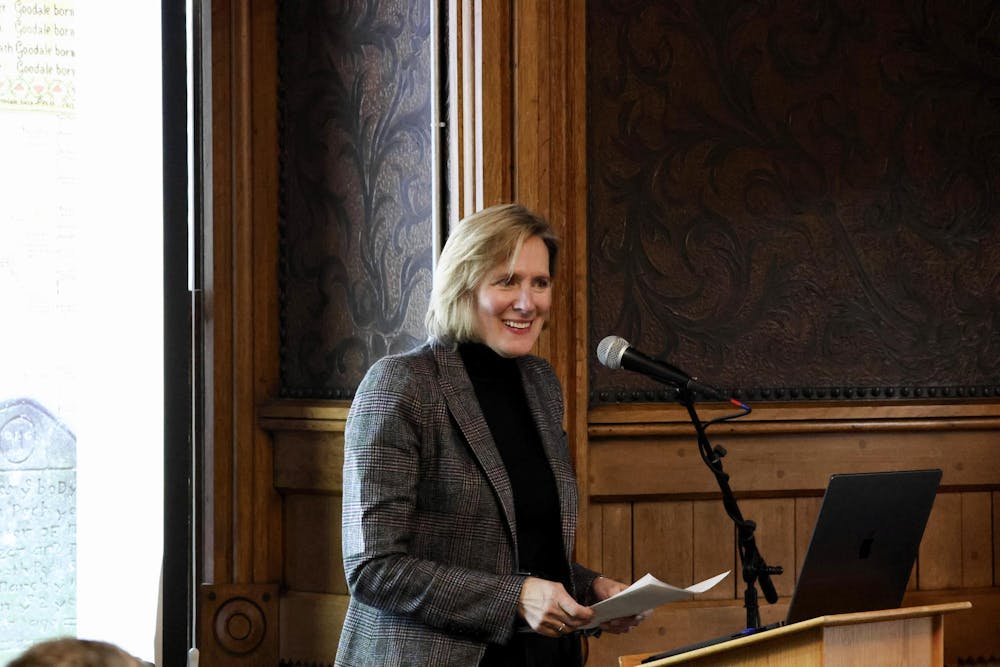
At a Department of History Event on Tuesday, Director of the John Carter Brown Library and Professor of History Karin Wulf celebrated the launch of her book “Lineage: Genealogy and the Politics of Connection in Early America” which explores the pervasive force that genealogy had in 18th-century American society.
The event featured remarks from Leslie Harris, a professor of history and African American studies at Northwestern University.
In her talk, Wulf discussed how her book, “Lineage,” explores the ways that genealogy permeated every level of society in early America.
Before welcoming Wulf on stage, History Department Chair Tara Nummedal introduced Wulf as a scholar “widely known for disseminating historical knowledge in multiple registers.”
During the talk, Wulf presented a family tree that George Washington made as a teenager. While one side of this document traced Washington’s lineage, the other showed the enslaved people he would inherit through his father and brother.
For Wulf, this family tree depicted the “twin functions of genealogy” and Washington’s “keen consciousness of the significance of genealogy and its relationship to slavery,” she wrote in her book.
Thomas Jefferson also documented his lineage in ways that shed light on this relationship. In one document, he recorded his children and his wife, Martha Jefferson. In another document, which he called his “Farm Book,” he kept a record of his children with Sally Hemings, an enslaved woman Jefferson owned, Wulf said in her talk.
Genealogy was both “an intimate practice that families and individuals” undertook and “a practice that governments and other institutions, like churches and corporations, were invested in,” Wulf said in an interview with The Herald. “This is definitely not your grandmother’s genealogy.”
“There are ways that genealogy has been attached to big, violent, political projects,” Wulf added, pointing to the Nazi regime’s employment of eugenics in the Holocaust. Another example she pointed to was U.S. slavery, which was perpetuated by “making it inheritable through (enslaved) mothers.”
In an interview with The Herald, Harris said that ideas in “Lineage” resonated with her own history as a descendant of “enslaved people who were removed from Africa and then brought here and placed in a new system of genealogy.”
These legacies of genealogy still provide “infrastructure” that influences U.S. society today, Wulf said. One example of this is the current debate about birthright citizenship.
The idea for “Lineage” arose when Wulf came across 18th-century archival materials that showed people writing family histories. She said this came as a surprise, since the 1700s was an era of “democracy and the rise of waged labor, all of these ways in which individuals, rather than families, are being emphasized, culturally, socially, politically,” she said.
While conducting research for “Lineage,” Wulf searched for genealogical records and family account books in libraries and archives across the United Kingdom and parts of America that had been colonized by England. She also utilized digital repositories.
Sarah Pearsall, a history professor at Johns Hopkins University, previously worked with Wulf on a conference “centering families in the Atlantic world in the period 1500 to 1800,” she told The Herald.
“She’s really a scholar’s scholar,” Pearsall said. “She’s able to place the family and people’s interest in family connections in all kinds of different ways at the center of early American history, and that’s a really monumental achievement.”
There are misconceptions about early America that center on the British-American revolutionary moment, Wulf told The Herald. As an “early Americanist,” Wulf is committed to “the full geography and the full history of all the people who lived in this place,” she said.
“What’s wonderful about the book is that often when people look at the colonial era, they look only at European Americans, especially for a topic like genealogy,” Harris said. But “Lineage” challenges that lens.
Wulf is currently focusing on multiple new works: a project on “unmarried mothers who went to court” in 18th-century Massachusetts, a book on the invention of early America and another about Esther Forbes, a Pulitzer Prize-winning author from the mid-20th century.

Ivy Huang is a University News and Science & Research editor from New York City. Concentrating in English, she has a passion for literature and American history. Her favorite authors include Marilynne Robinson, Vladimir Nabokov, and Toni Morrison. Outside of writing, she enjoys playing basketball, watching documentaries, and beating her high score on Subway Surfers.


