
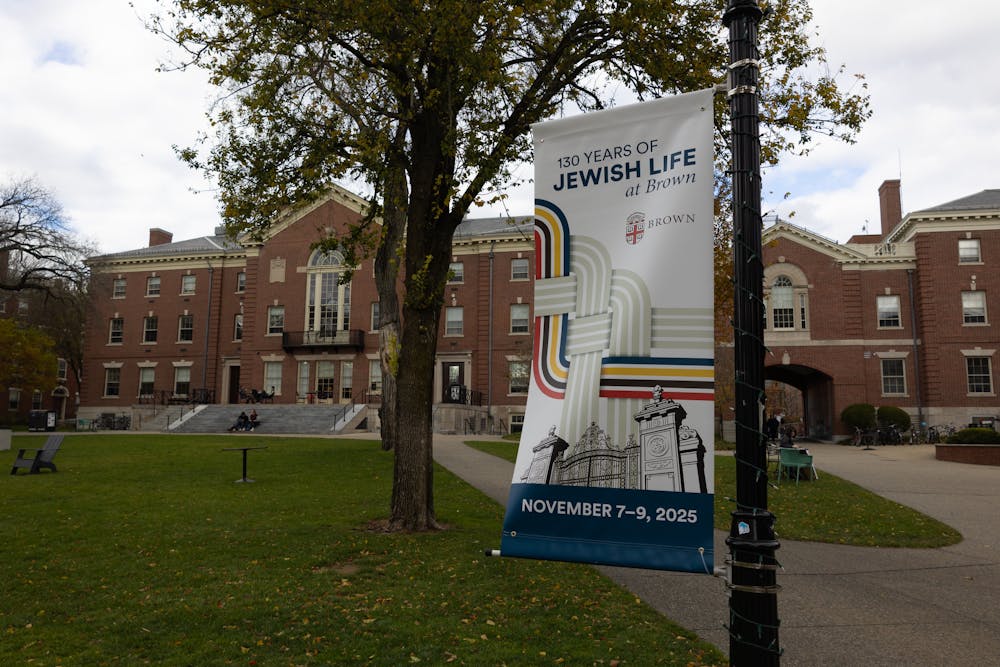
Everyone worried it might rain, but the night of Nov. 7 was crisp and clear, as beautiful an evening as you can imagine in New England. Under a tent on Pembroke Field, Cantor Lizzie Shammash ’91 sang Shalom Aleichem and Rabbi Ayelet Cohen ’96 recited Motzi and Kiddush — the Jewish blessings for bread and wine, respectively — as hundreds of students, alums, faculty and parents celebrated 130 years of Jewish life at Brown. The beauty of the moment, however, mattered less than what is signaled. In a time when Jewish visibility feels fraught, this celebration provided Jewish life with a chance to be seen and showed that the University understands how a healthy Jewish community contributes to a healthy Brown community.
It is harder to be a Jewish college student now than it was just a few years ago. Between 2019 and 2024, cases of antisemitic assault, harassment and vandalism rose by over 300%, with college campuses seeing an 84% increase in these antisemitic incidents between 2023 and 2024 — targeting a youth audience that is increasingly susceptible to antisemitic narratives. After the Oct. 7, 2023 Hamas attacks on Israel, many Jewish students nationwide worried that openly expressing their identity would carry social costs. In that context, Brown’s decision to host an expansive, public celebration — not a mere cautious acknowledgement — amounted to a clear assertion that Jewish students are not peripheral members of the Brown community. They are part of its core.
The celebration’s scale made this point self-evident. Planners hoped for 700 attendees, yet more than 1,050 came. That cross-generational presence — from the 1950s to today’s first-year students — wasn’t simply heartwarming: It demonstrated that Jewish life at Brown is an enduring institutional thread woven through the University’s history.
This continuity exemplifies how education is not merely individual, it is a membership in an ongoing intellectual and moral community.
The sing-along, the challah bake, the gala, Funk Nite, the gathering of alums — these were not embellishments. Rather, they showed that Jewish communal life creates strong social infrastructure at a moment when American adults nationally report unprecedented loneliness, disconnection and uncertainty. The weekend offered a remedy to the thinness of contemporary campus life: a form of belonging anchored in shared ritual, memory and responsibility.
The celebration’s intellectual programming served a similarly communal function. Panels featuring alums in journalism, theater, public service and entrepreneurship demonstrated how Jewish graduates have shaped public life — and how Brown’s environment helped them do so. The weekend showed how Jewish communal life supports academic ambition and civic engagement rather than existing separately from it.
Underlying all of this is the ethical tradition that Jewish life brings into conversation with the University. On the first day of the celebration, Professor of Judaic and Religious Studies Michael Satlow P’19 P’22 led a faculty seminar on happiness. In his class RELS 0010: “Happiness and the Pursuit of the Good Life,” Satlow includes a variety of Jewish texts and how they can relate to a more fulfilling life.
Many Jewish texts teach gratitude, patience, personal connection, humility and the dignity of the individual. For example, Pirkei Avot’s instruction — that while we are not obligated to complete work, we are not free to abandon it — is a counterweight to the perfectionism and anxiety that can define student life today.
In these ways, the celebration was not merely commemorative. It outlined a possible model for campus culture, one that is intellectually open, socially grounded and morally serious.
Brown-RISD Hillel is already working toward this model with plans to expand pastoral care, build a broader social home at 80 Brown St. and integrate questions shaped by Jewish values into academic life.
For one weekend, more than 1,000 members of the Brown community collectively said what Abraham said: Hineni. Here we are — and here is the culture we believe the University should sustain.
James M. Kaplan ’92 was a member of the steering committee for the “130 Years of Jewish Life at Brown” celebration and is president of the board of trustees for Brown-RISD Hillel. He was editor-in-chief of The Herald in 1991. Please send responses to this op-ed to letters@browndailyherald.com and other opinions to opinions@browndailyherald.com.
Clarification: This article has been updated to more clearly reflect that the celebration began Nov. 7.


